CISA KEV integration
| Version | 1.13.0 (View all) |
| Managed integration release status | GA |
| Subscription level What's this? |
Basic |
| Developed by What's this? |
Community |
| Ingestion method(s) | API |
| Minimum Kibana version(s) | 9.0.5 8.19.2 |
You can use this integration as an Elastic Managed integration on Elastic Cloud Hosted deployments running this version or later.
This integration is for CISA KEV logs. This data can be useful for current awareness of Known Exploited Vulnerabilities according to CISA and also for enriching other vulnerability scan data in the Elastic stack. The integration periodically checks for the latest CISA KEV list. It includes the following datasets for retrieving logs from the CISA KEV website:
vulnerabilitydataset: Supports vulnerabilities classified as known exploited from CISA.
Elastic Managed integrations allow you to collect data without having to manage Elastic Agent in your cloud. They make manual agent deployment unnecessary, so you can focus on your data instead of the agent that collects it. For more information, refer to Elastic Managed integrations and the Elastic Managed integrations FAQ. Elastic Managed deployments are only supported in Elastic Serverless and Elastic Cloud environments. This functionality is in beta and is subject to change. Beta features are not subject to the support SLA of official GA features.
An enrich policy can be created to have other vulnerability information be enriched based on the CVE number.
The following requests can be used to create and execute the enrich policy after the integration has been installed:
PUT /_enrich/policy/enrich_cve_with_context_cisa_kev
{
  "match": {
    "indices": ".ds-logs-cisa_kevs.vulnerability-*",
    "match_field": "vulnerability.id",
    "enrich_fields": ["cisa_kev.vulnerability.date_added", "cisa_kev.vulnerability.due_date", "cisa_kev.vulnerability.known_ransomware_campaign_use", "cisa_kev.vulnerability.name", "cisa_kev.vulnerability.notes","cisa_kev.vulnerability.product","cisa_kev.vulnerability.required_action","cisa_kev.vulnerability.vendor_project"]
  }
}

PUT /_enrich/policy/enrich_cve_with_context_cisa_kev/_execute
Here is an example ES|QL query that uses the index pattern of logs-nessus.vulnerability* to enrich the data source with CISA KEV information and keeping the top 10 results. Note, the enrich policy (shown above) must be created first:
from logs-nessus.vulnerability*
| where vulnerability.id IS NOT NULL
| keep vulnerability.*, nessus.plugin.name, host.name
| enrich enrich_cve_with_context_cisa_kev with cisa_kev.vulnerability.due_date, cisa_kev.vulnerability.known_ransomware_campaign_use, cisa_kev.vulnerability.name, cisa_kev.vulnerability.notes, cisa_kev.vulnerability.product, cisa_kev.vulnerability.required_action, cisa_kev.vulnerability.vendor_project, cisa_kev.vulnerability.date_added
| where cisa_kev.vulnerability.name IS NOT NULL
| stats count = COUNT(host.name) BY nessus.plugin.name, vulnerability.severity, cisa_kev.vulnerability.date_added, cisa_kev.vulnerability.product
| sort count desc
| keep nessus.plugin.name, vulnerability.severity, cisa_kev.vulnerability.product, cisa_kev.vulnerability.date_added, count
| limit 10
The package ships a latest transform that maintains the most recent KEV entry per CVE in the lookup index logs-cisa_kevs_latest.vulnerability. Unchanged catalog entries are deduplicated at ingest, while updated entries are retained as new source documents, so the raw data stream can hold multiple historical versions of a CVE. The lookup index collapses those versions into the latest row per CVE, making it the preferred enrichment path.
You can enrich vulnerability findings at query time with the ES|QL LOOKUP JOIN command on vulnerability.id:
FROM logs-endpoint.vulnerability-*
| LOOKUP JOIN logs-cisa_kevs_latest.vulnerability ON vulnerability.id
| KEEP vulnerability.id, cisa_kev.vulnerability.date_added, cisa_kev.vulnerability.due_date, cisa_kev.vulnerability.known_ransomware_campaign_use
| WHERE cisa_kev.vulnerability.date_added IS NOT NULL
If upgrading from a version of the package before v1.7.0, you will need to re-enter your configuration details and re-enable the package.
The CISA KEV data_stream retrieves vulnerability information from the endpoint https://www.cisa.gov/sites/default/files/feeds/known_exploited_vulnerabilities.json.
Example
{
    "@timestamp": "2024-02-15T00:00:00.000Z",
    "agent": {
        "ephemeral_id": "a0d090d4-72c3-4da1-9edd-dd1f21f73ea5",
        "id": "56c73d5d-f002-455d-b986-38250ca0f4b5",
        "name": "elastic-agent-16901",
        "type": "filebeat",
        "version": "9.5.4"
    },
    "cisa_kev": {
        "vulnerability": {
            "date_added": "2024-02-15T00:00:00.000Z",
            "due_date": "2024-03-07T00:00:00.000Z",
            "known_ransomware_campaign_use": "Known",
            "name": "Cisco ASA and FTD Information Disclosure Vulnerability",
            "notes": "https://tools.cisco.com/security/center/content/CiscoSecurityAdvisory/cisco-sa-asaftd-info-disclose-9eJtycMB",
            "product": "Adaptive Security Appliance (ASA) and Firepower Threat Defense (FTD)",
            "required_action": "Apply mitigations per vendor instructions or discontinue use of the product if mitigations are unavailable.",
            "vendor_project": "Cisco"
        }
    },
    "data_stream": {
        "dataset": "cisa_kevs.vulnerability",
        "namespace": "22597",
        "type": "logs"
    },
    "ecs": {
        "version": "8.11.0"
    },
    "elastic_agent": {
        "id": "56c73d5d-f002-455d-b986-38250ca0f4b5",
        "snapshot": false,
        "version": "9.5.4"
    },
    "event": {
        "agent_id_status": "verified",
        "category": [
            "vulnerability"
        ],
        "dataset": "cisa_kevs.vulnerability",
        "ingested": "2026-10-05T10:41:14Z",
        "kind": "enrichment",
        "module": "cisa_kevs",
        "original": "{\"cveID\":\"CVE-2020-3259\",\"dateAdded\":\"2024-02-15\",\"dueDate\":\"2024-03-07\",\"knownRansomwareCampaignUse\":\"Known\",\"notes\":\"https://tools.cisco.com/security/center/content/CiscoSecurityAdvisory/cisco-sa-asaftd-info-disclose-9eJtycMB\",\"product\":\"Adaptive Security Appliance (ASA) and Firepower Threat Defense (FTD)\",\"requiredAction\":\"Apply mitigations per vendor instructions or discontinue use of the product if mitigations are unavailable.\",\"shortDescription\":\"Cisco Adaptive Security Appliance (ASA) and Firepower Threat Defense (FTD) contain an information disclosure vulnerability. An attacker could retrieve memory contents on an affected device, which could lead to the disclosure of confidential information due to a buffer tracking issue when the software parses invalid URLs that are requested from the web services interface. This vulnerability affects only specific AnyConnect and WebVPN configurations.\",\"vendorProject\":\"Cisco\",\"vulnerabilityName\":\"Cisco ASA and FTD Information Disclosure Vulnerability\"}",
        "type": [
            "info"
        ]
    },
    "input": {
        "type": "cel"
    },
    "labels": {
        "is_transform_source": "true"
    },
    "tags": [
        "preserve_original_event",
        "forwarded",
        "cisa-kev"
    ],
    "vulnerability": {
        "description": "Cisco Adaptive Security Appliance (ASA) and Firepower Threat Defense (FTD) contain an information disclosure vulnerability. An attacker could retrieve memory contents on an affected device, which could lead to the disclosure of confidential information due to a buffer tracking issue when the software parses invalid URLs that are requested from the web services interface. This vulnerability affects only specific AnyConnect and WebVPN configurations.",
        "id": "CVE-2020-3259"
    }
}
Exported fields
| Field | Description | Type |
|---|---|---|
| @timestamp | Date/time when the event originated. This is the date/time extracted from the event, typically representing when the event was generated by the source. If the event source has no original timestamp, this value is typically populated by the first time the event was received by the pipeline. Required field for all events. | date |
| agent.ephemeral_id | Ephemeral identifier of this agent (if one exists). This id normally changes across restarts, but agent.id does not. |
keyword |
| agent.id | Unique identifier of this agent (if one exists). Example: For Beats this would be beat.id. | keyword |
| agent.name | Custom name of the agent. This is a name that can be given to an agent. This can be helpful if for example two Filebeat instances are running on the same host but a human readable separation is needed on which Filebeat instance data is coming from. | keyword |
| agent.type | Type of the agent. The agent type always stays the same and should be given by the agent used. In case of Filebeat the agent would always be Filebeat also if two Filebeat instances are run on the same machine. | keyword |
| agent.version | Version of the agent. | keyword |
| cisa_kev.vulnerability.date_added | The date the vulnerability was added to the catalog in the format YYYY-MM-DD | date |
| cisa_kev.vulnerability.due_date | The date the required action is due in the format YYYY-MM-DD | date |
| cisa_kev.vulnerability.known_ransomware_campaign_use | 'Known' if this vulnerability is known to have been leveraged as part of a ransomware campaign; 'Unknown' if CISA lacks confirmation that the vulnerability has been utilized for ransomware | keyword |
| cisa_kev.vulnerability.name | The name of the vulnerability | keyword |
| cisa_kev.vulnerability.notes | Any additional notes about the vulnerability | keyword |
| cisa_kev.vulnerability.product | The vulnerability product | keyword |
| cisa_kev.vulnerability.required_action | The required action to address the vulnerability | keyword |
| cisa_kev.vulnerability.vendor_project | The vendor or project name for the vulnerability | keyword |
| data_stream.dataset | The field can contain anything that makes sense to signify the source of the data. Examples include nginx.access, prometheus, endpoint etc. For data streams that otherwise fit, but that do not have dataset set we use the value "generic" for the dataset value. event.dataset should have the same value as data_stream.dataset. Beyond the Elasticsearch data stream naming criteria noted above, the dataset value has additional restrictions: * Must not contain - * No longer than 100 characters |
constant_keyword |
| data_stream.namespace | A user defined namespace. Namespaces are useful to allow grouping of data. Many users already organize their indices this way, and the data stream naming scheme now provides this best practice as a default. Many users will populate this field with default. If no value is used, it falls back to default. Beyond the Elasticsearch index naming criteria noted above, namespace value has the additional restrictions: * Must not contain - * No longer than 100 characters |
constant_keyword |
| data_stream.type | An overarching type for the data stream. Currently allowed values are "logs" and "metrics". We expect to also add "traces" and "synthetics" in the near future. | constant_keyword |
| ecs.version | ECS version this event conforms to. ecs.version is a required field and must exist in all events. When querying across multiple indices -- which may conform to slightly different ECS versions -- this field lets integrations adjust to the schema version of the events. |
keyword |
| error.message | Error message. | match_only_text |
| event.agent_id_status | Agents are normally responsible for populating the agent.id field value. If the system receiving events is capable of validating the value based on authentication information for the client then this field can be used to reflect the outcome of that validation. For example if the agent's connection is authenticated with mTLS and the client cert contains the ID of the agent to which the cert was issued then the agent.id value in events can be checked against the certificate. If the values match then event.agent_id_status: verified is added to the event, otherwise one of the other allowed values should be used. If no validation is performed then the field should be omitted. The allowed values are: verified - The agent.id field value matches expected value obtained from auth metadata. mismatch - The agent.id field value does not match the expected value obtained from auth metadata. missing - There was no agent.id field in the event to validate. auth_metadata_missing - There was no auth metadata or it was missing information about the agent ID. |
keyword |
| event.category | This is one of four ECS Categorization Fields, and indicates the second level in the ECS category hierarchy. event.category represents the "big buckets" of ECS categories. For example, filtering on event.category:process yields all events relating to process activity. This field is closely related to event.type, which is used as a subcategory. This field is an array. This will allow proper categorization of some events that fall in multiple categories. |
keyword |
| event.dataset | Name of the dataset. If an event source publishes more than one type of log or events (e.g. access log, error log), the dataset is used to specify which one the event comes from. It's recommended but not required to start the dataset name with the module name, followed by a dot, then the dataset name. | constant_keyword |
| event.ingested | Timestamp when an event arrived in the central data store. This is different from @timestamp, which is when the event originally occurred. It's also different from event.created, which is meant to capture the first time an agent saw the event. In normal conditions, assuming no tampering, the timestamps should chronologically look like this: @timestamp < event.created < event.ingested. |
date |
| event.kind | This is one of four ECS Categorization Fields, and indicates the highest level in the ECS category hierarchy. event.kind gives high-level information about what type of information the event contains, without being specific to the contents of the event. For example, values of this field distinguish alert events from metric events. The value of this field can be used to inform how these kinds of events should be handled. They may warrant different retention, different access control, it may also help understand whether the data is coming in at a regular interval or not. |
keyword |
| event.module | Name of the module this data is coming from. If your monitoring agent supports the concept of modules or plugins to process events of a given source (e.g. Apache logs), event.module should contain the name of this module. |
constant_keyword |
| event.original | Raw text message of entire event. Used to demonstrate log integrity or where the full log message (before splitting it up in multiple parts) may be required, e.g. for reindex. This field is not indexed and doc_values are disabled. It cannot be searched, but it can be retrieved from _source. If users wish to override this and index this field, please see Field data types in the Elasticsearch Reference. |
keyword |
| event.type | This is one of four ECS Categorization Fields, and indicates the third level in the ECS category hierarchy. event.type represents a categorization "sub-bucket" that, when used along with the event.category field values, enables filtering events down to a level appropriate for single visualization. This field is an array. This will allow proper categorization of some events that fall in multiple event types. |
keyword |
| input.type | Type of Filebeat input. | keyword |
| labels.is_transform_source | Distinguishes between documents that are a source for a transform and documents that are an output of a transform, to facilitate easier filtering. | constant_keyword |
| tags | List of keywords used to tag each event. | keyword |
| vulnerability.description | The description of the vulnerability that provides additional context of the vulnerability. For example (https://cve.mitre.org/about/faqs.html#cve_entry_descriptions_created[Common Vulnerabilities and Exposure CVE description]) | keyword |
| vulnerability.description.text | Multi-field of vulnerability.description. |
match_only_text |
| vulnerability.id | The identification (ID) is the number portion of a vulnerability entry. It includes a unique identification number for the vulnerability. For example (https://cve.mitre.org/about/faqs.html#what_is_cve_id)[Common Vulnerabilities and Exposure CVE ID] | keyword |
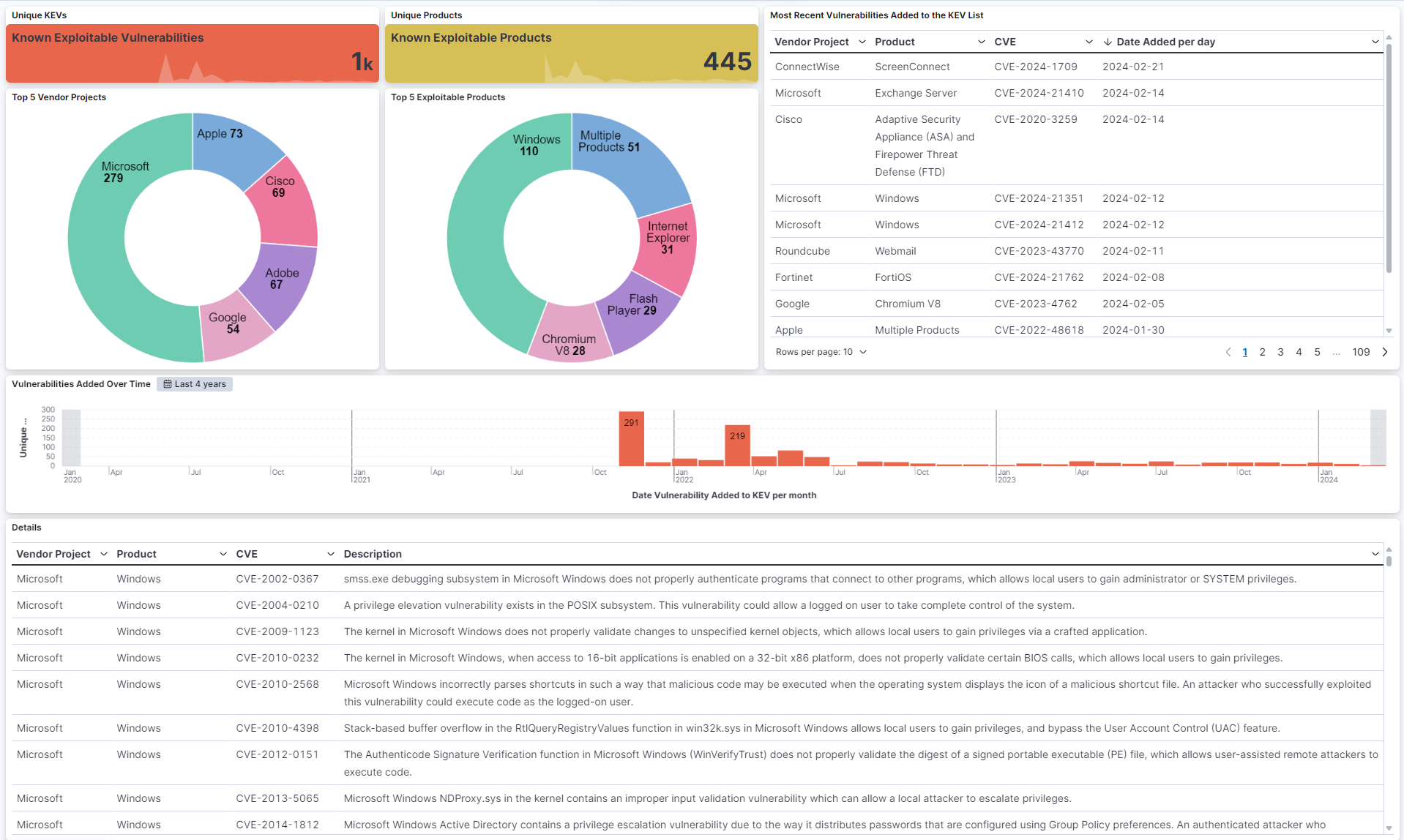
This integration includes one or more Kibana dashboards that visualizes the data collected by the integration. The screenshots below illustrate how the ingested data is displayed.
Changelog
| Version | Details | Minimum Kibana version |
|---|---|---|
| 1.13.0 | Bug fix (View pull request) Fingerprint document _id from event.original so unchanged catalog re-polls deduplicate and catalog updates index new documents on the data stream.Enhancement (View pull request) Add a latest transform that maintains a deduplicated lookup index of KEV entries per CVE for query-time enrichment with ES|QL LOOKUP JOIN. |
9.0.5 8.19.2 |
| 1.12.0 | Enhancement (View pull request) Enable request trace log removal. |
9.0.5 8.19.2 |
| 1.11.0 | Enhancement (View pull request) Add tags to ingest pipeline processors. |
9.0.5 8.19.2 |
| 1.10.1 | Enhancement (View pull request) Set agentless deployment mode release field to ga. |
9.0.5 8.19.2 |
| 1.10.0 | Enhancement (View pull request) Publish Agentless to Elastic Managed integrations name change. |
9.0.5 8.19.2 |
| 1.9.0 | Enhancement (View pull request) Use new release field for agentless deployment mode to establish as beta. |
9.0.5 8.19.2 |
| 1.8.0 | Enhancement (View pull request) Enable Agentless deployment. |
9.0.5 8.19.2 |
| 1.7.0 | Enhancement (View pull request) Migrate data streams to the CEL input. |
9.0.0 8.13.0 |
| 1.6.0 | Enhancement (View pull request) Add 'Security Solution' tag in the dashboard. |
9.0.0 8.13.0 |
| 1.5.0 | Enhancement (View pull request) Update Kibana constraint to support 9.0.0. |
9.0.0 8.13.0 |
| 1.4.1 | Bug fix (View pull request) Updated SSL description to be uniform and to include links to documentation. |
8.13.0 |
| 1.4.0 | Enhancement (View pull request) Add "preserve_original_event" tag to documents with event.kind set to "pipeline_error". |
8.13.0 |
| 1.3.1 | Bug fix (View pull request) Use triple-brace Mustache templating when referencing variables in ingest pipelines. |
8.13.0 |
| 1.3.0 | Enhancement (View pull request) Allow @custom pipeline access to event.original without setting preserve_original_event. |
8.13.0 |
| 1.2.0 | Enhancement (View pull request) Update the kibana constraint to ^8.13.0. Modified the field definitions to remove ECS fields made redundant by the ecs@mappings component template. |
8.13.0 |
| 1.1.0 | Enhancement (View pull request) Improve handling of empty responses. |
8.11.4 |
| 1.0.1 | Bug fix (View pull request) Update logo to align w/ Elastic Integrations page, fix description wording |
8.11.4 |
| 1.0.0 | Enhancement (View pull request) Add Enrich/ES|QL Samples to Readme, make GA. |
8.11.4 |
| 0.1.0 | Enhancement (View pull request) Initial draft of the package |
8.11.4 |