ES|QL COUNT function
Returns the total number of input values.
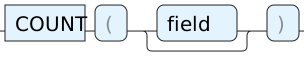
field- Expression that outputs values to be counted. If omitted, equivalent to
COUNT(*)(the number of rows). bucket-
Range of histogram values to count.
Returns the total number (count) of input values.
| field | bucket | result |
|---|---|---|
| aggregate_metric_double | long | |
| boolean | long | |
| cartesian_point | long | |
| cartesian_shape | long | |
| date | long | |
| date_nanos | long | |
| date_range
|
long | |
| dense_vector | long | |
| double | long | |
| double_range
|
long | |
| exponential_histogram
|
long | |
| exponential_histogram
|
double_range
|
long |
| flattened
|
long | |
| geo_point | long | |
| geo_shape | long | |
| geohash | long | |
| geohex | long | |
| geotile | long | |
| integer | long | |
| ip | long | |
| keyword | long | |
| long | long | |
| tdigest
|
long | |
| tdigest
|
double_range
|
long |
| text | long | |
| unsigned_long | long | |
| version | long |
FROM employees
| STATS COUNT(height)
| COUNT(height):long |
|---|
| 100 |
To count the number of rows, use COUNT() or COUNT(*)
FROM employees
| STATS count = COUNT(*) BY languages
| SORT languages DESC
| count:long | languages:integer |
|---|---|
| 10 | null |
| 21 | 5 |
| 18 | 4 |
| 17 | 3 |
| 19 | 2 |
| 15 | 1 |
The expression can use inline functions. This example splits a string into multiple values
using the SPLIT function and counts the values.
ROW words="foo;bar;baz;qux;quux;foo"
| STATS word_count = COUNT(SPLIT(words, ";"))
| word_count:long |
|---|
| 6 |
To count the number of times an expression returns TRUE use a
WHERE command to remove rows that
shouldn’t be included.
ROW n=1
| WHERE n < 0
| STATS COUNT(n)
| COUNT(n):long |
|---|
| 0 |
To count the number of times multiple expressions return TRUE use a WHERE inside the STATS.
FROM employees
| STATS
    gte20 = COUNT(*) WHERE height >= 2,
    lte18 = COUNT(*) WHERE height <= 1.8
| gte20:long | lte18:long |
|---|---|
| 20 | 56 |
COUNTing a multivalued field returns the number of values. COUNTing NULL returns 0.
COUNTing true returns 1. COUNTing false returns 1.
ROW mv = [1, 2], n = NULL, t = TRUE, f = FALSE
| STATS COUNT(mv), COUNT(n), COUNT(t), COUNT(f)
| COUNT(mv):long | COUNT(n):long | COUNT(t):long | COUNT(f):long |
|---|---|---|---|
| 2 | 0 | 1 | 1 |
You may see a pattern like COUNT(<expression> OR NULL). This has the same meaning as
COUNT() WHERE <expression>. This relies on COUNT(NULL) to return 0 and builds on the
three-valued logic (3VL): TRUE OR NULL is TRUE, but
FALSE OR NULL is NULL. Prefer the COUNT() WHERE <expression> pattern.
ROW n=1
| STATS COUNT(n > 0 OR NULL), COUNT(n < 0 OR NULL)
| COUNT(n > 0 OR NULL):long | COUNT(n < 0 OR NULL):long |
|---|---|
| 1 | 0 |
COUNT can also operate on exponential_histogram fields, returning the total number of values which were used to construct the histograms.
TS exp_histo_sample
| WHERE instance == "instance-0"
| STATS cnt = COUNT(responseTime)
| cnt:long |
|---|
| 8841 |
COUNT can also operate on tdigest and casted histogram fields, returning the total number of values which were used to construct the digests.
TS histogram_timeseries_index
| WHERE instance == "instance-0"
| STATS cnt = COUNT(responseTime::tdigest)
| cnt:long |
|---|
| 8841 |
To count only the histogram values that fall into a range, pass a double_range (for example from
TO_RANGE) as the
second argument. Combine this with
BUCKET on the same
histogram field to create a histogram of the recorded values:
TS exp_histo_sample
| WHERE instance == "instance-0"
| STATS count = COUNT(responseTime, bucket) BY bucket = BUCKET(responseTime, 1)
| SORT RANGE_MIN(bucket)
| count:long | bucket:double_range |
|---|---|
| 8723 | 0.0..1.0 |
| 112 | 1.0..2.0 |
| 1 | 2.0..3.0 |
| 2 | 3.0..4.0 |
| 2 | 5.0..6.0 |
| 1 | 6.0..7.0 |
Histograms only record approximate value distributions, so the counts per bucket are estimates.
The same works for tdigest and casted histogram fields:
TS histogram_timeseries_index
| WHERE instance == "instance-0"
| STATS count = COUNT(responseTime::tdigest, bucket) BY bucket = BUCKET(responseTime::tdigest, 1)
| SORT RANGE_MIN(bucket)
| count:long | bucket:double_range |
|---|---|
| 8733 | 0.0..1.0 |
| 100 | 1.0..2.0 |
| 4 | 2.0..3.0 |
| 2 | 3.0..4.0 |
| 0 | 4.0..5.0 |
| 0 | 5.0..6.0 |
| 2 | 6.0..7.0 |
A tdigest does not track which ranges between its centroids are empty, so BUCKET returns every bucket
between the smallest and the largest centroid of a digest, and some of them may end up with a count of 0.