Elastic Agent as an OpenTelemetry Collector
Starting with version 9.2, Elastic Agent runs an embedded OTel Collector. Rather than managing separate Beats sub-processes, the agent collects data through an embedded OpenTelemetry (OTel) Collector process, leveraging the extensibility and interoperability of the OTel ecosystem. This architecture brings OTel capabilities while maintaining compatibility with existing Beats-based workflows and integrations.
This transition is incremental: in 9.2, agent self-monitoring uses the OTel runtime by default, while data collection inputs will be migrated to run as OTel receivers over subsequent releases. Existing integrations and agent configurations continue to work without disruption.
Previously Elastic Agent acted as a supervisor that launched and managed individual Beats processes to collect telemetry (Filebeat, Metricbeat, and others), each running as a separate sub-process.
With the new Elastic Agent OTel Collector architecture:
- Elastic Agent embeds an OTel Collector as its runtime, eliminating the overhead associated with managing separate sub-processes.
- Instead of running as individual Beats processes, Beat inputs can run inside the OTel Collector as Beat receivers.
- Elastic Agent leverages OTel receivers and pipelines to ingest, process, and export telemetry data in a unified, standard manner within a single OTel Collector process, reducing the agent's footprint.
- OTel-native receivers and pipelines run in the same Collector alongside Beat receivers.
- Backward compatibility is preserved: existing Beats-based integrations continue to work through Beat receivers without configuration changes or changes to the collected data.
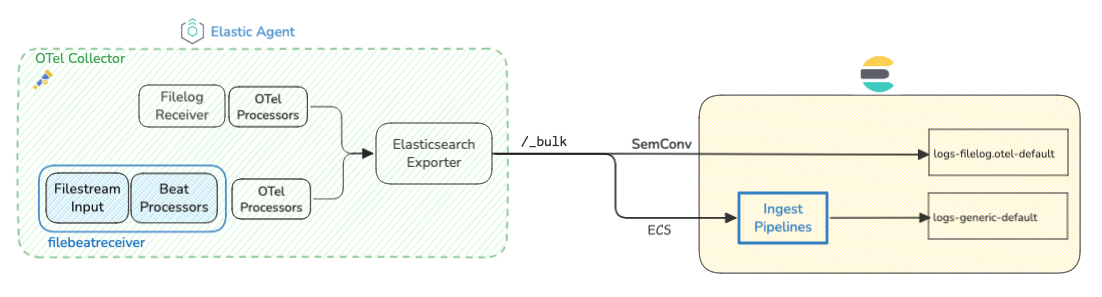
The component that implements Beats-based integrations is named elastic-otel-collector. For more information, refer to Elastic Agent installation flavors.
A Beat receiver is a Beat input and its associated processors, wrapped to run as an OTel receiver inside the OTel Collector. Beat receivers produce the exact same data, formatted according to the Elastic Common Schema (ECS), as current Beat inputs. Beat receivers don't output data in the OTLP schema.
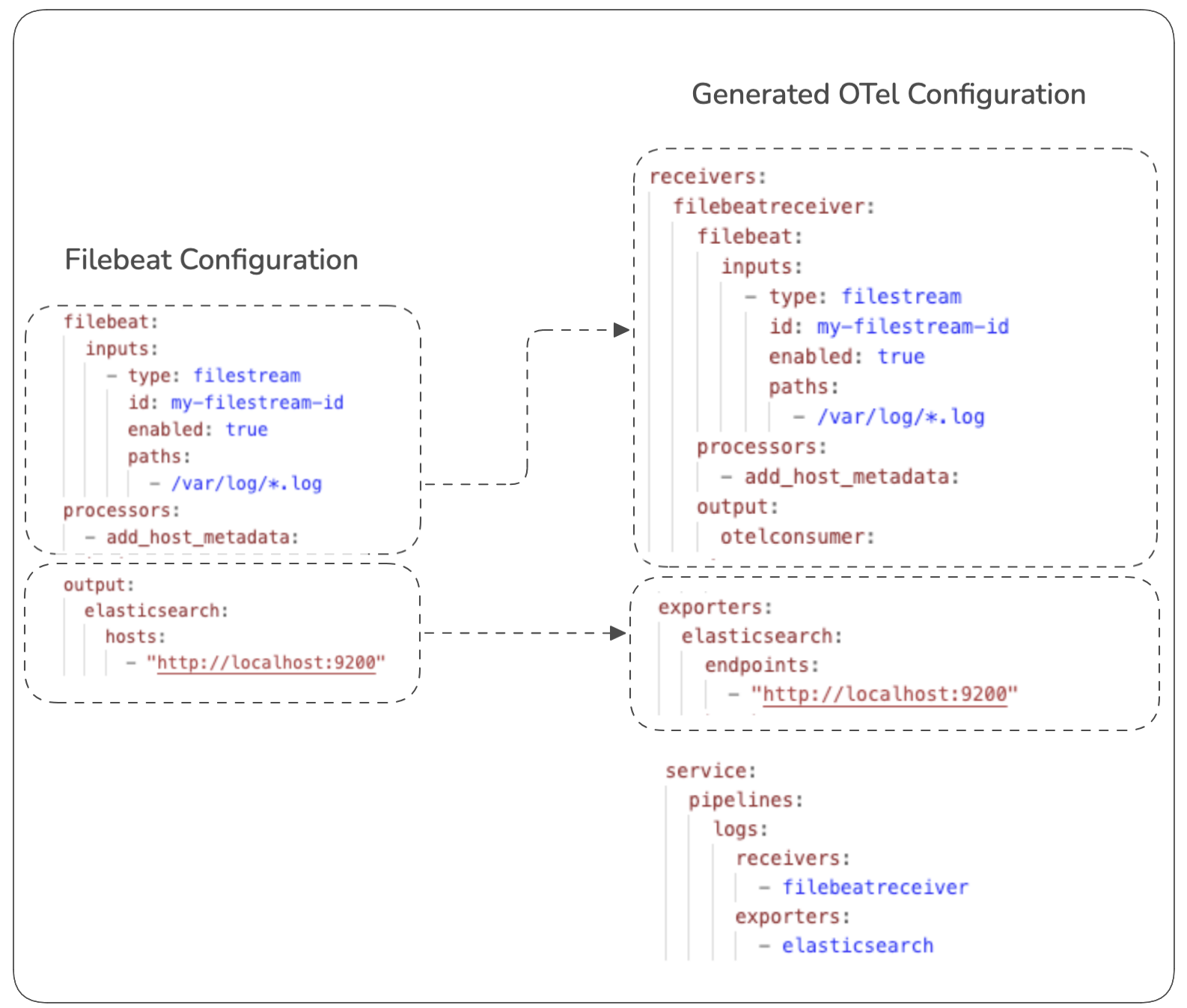
When Beat receivers are enabled, Elastic Agent automatically translates the relevant parts of its standalone or Fleet-generated elastic-agent.yml file into an OTel Collector configuration.
The data path works as follows:
- A Beat input (like
filestream) collects data. - Beat-specific processors transform the data.
- The data passes through OTel processing.
- An exporter (Elasticsearch, Logstash, or Kafka) writes the data to the output destination.
- As with Beats and Elastic Agent configurations for Beat inputs, data can be processed by ingest pipelines before being stored in Elasticsearch.
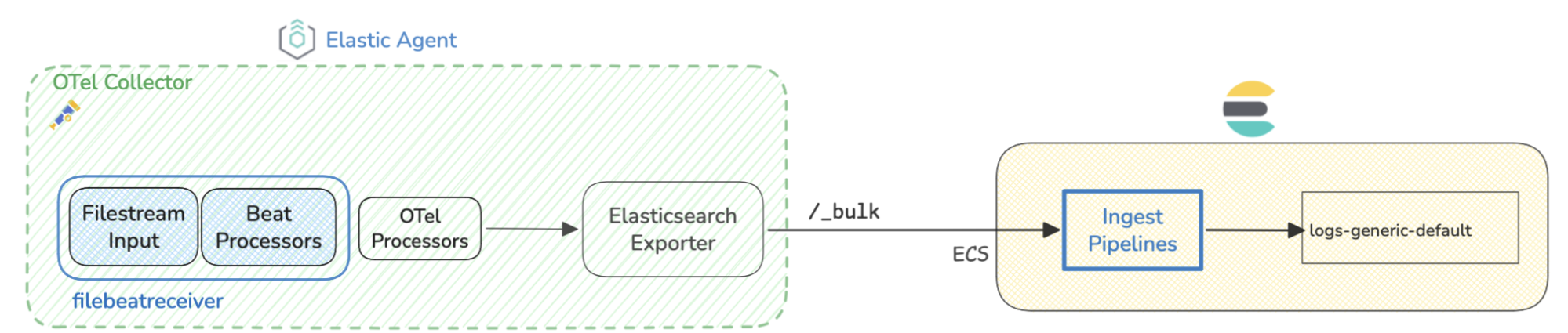
Output support for Beat receivers varies by Elastic Agent version. Refer to Configuration compatibility for details.
The introduction of Beat receivers does not require configuration changes. Inputs and outputs remain consistent for integration data. The migration to Beat receivers is rolling out incrementally across Elastic Agent versions:
-
Agent self-monitoring data (metrics and logs) uses Beat receivers by default with the Elasticsearch output. -
Some metrics inputs use Beat receivers by default with the Elasticsearch output. For a list of the migrated inputs, refer to the Elastic Agent 9.3.0 release notes. -
All metrics inputs use Beat receivers by default, with support for the Elasticsearch, Logstash, and Kafka outputs.
Fleet-managed agents: The same Beats-based integration packages continue to work. These packages configure the relevant Beat receivers automatically. Assets such as dashboards, alerts, and ingest pipelines remain unchanged.
Standalone agents: Existing standalone configurations are accepted as before. Elastic Agent generates the OTel Collector configuration internally.
This example shows a Filebeat input configuration and its respective generated OTel configuration:
Elastic Agent can collect data using two methods simultaneously in the same OTel Collector process:
- Beats-based data collection: The agent uses Beat inputs or Beat receivers to collect ECS-formatted data.
- OTel-native data collection: The agent uses standard OTel Collector receivers to ingest telemetry data using OTLP, with the data following semantic conventions.
Both methods run inside the same OTel Collector process. This lets you combine traditional Beats-based data collection and OTel-native data collection within a single agent instance, rather than requiring separate tools for each. This reduces memory consumption compared to running separate Beat sub-processes alongside a standalone OTel Collector.
In practice, a single elastic-agent.yml can contain both an inputs and outputs section for Beats-based data collection and receivers, exporters, and service.pipelines sections for OTel-based data collection.
This example shows an Elastic Agent configuration that collects system auth logs through a Beat input and monitors an HTTP endpoint through an OTel receiver.
inputs:
  - id: filestream-system-66cab0a6-6fa3-46b1-9af1-2ea171fbd885
    type: filestream
    data_stream:
      namespace: default
    streams:
      - id: filestream-system.auth-66cab0a6-6fa3-46b1-9af1-2ea171fbd885
        data_stream:
          dataset: system.auth
        paths:
          - /var/log/auth*.log

outputs:
  default:
    type: elasticsearch
    hosts: [127.0.0.1:9200]
    api_key: "your-api-key"

receivers:
  httpcheck/httpcheck-6d24bb0d-5349-4714-a7ea-2088abcb928b:
    collection_interval: 30s
    targets:
      - method: "GET"
        endpoints:
            - https://example.com

exporters:
  elasticsearch/default:
    endpoints: [127.0.0.1:9200]
    api_key: "your-api-key"

service:
  pipelines:
    metrics/httpcheck-6d24bb0d-5349-4714-a7ea-2088abcb928b:
      receivers: [httpcheck/httpcheck-6d24bb0d-5349-4714-a7ea-2088abcb928b]
      exporters: [elasticsearch/default]
The Integrations catalog offers packages that bundle application-specific configuration and assets. ECS-based integrations include an agent configuration and Elasticsearch and Kibana assets (dashboards, alerts, ingest pipelines). A similar approach exists for OTel-native data collection:
- OpenTelemetry input packages contain the configuration required for the OTel receiver and related pipeline components.
- Content packages contain the corresponding set of assets (dashboards, visualizations, and more) for the application whose data is ingested through the OTel receiver.
The same agent policy can include both ECS-based integrations and OpenTelemetry input packages. When you add an OpenTelemetry input package to your agent policy, it configures the OTel receiver section of the Elastic Agent configuration. Once data is ingested into Elasticsearch, the relevant OTel assets are automatically installed when available.
For more details on OpenTelemetry input packages and their configuration, refer to Collect OpenTelemetry data with Elastic Agent integrations.
The same automatic asset deployment applies when using standalone Elastic Agent: once data is ingested through the collector, it triggers the automatic installation of the relevant OTel assets when available.
Depending on your environment, you can use Elastic Agent (as described on this page), standalone Elastic Agent in OTel mode, or a third-party OpenTelemetry Collector to send OTel data to Elastic. The following table highlights the differences between these options in terms of management capabilities and feature support:
| Collector | Fleet central monitoring | Fleet central management | Beat receivers | Logstash exporter | Elastic Defend | Cloud Security | Profiler |
|---|---|---|---|---|---|---|---|
| Elastic Agent (Fleet-managed) |  |
|
|
|
|
|
|
| Elastic Agent (standalone) | Planned |  |
|
|
|
|
|
| Upstream OTel Collector | Planned | Planned | |
|
|
|
|
Planned indicates that support is on the roadmap and not yet generally available.
A standalone Elastic Agent can enroll into Fleet in the field if an in-place upgrade to Fleet-managed is required. Standalone Elastic Agent in OTel mode does not support enrollment into Fleet.
Does the data collected by Elastic Agent go through ingest pipelines?
It depends on which receiver collected the data.
Data collected by a Beat receiver is written by the Elasticsearch exporter. As with traditional Elastic Agent and Beats, this data is processed by ingest pipelines, schematized, and stored in the appropriate data stream.
Data collected by an OTel-native receiver follows OpenTelemetry semantic conventions. When this data arrives at the Elastic cluster, it bypasses ingest pipelines and is stored directly in an OTel-specific data stream.
Can you configure Beat receivers in a standalone Elastic Agent?
Yes. To configure Beat receivers in a standalone Elastic Agent, provide a standard OTel Collector configuration and configure Beat receivers manually as filebeatreceiver or metricbeatreceiver. For example:
receivers:
    filebeatreceiver:
        filebeat:
            inputs:
                - data_stream:
                    dataset: generic
                  id: filestream-receiver
                  index: logs-generic-default
                  paths:
                    - /var/log/*.log
                  type: filestream
    metricbeatreceiver:
        metricbeat:
            modules:
                - data_stream:
                    dataset: system.cpu
                  index: metrics-system.cpu-default
                  metricsets:
                    - cpu
                  module: system
What are the differences between Fleet-managed Elastic Agent, standalone Elastic Agent, and a third-party OpenTelemetry Collector?
The main difference is management support. Elastic Agent can be managed by Fleet when you use Fleet-managed deployment. Standalone Elastic Agent in OTel mode does not support Fleet enrollment or central management. Some features, such as Elastic Defend, are only available under Fleet management and cannot be used with standalone Elastic Agent alone. Refer to the collector type comparison table for a full breakdown.
What is the future of Elastic Agent in standalone mode?
Standalone Elastic Agent use cases can now be addressed using Elastic Agent in OTel mode. A practical advantage of the standalone Elastic Agent today is that it can be upgraded to Fleet-managed in the field without having to reinstall it.
Can data collected with third-party OTel Collectors trigger the automatic installation of relevant assets?
The automatic asset installation from OTel content packages currently works only for data ingested by Elastic Agent. Data ingested with a third-party OpenTelemetry Collector does not trigger automatic asset installation.
Will there be a separate operating system support matrix?
No, the Elastic system support matrix does not change. Where Elastic does not provide Elastic Agent support for a specific operating system, you can deploy a third-party OpenTelemetry Collector supported by that vendor and send data to Elastic. The same configuration can also be used with Elastic Agent on operating systems that Elastic supports.