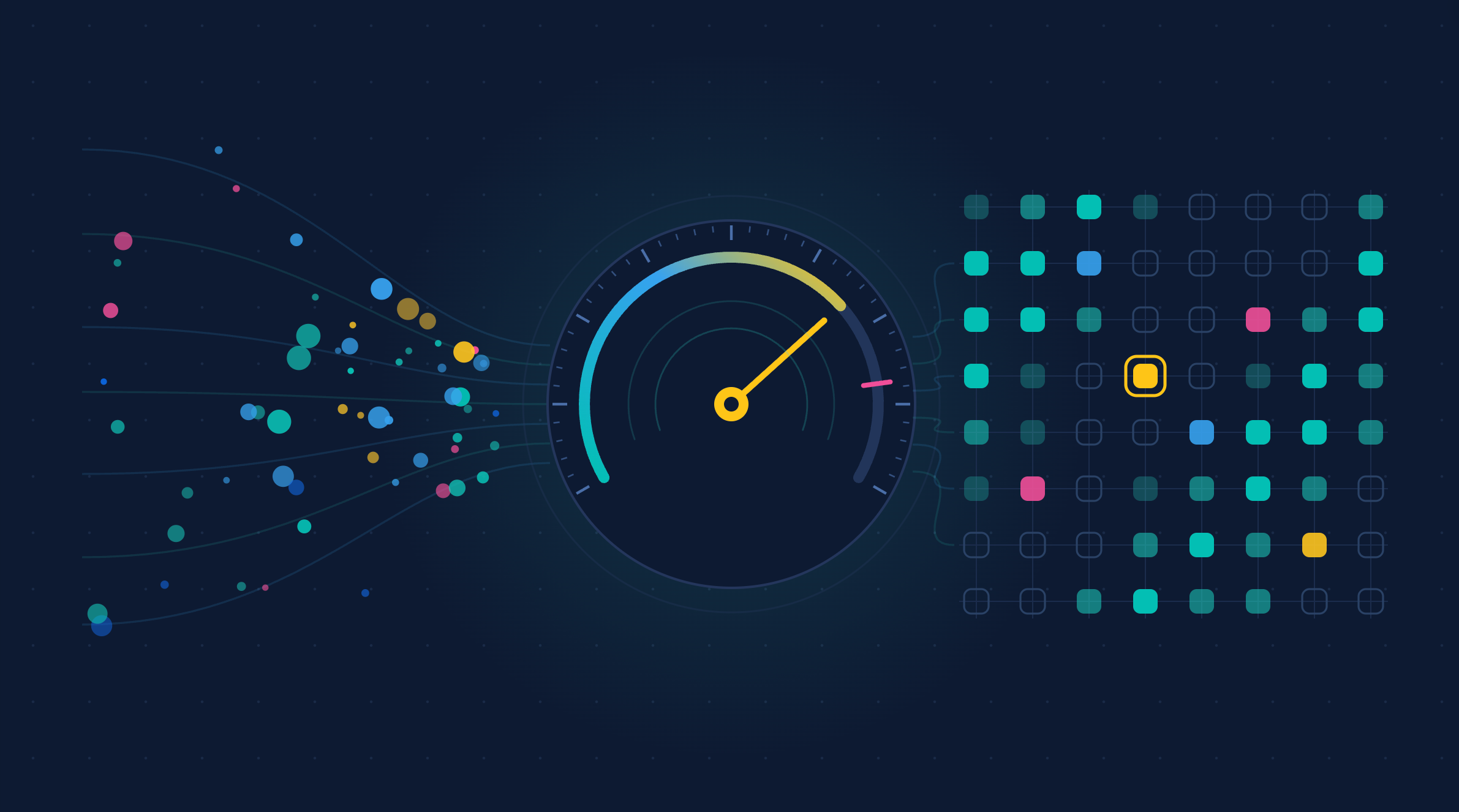
No more allocation delays: Decoupling snapshots from shard relocation in stateless Elasticsearch
Clusters scale out under load without waiting for a snapshot to finish, because snapshots now read straight from the object store and no longer pin shards in place.
Free yourself from operations with Elastic Cloud Serverless. Scale automatically, handle load spikes, and focus on building—start a 14-day free trial to test it out yourself!
You can follow these guides to build an AI-Powered search experience or search across business systems and software.
Stateless snapshots now read directly from the object store. Server-side "undesired allocation due to snapshot" warnings stopped entirely after the release. Primary shards stay free to relocate while a snapshot runs, so clusters scale out under load without waiting for one to finish. Across the fleet, cache misses dropped by more than 60% and median cache population throughput rose roughly 50%.
Why snapshots pin primary shards in stateful Elasticsearch
In traditional stateful Elasticsearch, snapshots lock primary shards to their active nodes, completely preventing relocation. That works fine when cluster topology is stable and nodes stay online between maintenance windows, but stateless Elasticsearch works differently. Index data lives in an external object store, with local disk as a cache, and the cluster scales automatically based on CPU, memory, and data size, both vertically (upsizing nodes) and horizontally (adding nodes).
During vertical scale-up, existing nodes must vacate all shards and shut down before new hardware takes over. Since Elasticsearch version 8.13, shard snapshots can pause during node shutdowns and resume after relocation, so a long-running snapshot doesn't block an infrastructure update.
Horizontal scale-out is a different story: No nodes shut down, so pause logic never triggers. New nodes sit idle while existing nodes finish their snapshots, and as soon as a snapshot is queued, the primary shard is pinned to its node, significantly delaying relocation.
Clusters typically scale out because they're already under heavy load. Blocking shard relocations at that moment limits the cluster's ability to reduce pressure, which shows up as degraded indexing throughput and higher latency. The resource imbalance can also trigger unexpected autoscaling behavior. And even when overall topology stays the same, shard locking disrupts hotspot mitigation and workload distribution. These failures used to surface as server-side warnings: "undesired allocation due to snapshot."
| Stateful Elasticsearch | Stateless Elasticsearch |
Snapshot reads from | Local shard data on the node holding the primary | The object store, using file locations recorded in the commit |
Primary shard during snapshot | Pinned to its node until the snapshot completes | Free to relocate at any time |
Effect on horizontal scale-out | New nodes wait for in-flight snapshots before taking shards | New nodes take shards immediately, regardless of snapshot state |
How stateless snapshots read directly from the object store
A shard snapshot pins primary shards because it needs to read local shard data. In stateless Elasticsearch, that data already lives in the object store, so reading from local disk is unnecessary. Letting snapshots read directly from the object store removes the requirement to lock primary shards. They can relocate freely, and backup is decoupled from cluster balancing.
Stateless commits include location information for each data file in the object store, so snapshots can read and stream directly to the snapshot repository (a separate object store bucket). In the future, we plan to look at server-side ranged copies, which object stores support natively, to skip the local copy step entirely.
Tracking commits when shards relocate mid-snapshot
A snapshot is bound to a specific commit point that determines which files to back up, and those files must remain accessible for the full duration of the operation. In stateful clusters, this is simple: The snapshotting node and the data node are the same, so the commit is managed locally and held until completion.
In a stateless model, the snapshotting node and the data node can be entirely separate, or they can diverge if a shard relocates mid-snapshot. To handle this, we added a transport action that acquires commits on remote data nodes over the network. The data node tracks which commit belongs to which snapshot and releases it once cluster state signals completion.
There's a wrinkle during relocation. A stationary shard relies on its commit point to preserve files. A relocating shard must release its commit so its local store can close cleanly. To keep files accessible through that transition, a newly recovered primary temporarily preserves all existing data files in the object store until notified of snapshot completion via cluster state. This handles both graceful relocations and ungraceful recovery from node or engine failures.
No more allocation delays and improved cache stats
After stateless snapshots shipped, the server-side "undesired allocation due to snapshot" warnings stopped. The chart below shows the before and after, with the release marked by the red arrow. Hotspot mitigation became more responsive because shard relocations no longer had to wait for backup operations.
Cache use is also improved. Snapshots that bypass local shard data stop competing with indexing for cache space. After the release (also marked in the chart), we observed the following two positive changes in cache metrics:
The median cache population throughput, defined as bytes per second for filling the local disk cache from the object store, increased about 50%.
Cache misses, where data must be retrieved from the object store to fill local disk cache, have dropped more than 60%.
What comes after stateless snapshots
Object-store-native architectures are increasingly the standard for cloud-native data systems, and stateless snapshots are a step toward fully exploiting that model across Elasticsearch operations. Backups read from the object store, and shards move freely. Neither process waits on the other. Removing the local shard dependency is a step toward further modularizing the stateless architecture.
How helpful was this content?
Related Content
How Elasticsearch Serverless hollow shards cut indexing-node shutdowns by 30%

Elasticsearch Vector Database: Ship in minutes, scale affordably to hundreds of billions
Avoiding and Correcting Hotspots: How Elasticsearch Serverless Balances Shards
Your AI agent doesn't need your API key: OAuth 2.1 for Elasticsearch MCP server authentication