Build waffle charts with Kibana
Waffle charts display data as a 10x10 grid of small squares, where each square represents 1% of the whole. They are ideal for showing percentages, visualizing survey results, and making proportions intuitive by representing data as discrete units. They work best with fewer than 10 categories.
Like pie charts, waffle charts show part-to-whole relationships. However, waffle charts make it easier to compare similarly-sized proportions (for example, 23% vs. 27%) because areas in a grid are easier to distinguish than angles in a circle. Choose a pie chart when you have a small number of slices (2-4) with clearly different sizes, or when you want to use a donut layout.
You can build a waffle chart in Kibana in either of these ways:
To automate chart or dashboard creation, use the Dashboards and Visualizations APIs. To create dashboards from natural-language instructions, use Elastic Agent Builder or the Kibana dashboards agent skill.
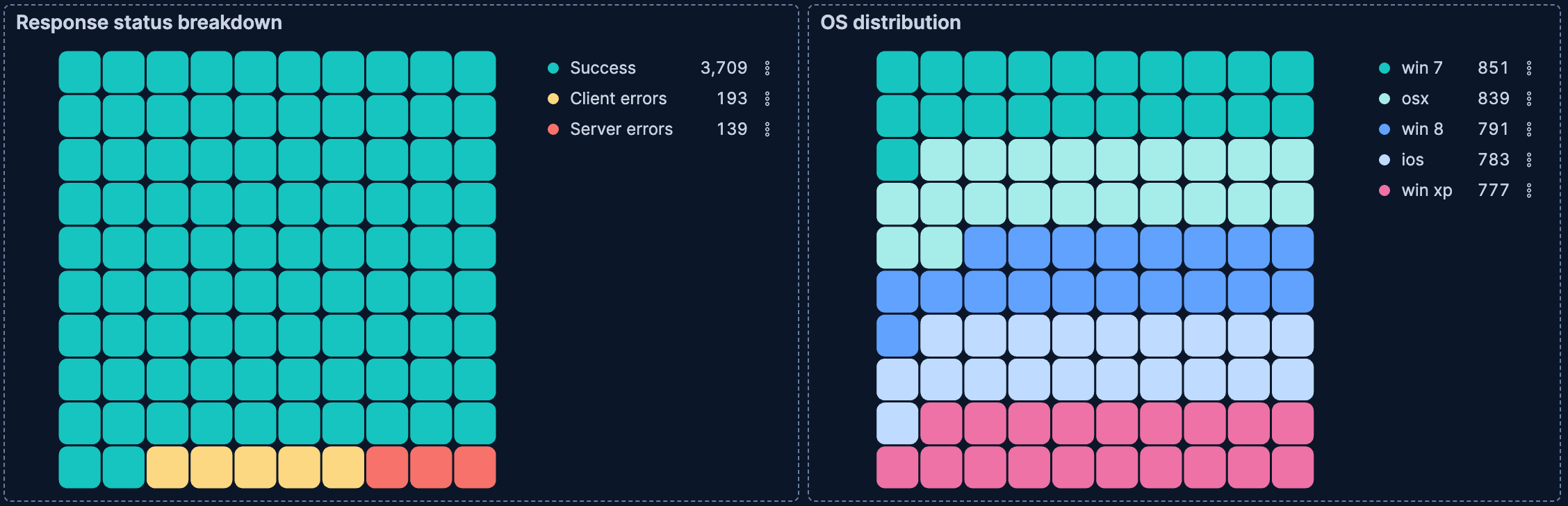
Before you start, make sure you have data indexed into Elasticsearch or install sample data. The point-and-click editor uses data views to access your Elasticsearch data. Data views are usually created automatically when you ingest data. You can also create one manually to select the data that you want.
To build a waffle chart:
-
Lens is Kibana's main visualization editor. You can access it:
- From a dashboard: On the Dashboards page, open or create the dashboard where you want to add the visualization, then add a new visualization.
- From the Visualize library page by creating a new visualization.
-
New visualizations often start as Bar charts.
Using the Visualization type dropdown, select Waffle.
-
- Select the data view that contains your data.
- Configure the Group by dimension to define the categories. Each category is displayed as a colored section of the waffle.
- Configure the Metric dimension to define the value for each category. This determines how many squares each category occupies.
Optionally:
- Enable Multiple metrics in the layer settings to define each category as a separate metric.
The chart preview updates to show a grid of colored squares. Each color represents a category, and the number of squares reflects its proportion of the total.
-
- If you accessed Lens from a dashboard, select Save and return to save the visualization and add it to that dashboard, or select Save to library to add the visualization to the Visualize library and be able to add it to other dashboards later.
- If you accessed Lens from the Visualize library, select Save. A menu opens and lets you add the visualization to a dashboard and to the Visualize library.
Before you start, make sure you have data indexed into Elasticsearch or install sample data. ES|QL queries the indices named in the query directly, so you do not need a data view. The columns returned by the query become available as chart dimensions. Refer to Visualizations using ES|QL queries to learn how to open the editor, shape the query result for a visualization, and save the visualization.
A waffle chart needs a categorical column to define its color groups and a numeric metric column to determine each group's share of the squares. In this query, BY returns one row for each operating system, COUNT provides its metric value, and SORT and LIMIT retain the five most common operating systems:
FROM kibana_sample_data_logs
| STATS requests = COUNT(*) BY machine.os.keyword
| SORT requests DESC
| LIMIT 5
To build the chart:
- Create an ES|QL visualization and run the query.
- Set the visualization type to Waffle.
- Assign
machine.os.keywordto Group by andrequeststo Metric. - Customize the chart appearance using the waffle chart settings.
- Select Apply and close.
The chart preview shows the relative share of requests from each operating system.
After building the chart with the point-and-click editor or an ES|QL query, customize its appearance for your data and audience:
- Limit categories
- Keep your waffle chart to a maximum of 6-8 categories. More categories make the chart difficult to read.
- Use intuitive colors
- Assign colors that have semantic meaning when possible (for example, green for success, red for errors). Use the color mapping feature for consistent coloring.
- Order categories meaningfully
- Arrange categories from largest to smallest or in a natural order (such as satisfaction ratings from low to high).
Refer to Waffle chart settings for all waffle chart configuration options. For panel sizing and layout guidance, refer to Organize dashboard panels.
You can use Multiple metrics to show progress toward a goal, with filled squares for completed work and empty squares for remaining work.
This example uses the Kibana Sample Data eCommerce data set. If you haven't installed it yet, refer to Sample data for instructions.
- Create a Waffle chart using the Kibana Sample Data eCommerce data view.
- Open the layer settings:
-
Select Settings/Layer settings. -
Select , then select Layer settings.
-
- Select Multiple metrics, then close the layer settings.
- Add two metrics:
- Revenue earned: Set to
Sumoftaxful_total_price. Name it "Revenue earned" and assign a green color. - Remaining to goal: Set to a formula:
500000 - sum(taxful_total_price). Name it "Remaining to goal" and assign a gray color.
- Revenue earned: Set to
- The chart shows how close revenue is to the $500,000 target. Each green square represents 1% of the goal achieved.
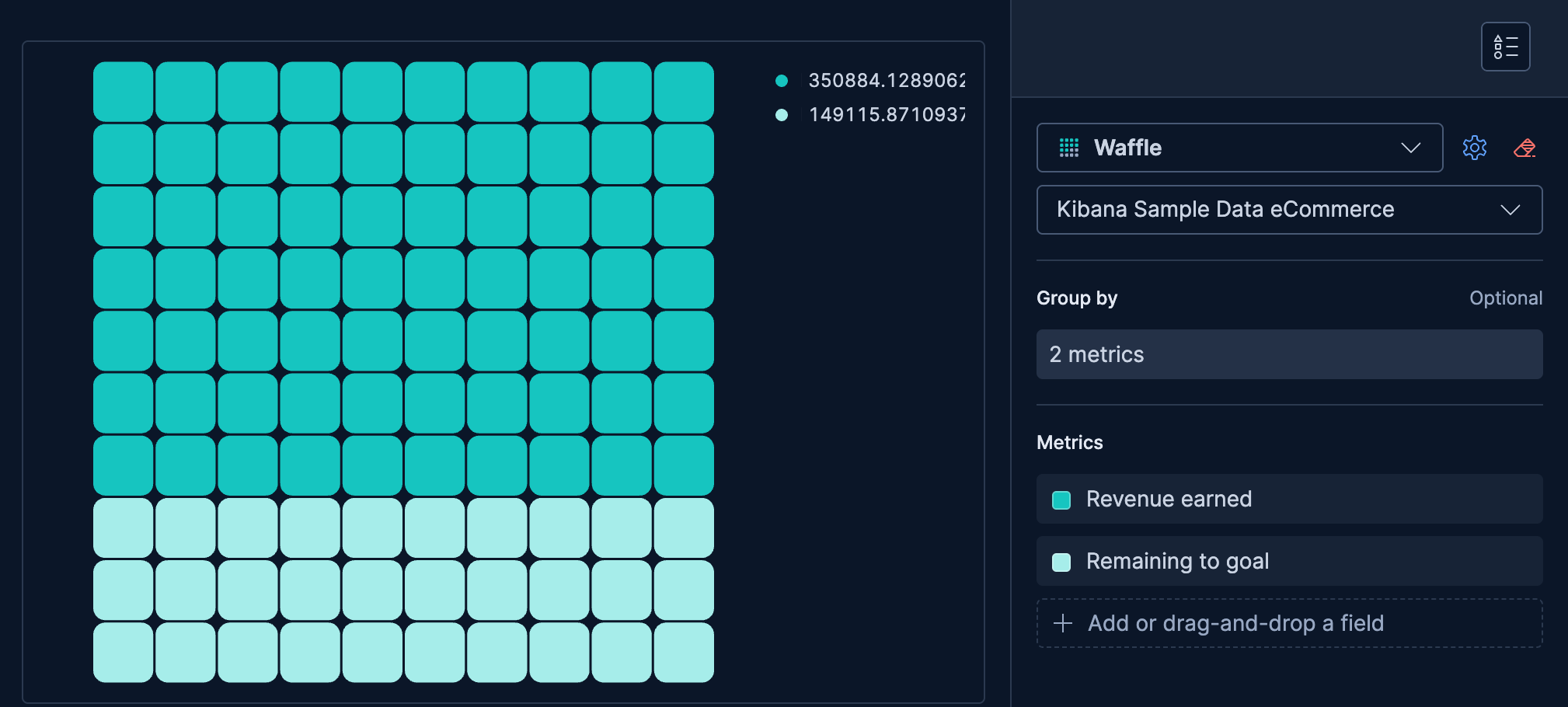
This example uses two metrics without a group_by to create a goal-tracking waffle: one metric shows earned revenue and the other calculates the gap to a $500K target.
These API request examples are kept up to date with the latest version of the APIs, so some fields might differ if you're using an earlier version. For a history of breaking changes, refer to the Kibana breaking changes or the Elastic Cloud Serverless breaking changes.
				POST kbn://api/visualizations
					{
  "type": "waffle",
  "title": "Revenue progress toward sales target",
  "filters": [],
  "query": { "expression": "" },
  "legend": { "size": "auto" },
  "metrics": [
    {
      "operation": "sum",
      "field": "taxful_total_price",
      "label": "Revenue earned",
      "format": {
        "type": "number"
      },
      "filter": { "expression": "" }
    },
    {
      "operation": "formula",
      "formula": "500000 - sum(taxful_total_price)",
      "label": "Remaining to goal",
      "format": {
        "type": "number"
      },
      "filter": { "expression": "" }
    }
  ],
  "data_source": {
    "type": "data_view_spec",
    "index_pattern": "kibana_sample_data_ecommerce",
    "time_field": "order_date"
  },
  "styling": { "values": { "mode": "percentage" } }
}
wafflerenders a 10x10 grid of squares where each square represents 1% of the whole.- The first metric fills squares proportionally to earned revenue, showing progress at a glance.
- The
formulametric computes the gap between a $500K target and actual revenue, filling the remaining squares.
curl -X POST "${KIBANA_URL}/api/visualizations" \
  -H "Authorization: ApiKey ${API_KEY}" \
  -H "kbn-xsrf: true" \
  -H "Content-Type: application/json" \
  -d '{
  "type": "waffle",
  "title": "Revenue progress toward sales target",
  "filters": [],
  "query": { "expression": "" },
  "legend": { "size": "auto" },
  "metrics": [
    {
      "operation": "sum",
      "field": "taxful_total_price",
      "label": "Revenue earned",
      "format": {
        "type": "number"
      },
      "filter": { "expression": "" }
    },
    {
      "operation": "formula",
      "formula": "500000 - sum(taxful_total_price)",
      "label": "Remaining to goal",
      "format": {
        "type": "number"
      },
      "filter": { "expression": "" }
    }
  ],
  "data_source": {
    "type": "data_view_spec",
    "index_pattern": "kibana_sample_data_ecommerce",
    "time_field": "order_date"
  },
  "styling": { "values": { "mode": "percentage" } }
}'
wafflerenders a 10x10 grid of squares where each square represents 1% of the whole.- The first metric fills squares proportionally to earned revenue, showing progress at a glance.
- The
formulametric computes the gap between a $500K target and actual revenue, filling the remaining squares.
For more information, refer to the Visualizations API.
Customize your waffle chart to display exactly the information you need, formatted the way you want.
The Group by dimension defines how the waffle is divided into colored sections. Waffle charts support a single Group by dimension.
- Data
-
The Group by dimension supports the following functions:
- Top values: Show the most common values of a field.
- Field: Select the field to group by. You can add up to 4 fields to create multi-term groups. When multiple fields are selected, each group represents a unique combination of values across those fields. You can reorder the fields by dragging them to change their priority.
- Number of values: How many top values to display. The default number of values depends on your environment:
-
Defaults to 9. -
Defaults to 5 for the first Top values dimension added to the chart and 3 for each additional one.
-
- Rank by: Specifies the dimension the top values are ranked by. Available options:
- Count of records: Rank by the number of documents containing each value. This is the default when a metric is defined.
- Alphabetical: Rank by the term key alphabetically. This is the default when no metric is defined.
- Rarity: Find terms that appear in very few documents, using a rare terms aggregation. You can configure the Max doc count per term to set the maximum number of documents a term can appear in to be considered rare (default: 1, max: 100). Available for single-field terms only, and not for floating-point numeric fields (
float,double,half_float, andscaled_float). - Significance: Find statistically unusual terms compared to the overall data set, using a significant terms aggregation. Only available for
keywordfields and single-field terms. - Custom: Define a custom metric aggregation to rank by (for example, rank by the sum of a numeric field rather than by count).
- Rank direction: Ascending or descending order. Disabled when Rank by is set to Rarity or Significance.
Advanced settingsSeveral advanced options allow you to refine the behavior of the breakdown:
- Include documents without the selected field: Off by default.
- Group remaining values as "Other": On by default.
- Enable accuracy mode: This option improves results for high-cardinality data, but increases the load on the Elasticsearch cluster.
- Include values: Values from the dimension to always include, even if they aren't among the top values. You can enter exact values or a regular expression.
- Exclude values: Values from the dimension to always exclude. You can enter exact values or a regular expression.
- Date histogram: Group data into time-based buckets.
- Field: Select the date field to use for the time-based grouping.
Include empty rows: Include buckets that contain no matching documents. Existing saved visualizations keep their configured setting.
For new visualizations, this option is: - On by default for tables, line charts, and area charts
- Off by default for bar charts, heat maps, pie charts, treemap charts, mosaic charts, waffle charts, metric charts, and tag clouds
When you switch visualization or series type, Lens applies the default for the new type. If you switch back to the visualization type you saved, Lens restores the saved setting.
This option is on by default for all visualization types.
Bind to global time picker: Associate the selected field to the Lens or dashboard main time selector.
Minimum interval: Define the time interval for aggregating the data. For example,
30s,20m,24h,2d,1w,1MDrop partial intervals: Exclude incomplete intervals from the data. This option is off by default.
- Intervals: Create numeric ranges for continuous data by grouping a numeric field into buckets.
- Field: Select the numeric field to create intervals from.
- Intervals granularity: Use the slider to control how many intervals to create. Kibana divides the field into evenly spaced intervals (incremented by 10, 5, or 2) between the field's minimum and maximum values. The minimum granularity is 1, and the maximum is set by the
histogram:maxBarsadvanced setting. - Create custom ranges: Define your own ranges with specific lower and upper bounds and optional labels, instead of using the automatic granularity.
- Include empty rows: Include intervals that contain no matching documents. Existing saved visualizations keep their configured setting.
For new visualizations, this option is: - On by default for tables, line charts, and area charts
- Off by default for bar charts, heat maps, pie charts, treemap charts, mosaic charts, waffle charts, metric charts, and tag clouds
When you switch visualization or series type, Lens applies the default for the new type. If you switch back to the visualization type you saved, Lens restores the saved setting.
This option is on by default for all visualization types.
- Filters: Define custom KQL filters. Each filter creates one group from the documents that match its query.
- Collapse by: Aggregate all metric values that share the same value for this dimension into a single number, removing it as an independent grouping. Available aggregation methods:
Sum,Min,Max, orAverage.
- Top values: Show the most common values of a field.
- Appearance
-
- Name: Customize the legend label.
- Color mapping: Select a color palette or assign specific colors to categories. Refer to Assign colors to terms for details.
The Metric dimension defines the value for each category, determining how many squares each section occupies.
- Data
-
The value that determines how many squares each category fills. When you drag a field onto the chart, Kibana suggests a function based on the field type. You can use aggregation functions like
Sum,Average,Count,Median, and more, or create custom calculations with formulas.Advanced settingsDepending on the data you defined, several options allow you to apply additional filtering to the data taken into account to compute the final value to show.
Based on the type of visualization you're creating, only some of the following options can be available:
- Normalize by unit: Normalize the metric values to show per unit of time.
- Filter by: Specify a query.
- Reduced time range: Reduce the time range specified on the dashboard's time filter by the specified duration.
- Time shift: Shift the time range by the specified duration. This is useful if the value should use a different time range than the one selected on the dashboard.
- Hide zero values: Don't show values equal to zero. This option is on by default.
- Appearance
-
- Name: Customize the metric label displayed in tooltips and legends.
- Value format: Control how numeric values are displayed (number, percent, bytes, and more).
- Series color: When using multiple metrics without a Group by dimension, assign a specific color to each metric.
When creating or editing a visualization, you can customize the legend from the  Legend menu.
Waffle charts do not have configurable style settings. The chart automatically displays labels and percentages on each section.
- Visibility
-
Specify whether to automatically show the legend or hide it:
- Auto: Show the legend when there are multiple categories.
- Show: Always show the legend (default).
- Hide: Never show the legend.
- Width
- Control the width of the legend panel: Small, Medium (default), Large, or Extra large.
- Show value
- Toggle whether to display the numeric value alongside each legend entry. This is enabled by default.
- Label truncation
- Toggle whether to truncate long legend labels. When enabled, set the Line limit to control how many lines to display before truncating (1-5, default: 1).
The following examples show various configuration options for building impactful waffle charts.
- Response status breakdown
-
Visualize the proportion of successful and failed HTTP requests at a glance:
- Example based on: Kibana Sample Data Logs
- Group by: Filters
- "Success (2xx/3xx)":
response.keyword >= "200" AND response.keyword < "400" - "Client errors (4xx)":
response.keyword >= "400" AND response.keyword < "500" - "Server errors (5xx)":
response.keyword >= "500"
- "Success (2xx/3xx)":
- Metric: Count
- Color mapping: Green for success, yellow for client errors, red for server errors
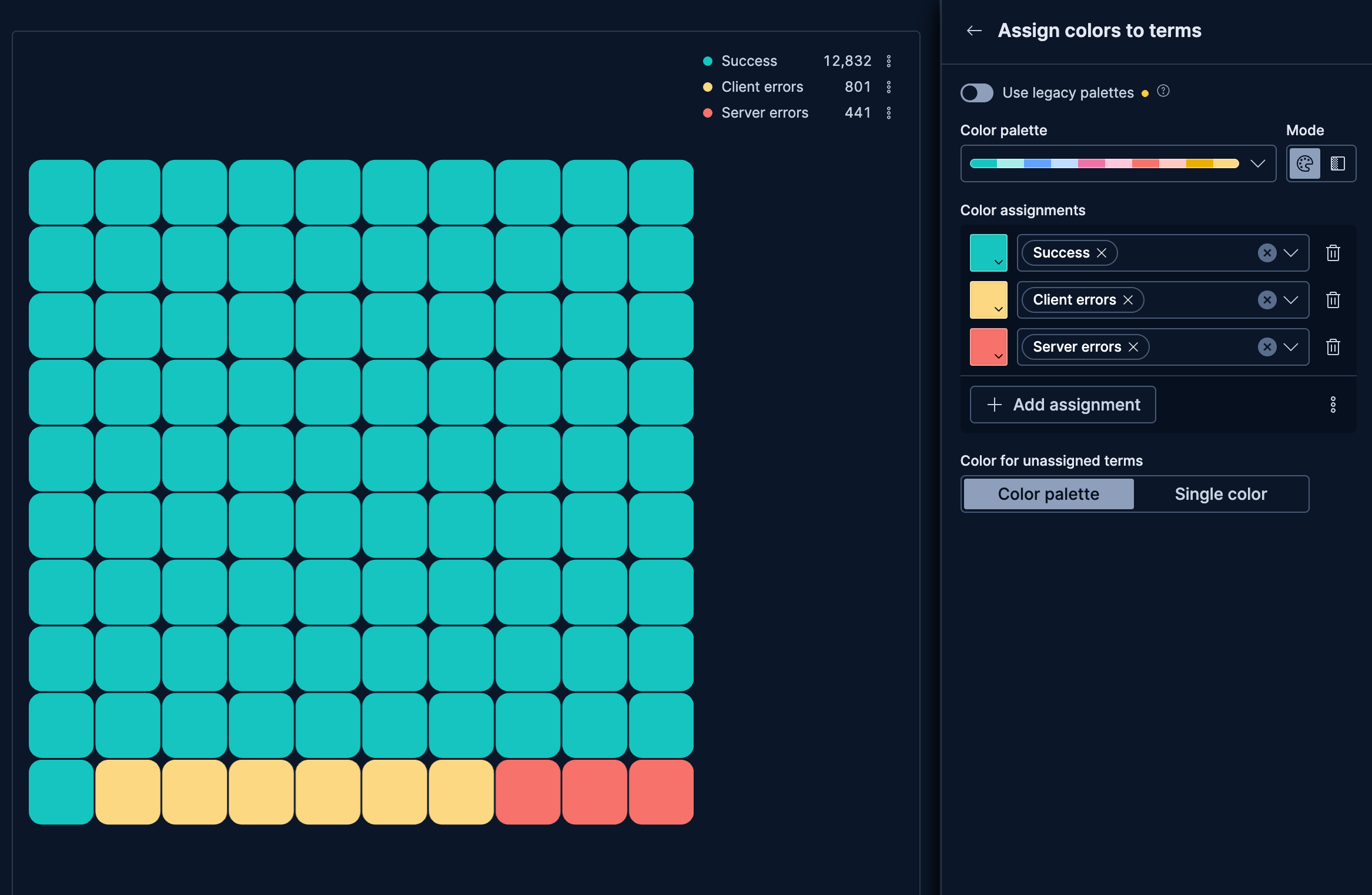
This example uses filters grouping to define three custom categories based on HTTP response code ranges, each filling a proportional section of the waffle grid.
These API request examples are kept up to date with the latest version of the APIs, so some fields might differ if you're using an earlier version. For a history of breaking changes, refer to the Kibana breaking changes or the Elastic Cloud Serverless breaking changes.
				POST kbn://api/visualizations
					{
  "type": "waffle",
  "title": "Response status breakdown",
  "filters": [],
  "query": { "expression": "" },
  "legend": { "size": "auto" },
  "metrics": [
    {
      "operation": "count",
      "format": { "type": "number" },
      "filter": { "expression": "" }
    }
  ],
  "group_by": [
    {
      "operation": "filters",
      "filters": [
        {
          "filter": { "expression": "response.keyword >= \"200\" AND response.keyword < \"400\"" },
          "label": "Success (2xx/3xx)"
        },
        {
          "filter": { "expression": "response.keyword >= \"400\" AND response.keyword < \"500\"" },
          "label": "Client errors (4xx)"
        },
        {
          "filter": { "expression": "response.keyword >= \"500\"" },
          "label": "Server errors (5xx)"
        }
      ],
      "color": {
        "mode": "categorical",
        "palette": "default",
        "mapping": [
          { "values": ["Success (2xx/3xx)"], "color": { "type": "color_code", "value": "#209280" } },
          { "values": ["Client errors (4xx)"], "color": { "type": "color_code", "value": "#D6BF57" } },
          { "values": ["Server errors (5xx)"], "color": { "type": "color_code", "value": "#CC5642" } }
        ]
      }
    }
  ],
  "data_source": {
    "type": "data_view_spec",
    "index_pattern": "kibana_sample_data_logs",
    "time_field": "timestamp"
  },
  "styling": { "values": { "mode": "percentage" } }
}
filterscreates one waffle section per KQL query, letting you define arbitrary status categories rather than grouping by raw field values.colorassigns explicit hex colors to each category by label — green for success, yellow for client errors, red for server errors.
curl -X POST "${KIBANA_URL}/api/visualizations" \
  -H "Authorization: ApiKey ${API_KEY}" \
  -H "kbn-xsrf: true" \
  -H "Content-Type: application/json" \
  -d '{
  "type": "waffle",
  "title": "Response status breakdown",
  "filters": [],
  "query": { "expression": "" },
  "legend": { "size": "auto" },
  "metrics": [
    {
      "operation": "count",
      "format": { "type": "number" },
      "filter": { "expression": "" }
    }
  ],
  "group_by": [
    {
      "operation": "filters",
      "filters": [
        {
          "filter": { "expression": "response.keyword >= \"200\" AND response.keyword < \"400\"" },
          "label": "Success (2xx/3xx)"
        },
        {
          "filter": { "expression": "response.keyword >= \"400\" AND response.keyword < \"500\"" },
          "label": "Client errors (4xx)"
        },
        {
          "filter": { "expression": "response.keyword >= \"500\"" },
          "label": "Server errors (5xx)"
        }
      ],
      "color": {
        "mode": "categorical",
        "palette": "default",
        "mapping": [
          { "values": ["Success (2xx/3xx)"], "color": { "type": "color_code", "value": "#209280" } },
          { "values": ["Client errors (4xx)"], "color": { "type": "color_code", "value": "#D6BF57" } },
          { "values": ["Server errors (5xx)"], "color": { "type": "color_code", "value": "#CC5642" } }
        ]
      }
    }
  ],
  "data_source": {
    "type": "data_view_spec",
    "index_pattern": "kibana_sample_data_logs",
    "time_field": "timestamp"
  },
  "styling": { "values": { "mode": "percentage" } }
}'
filterscreates one waffle section per KQL query, letting you define arbitrary status categories rather than grouping by raw field values.colorassigns explicit hex colors to each category by label — green for success, yellow for client errors, red for server errors.
For more information, refer to the Visualizations API.
- OS distribution
-
Show the distribution of operating systems used by your website visitors:
- Example based on: Kibana Sample Data Logs
- Group by:
machine.os.keyword(Top 5 values) - Metric: Count
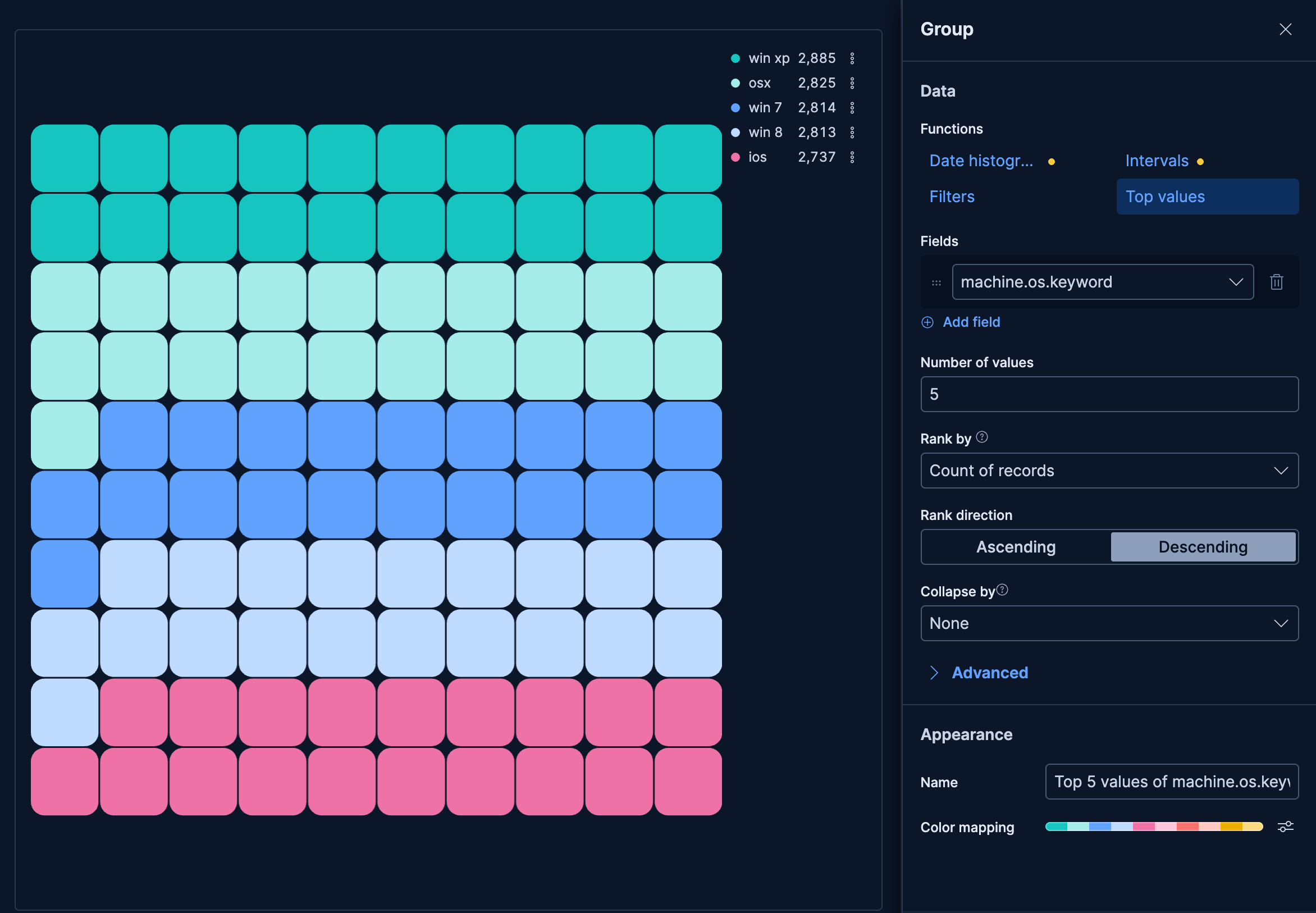
This example creates a waffle chart grouped by operating system, where each colored section represents a different OS and its size shows the proportion of visitors using it.
These API request examples are kept up to date with the latest version of the APIs, so some fields might differ if you're using an earlier version. For a history of breaking changes, refer to the Kibana breaking changes or the Elastic Cloud Serverless breaking changes.
				POST kbn://api/visualizations
					{
  "type": "waffle",
  "title": "OS distribution",
  "filters": [],
  "query": { "expression": "" },
  "legend": { "size": "auto" },
  "metrics": [{ "operation": "count", "format": { "type": "number" }, "filter": { "expression": "" } }],
  "group_by": [
    {
      "operation": "terms",
      "fields": ["machine.os.keyword"],
      "limit": 5
    }
  ],
  "data_source": {
    "type": "data_view_spec",
    "index_pattern": "kibana_sample_data_logs",
    "time_field": "timestamp"
  },
  "styling": { "values": { "mode": "percentage" } }
}
group_bysplits the waffle into sections bymachine.os.keyword, with the top 5 OSes each getting a proportionally sized colored section.percentagemode labels each section with its share of total traffic, which maps naturally to the waffle's 100-square grid.
curl -X POST "${KIBANA_URL}/api/visualizations" \
  -H "Authorization: ApiKey ${API_KEY}" \
  -H "kbn-xsrf: true" \
  -H "Content-Type: application/json" \
  -d '{
  "type": "waffle",
  "title": "OS distribution",
  "filters": [],
  "query": { "expression": "" },
  "legend": { "size": "auto" },
  "metrics": [{ "operation": "count", "format": { "type": "number" }, "filter": { "expression": "" } }],
  "group_by": [
    {
      "operation": "terms",
      "fields": ["machine.os.keyword"],
      "limit": 5
    }
  ],
  "data_source": {
    "type": "data_view_spec",
    "index_pattern": "kibana_sample_data_logs",
    "time_field": "timestamp"
  },
  "styling": { "values": { "mode": "percentage" } }
}'
group_bysplits the waffle into sections bymachine.os.keyword, with the top 5 OSes each getting a proportionally sized colored section.percentagemode labels each section with its share of total traffic, which maps naturally to the waffle's 100-square grid.
For more information, refer to the Visualizations API.