AI-driven threat detection and response
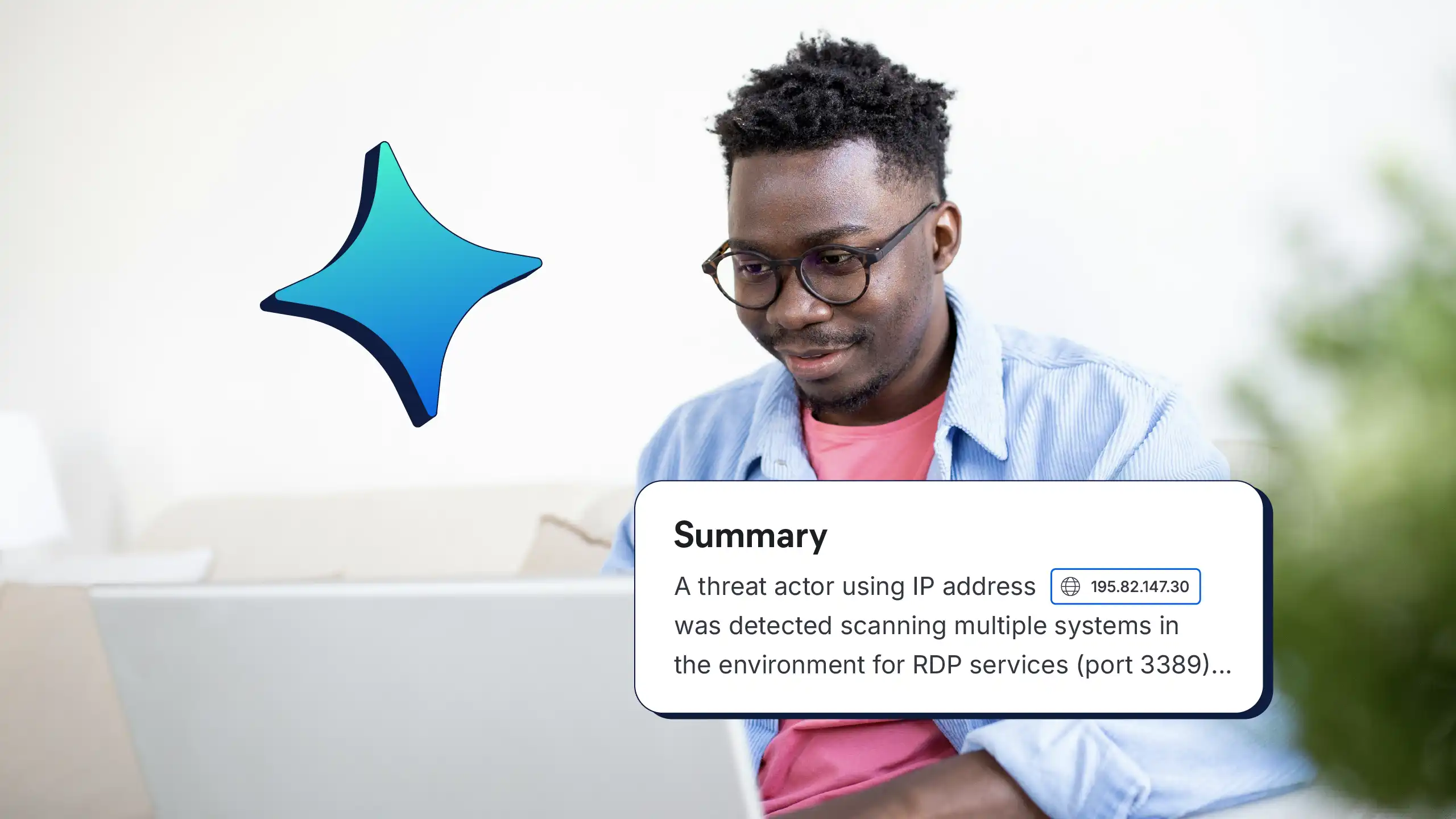
Relegating time-consuming, data-intensive tasks to AI expedites teams' mean time to detect and respond, increases scale of data analysis, improves fidelity and accuracy of alerts, and boosts efficiency. Here's how...

 Share on Twitter
Share on Twitter

 Share on LinkedIn
Share on LinkedIn

 Share on Facebook
Share on Facebook

 Share by Email
Share by Email

 Print this page
Print
AI cybersecurity
AI's proficiency at cybersecurity use cases has become a necessity for security teams striving to stay ahead of the scale and sophistication of today's advanced threats. Yet it's estimated that more than 80% of AI projects fail.1 There's no shortage of security vendors promising a wide array of AI capabilities to help teams achieve more … but which AI tools will actually help your SOC teams succeed?
Let's explore how you can make measurable improvements to your team's ability to detect and respond to cyber threats faster and with more precision and context — using the right AI tools.
What is AI-driven threat detection and response?
AI-driven threat detection and response is the use of AI technologies, including machine learning models, large language models (LLMs), and natural language processing (NLP) to augment and expedite threat identification, investigation, and mitigation in real time.
AI-driven threat detection and response modernizes security operations by automating otherwise highly complex, manual, time-consuming tasks and surfacing real-time, actionable insights to improve organizations’ security posture and cyber resilience.
Which cybersecurity tasks is AI best for?
It’s important to establish where AI can make a game-changing impact and where it’s best to trust human problem-solving.
When to use AI
AI is best at tasks that involve high-volume data processing, pattern recognition, and support for real-time decisions. Think:
- Threat detection
- Incident response
- Alert triage and summarization
- Copiloting for workflow recommendations
- Data ingestion and normalization (particularly helpful for SIEM onboarding)
- Language conversion for detection rules and queries
When to leave it to the pros
When strategic judgment, nuanced decision-making, or deep business context are required, the risks of automation can outweigh the benefits. AI is no match for experienced security professionals for things like:
- Escalated case investigation
- Crisis management
- Security architecture design
- Threat hunting (though AI can help threat hunters with data enrichment and query generation)
- Forensic investigations
- Policy development and governance
- Cybersecurity training and building a resilient corporate culture
Using AI as a force multiplier
Of all the security use cases for which AI has shown proficiency, its application for threat detection and incident response has proven to be especially strong.
In the following sections, see how your team can benefit from AI for threat detection and response, starting with AI-driven threat detection.
How can AI improve threat detection?
For security leaders, the mandate is clear: Detect threats faster, reduce false positives, and keep teams focused on what matters. Traditional detection approaches, rooted in static rules and signature-based alerts, can't keep up with today's dynamic landscape — especially considering adversaries themselves are using AI for their own efforts. In fact, phishing attacks have surged 1,200% since the rise of GenAI in late 2022.2
To defend against the surge in attacks, AI-driven threat detection brings powerful advantages to security operations. It identifies patterns across massive datasets, learns from behavioral baselines, and surfaces subtle or emerging cyber threats that traditional tools and processes often miss. More importantly, it reduces the operational drag of noise and alert fatigue — giving analysts time back and enabling the SOC to scale without burning out the team.
What are other ways AI can enhance detection?
Security alert summarization and distillation
The traditional burden of sifting through hundreds or thousands of alerts daily, many of which are low-priority or redundant, has long been a major pain point for security analysts. AI tools can now summarize alerts and highlight those with the highest impact or urgency. Benefits include:
- Significant reduction in time spent on triage
- Prioritization of high-confidence threats
- Automatic correlation of related events to show full attack chains
The AI advantage
AI can learn from historical alert outcomes to suppress noisy rules and boost high-fidelity signals. Reducing the number of alerts and prioritizing their importance elevates analyst productivity and effectiveness at responding to those that are the highest priority.
Anomaly detection
At a scale that human efforts alone can’t realistically match, AI analyzes millions of events in real time to establish baselines for normal activity and surface anomalous activity that deviates from this norm. This can include:
- Detecting unusual login patterns (geo-velocity, time-of-day anomalies, suspicious user activity)
- Building context from correlation of multiple low-severity alerts across devices
- Spotting rare process executions or protocol usage
- Uncovering abnormal data access patterns (e.g., mass downloads)
- Identification of slow lateral movement or “low and slow” exfiltration
The AI advantage
AI connects the dots across noisy logs to surface early signs of complex attacks and catches novel or stealthy threats that traditional rules or signatures miss.
Generating detection rules and query assistance
LLMs help create, translate, and optimize detection logic — converting common language into actionable results. Common use cases include:
- Converting MITRE ATT&CK® techniques into detection queries
- Translating detection rules across platforms (e.g., Splunk → Elastic)
- Writing programming language queries from natural language prompts
The AI advantage
Teams now spend less time hand-coding detection rules and more time tuning and responding to threats.
Enriching and correlating threat intelligence
AI tools ingest threat intel, automatically matching it against internal telemetry. This results in:
- Matching across endpoints, logs, and cloud environments with real-time Indicators of Compromise (IoCs)
- Linking new threat reports to previously undetected behaviors
- Suggesting new detection rules based on emerging threat actor tactics, techniques, and protocols (TTPs)
The AI advantage
AI tools shorten the gap between threat intel ingestion and actionable detection.
Detecting advanced attacks
Detection tools that use AI help security analysts elevate beyond one-at-a-time alert triage by providing higher-quality alerting, thereby scaling the amount teams can resolve. AI-driven detection tools:
- Identify behavioral anomalies across users, endpoints, and network activity
- Correlate low-level signals to detect lateral movement or command-and-control activity
- Use statistical and pattern analysis to spot previously unseen attack techniques
The AI advantage
Teams catch advanced threats earlier, even those that don’t trigger traditional signatures or rules.
Now that you’ve successfully detected threats with the help of AI, let’s explore how AI can help you quickly respond to them.
How can AI improve incident response?
It’s not enough to have strong detection capabilities. Teams also need to be able to respond quickly. Traditional incident response processes are manual, fragmented, and dependent on limited human capacity. The right AI tools help teams break that cycle.
By automating repetitive tasks, enriching alerts with actionable context, and guiding analysts through triage and remediation, AI transforms incident response into a faster, more scalable, and more consistent function. It empowers teams to move from reaction to resolution with clarity and confidence — without adding headcount or burning out staff.
From triage assistance to step-by-step workflow guidance, here’s how AI integrates into the key stages of incident response.
Accelerating triage
Fast response can make the difference between threat containment and escalation. AI-driven response processes identify patterns across alerts and connect them into larger incident narratives. For example, AI-driven processes can:
- Group alerts that are part of the same attack chain (phishing → credential use → lateral movement)
- Suppress duplicates or false positives using learned behavior patterns
The AI advantage
AI-driven processes reduce alert fatigue and enable analysts to focus on priority incidents rather than noisy one-offs.
Context enrichment
By instantly enriching alerts with contextual data, AI-driven response accelerates triage — connecting users, assets, and potential attack paths — without all the manual sleuthing. Analysts can now move confidently through response workflows in a fraction of the time. AI helps by:
- Automatically enriching alerts with context (e.g., threat intel, geolocation, asset criticality)
- Summarizing event timelines and root cause analysis in natural language
- Highlighting affected users, systems, and paths of lateral movement
The AI advantage
AI elevates the skillset and understanding of every analyst while reducing time spent gathering basic context.
Automating playbooks
Unassisted by AI, incident response can be slow, error-prone, and inconsistent. AI-automated playbooks trigger the right actions based on alert context, threat severity, and historical outcomes. This ensures faster containment, reduces analyst workload, and drives more consistent response across the SOC.
For example, AI-driven response:
- Kicks off automated response actions based on detection type (via SOAR or built-in automation actions)
- Uses conditional logic to escalate or contain based on severity and context
- Learns from past incidents to optimize playbook decisions
The AI advantage
AI allows for automatic and accurate quarantining of infected endpoints, disabling of compromised user accounts, and blocking of malicious IPs or domains.
Copilot guidance
Even experienced analysts can struggle with uncertainty during fast-moving incidents. AI-driven guidance acts as a real-time copilot, suggesting investigation steps, surfacing similar historical cases and data, and highlighting the next best steps to take at each phase of a response. It accomplishes this by:
- Recommending context-aware actions based on the specific alert type, affected systems, and past resolution paths
- Linking related incidents and threat intelligence to help analysts quickly understand scope, tactics, and potential impact
- Providing natural language summaries for each suggestion, making decisions easier to validate and execute
The AI advantage
With AI-driven guidance, analysts can make accelerated, consistent, and accurate decisions during incident response, elevating analyst productivity and confidence.
Fresh-squeezed data
Of course, even with the best AI tools on the market, a team’s ability to detect and respond is only as good as the data they can analyze. Fortunately, AI again shows strong ability to help teams ingest, normalize, and analyze their data like never before.
In the next section, see how AI is helping teams onboard data and ease SIEM migration to maximize detection and response through improved visibility.
How can AI accelerate data onboarding?
The most powerful detection and response capabilities are only as good as the data they can analyze. Yet bringing new data sources into a security ecosystem — whether during cloud expansion, SIEM migration, architecture changes, or another event — is often a slow, error-prone, and resource-intensive process.
AI can help by simplifying data normalization, auto-mapping schemas, and converting unstructured logs into actionable security signals. By accelerating data onboarding, AI helps SOC teams gain visibility faster, reduce implementation time, and detect threats across their evolving environments sooner.
Faster parsing and normalization of log data
AI models can automatically recognize and standardize diverse log formats across systems, applications, and cloud platforms. Instead of writing manual parsing rules or custom extractors, AI can infer structure from sample data and normalize logs into a schema ready for analysis. This is particularly valuable during SIEM migrations, when legacy and modern sources need to coexist in a single detection and response environment.
The AI advantage
Days or weeks of data mapping work are reduced to hours, helping security teams gain visibility into their environment much faster and freeing up time to focus on more strategic initiatives.
Automated schema mapping and enrichment
AI accelerates the often tedious process of mapping data fields from different sources to your SIEM’s preferred format. It can infer data formats, auto-generate parsing logic, and suggest normalization mappings based on prior ingestion patterns.
Missing fields? It can identify those while also enriching logs with context like geolocation, asset tags, or user roles using existing configuration management database (CMDB) or identity access management (IAM) data. This reduces the risk of incomplete onboarding or low-fidelity data that can hinder threat detection.
The AI advantage
AI provides cleaner, more holistic data pipelines that fuel stronger and more accurate detections.
Query conversion
Writing effective queries and detection rules has long required deep expertise in proprietary query languages and platform-specific syntax. This reliance on specialists slows down threat detection and limits the agility of SOC teams, especially when onboarding new analysts or adapting to evolving threats.
AI changes this by acting as a real-time translator and co-creator. It converts natural language into powerful, precise queries and helps teams scale detection engineering without sacrificing quality. Models can convert simple prompts like “show failed login attempts from new devices in the last 24 hours” into fully formed, platform-specific queries.
The AI advantage
AI lowers the barrier to entry for junior analysts, enabling more team members to ask questions of their data and contribute to security posture.
Detection rule creation
AI models identify patterns of malicious behavior and suggest detection rules automatically. The model might notice, for example, that a set of PowerShell commands, process launches, and registry changes frequently co-occur during lateral movement. It can then offer a rule to detect that sequence in future.
This helps simplify cross-platform transitions, enabling faster iteration of detections that can be refined by detection engineers rather than created from scratch.
The AI advantage
AI drives faster, data-backed rule creation that keeps pace with evolving attacker tactics, techniques, and procedures (TTPs).
Like using a forklift for your data
Overall, AI accelerates data onboarding by automating the heavy lifting, moving your team from ingestion to detection for stronger threat coverage, faster response, and a more agile SOC. Sounds exciting? It is! In the next section, explore how you can build your AI-augmented SOC to start reaping the benefits we’ve covered.
Choosing the right solution
Any AI tool your team is considering should be able to help you accomplish the above use cases while being context-aware, staying transparent in process, and playing nice with your security stack.
Plays nice
The best AI tool? The one your team uses consistently because it integrates well with your security stack. Be certain the AI tools you’re assessing will work with your technology, data architecture, and organizational priorities. If your existing security vendors’ AI offerings aren’t providing what you need, it may be time to consider migrating to a solution that can rise to your needs (hint: AI can help with that migration process, too).
Your AI solution should also be LLM-agnostic. The performance, costs, and architecture that all influence your organization’s choice of LLM may change quickly, causing a pivot to a new model. Be sure your AI solution can integrate well with many different LLMs so you don’t get burned if or when your organization announces it’s switching up its provider.
Is context-aware
Choose tools that go beyond generic detection and can reason within the context of your specific users, assets, configurations, and historical activity. The most effective AI solutions integrate with your existing telemetry and factor in environmental context to reduce false positives and increase response accuracy.
Provides transparency
Look for AI that provides clear, human-readable explanations for alerts, risk scores, and recommended actions. This is critical for analyst confidence, incident documentation, and auditing. Avoid black-box models that can’t justify why something is flagged.
Augment, don't replace
AI is not here to replace your security team. It’s here to elevate it. By reducing noise, surfacing real threats faster, and guiding effective responses, AI-driven threat detection and response empowers SOC teams to defend at machine speed while also maintaining human judgment. The future of threat detection and response is not just automated; it’s a strategic ally in your cybersecurity program.
Learn more on how you can implement powerful AI-driven capabilities into your security operations with our webinar, Fight smarter: Accelerate your SOC with AI.
Plus, Elastic’s AI SOC Engine (EASE) layers AI into your existing stack. Correlate alerts, prioritize threats, and guide workflow responses without a full SIEM replacement. It’s AI that fits your SOC, and only takes minutes to get started. EASE your way into AI.
Footnotes
1 Rand, "The root causes of failure for artificial intelligence projects and how they can succeed," 2024.
2 McKinsey & Company, "AI is the greatest threat—and defense—in cybersecurity today. Here's why.," 2025.
Share
- Share on Twitter
Share on Twitter
- Share on LinkedIn
Share on LinkedIn
- Share on Facebook
Share on Facebook
- Share by Email
Share by Email
- Print this page
Print