The data challenge facing modern law enforcement
Explore real-world case studies from agencies around the globe


 Share on Twitter
Share on Twitter

 Share on LinkedIn
Share on LinkedIn

 Share on Facebook
Share on Facebook

 Share by Email
Share by Email

 Print this page
Print
Introduction
The data challenge
Around the world, law enforcement agencies are confronting a new kind of challenge — one measured not only in crime rates or caseloads, but in the sheer scale, variety, and velocity of digital information. Every modern investigation now generates a mountain of data: surveillance footage, forensic photos, mobile phone logs, social media posts, GPS coordinates, and intelligence reports — all of which must be collected, processed, and analyzed, often in real time.
There’s more data, in more formats, than traditional tools can keep up with. Investigators spend valuable hours behind a screen manually searching through disconnected systems. Analysts struggle to connect unstructured information scattered across silos. And agencies risk missing critical links hidden in plain sight.
At the same time, public expectations for speed, transparency, and accuracy have never been higher. Whether identifying a suspect, locating a missing person, or detecting emerging threats online, every second counts — and every insight must be both trustworthy and explainable.
To meet this challenge, agencies need a foundation that can search, correlate, and analyze data across every system without duplication or delay. The Elasticsearch Platform turns fragmented data into a unified, real-time intelligence layer that investigators can trust.
Rise of AI-powered search
In this environment, AI-powered search has become mission critical. The ability to instantly locate, understand, and act on data across formats and environments is no longer a luxury — it’s the backbone of modern policing. That’s where Elastic comes in.
The Elasticsearch Platform helps agencies turn data chaos into clarity. By unifying structured and unstructured information under a single, scalable architecture, it gives investigators and analysts the speed, context, and confidence to act when it matters most. Text, images, and intelligence feeds become searchable together, surfacing relevant answers in seconds instead of hours.
Elastic’s approach is open, explainable, and secure. Agencies can deploy it within their own infrastructure, maintain full control over where data resides, and understand exactly how AI-driven insights are produced. Built-in vector search and retrieval augmented generation (RAG) capabilities enrich results with context while still preserving auditability.
By combining AI-driven discovery with Elastic’s data mesh approach, agencies gain a reusable data layer that fuels every mission — from investigations to analytics — without constant re-engineering. The result is an environment where AI accelerates decision-making without compromising trust, sovereignty, or security.
Real-world results from across the globe
Around the world, law enforcement leaders are already proving what’s possible with Elastic.
In Brazil, a regional police force built an AI-powered facial-recognition system that cut image search times from a full day to just minutes, transforming how officers conduct field investigations and reuniting missing persons with their families.
In Europe, a national police organization unified massive amounts of application and infrastructure data to gain real-time visibility across its digital systems, strengthening operational resilience and accelerating response times.
And through DarkBlue, an intelligence platform developed by CACI, agencies now have safe, scalable access to dark web and open source intelligence, enabling analysts to uncover criminal networks and emerging cyber threats faster than ever before.
Each success demonstrates how Elastic’s open, flexible, and distributed architecture lets agencies search and correlate data across boundaries while maintaining local control. And with granular access controls (RBAC + ABAC) and cross-cluster search, forces can collaborate instantly without duplicating sensitive data — turning insight sharing from a manual process into a real-time capability.
How Elastic supports your mission
When law-enforcement teams can see and search everything — across every system, in real time — they don’t just solve cases faster; they build safer, more connected communities.
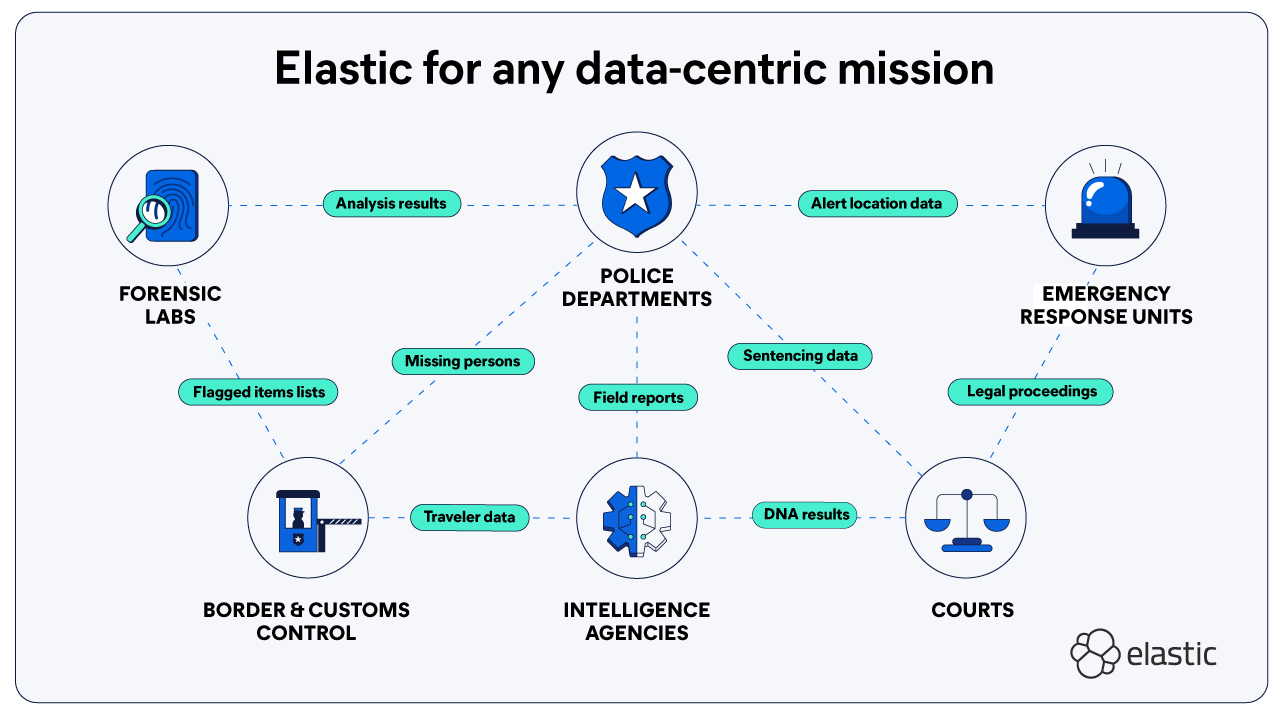
By establishing a data foundation with Elastic’s data mesh approach, agencies move from reactive, project-by-project integration to a permanent, reusable data layer. Investigators, analysts, and partner organizations access the same authoritative data. The Elasticsearch Platform gives every authorized user the information they need, when and where they need it, without costly engineering or vendor lock-in. The result is faster investigations, stronger inter-agency collaboration, and a modern data infrastructure ready for tomorrow’s innovations.
Brazilian police force
The challenge
Improving search accuracy and performance
In one of Brazil’s largest metropolitan regions, home to more than three million residents, the local police force faced a mounting data problem. Every case generated vast amounts of digital evidence — from photographs and documents to hours of surveillance video. Investigators spent hours, sometimes days, manually searching through disconnected databases to identify suspects, locate missing persons, or verify identities.
This manual process created serious inefficiencies. Valuable time that could have been spent in the field was lost behind screens. Investigations moved slower, and leads grew colder with each passing hour. The agency needed a faster, more intelligent way to search its growing archives — one capable of handling millions of records in real time and easily accessible to officers working in the field.
The transformation
Accelerating facial recognition searches by 100 times
The introduction of AI-powered search changed everything. With the Elasticsearch Platform at the core of its new system, the police force gained the ability to instantly match a single image against millions of records. What once took a full day can now be done in less than 15 minutes.
The new platform supports both mobile and web-based search, allowing officers to take a photo in the field, upload it, and immediately receive potential matches based on visual similarity. Within the first three months of operation, the system processed more than one million searches — and today, it handles over 300,000 every month.
The impact extends far beyond speed. Faster search has led to faster results: The agency has located missing persons, identified suspects, and even reunited families. In one case, officers found an elderly man with Alzheimer’s who had been missing for nearly two weeks. A single photo taken by officers led to a quick identification and a safe return home.
With time-consuming manual searches replaced by automated intelligence, officers can now spend more time where they’re needed most: engaging with communities, solving cases, and preventing crime.
The solution
Building a new image-recognition system on the Elasticsearch Platform
The agency built its new image-recognition system on the Elasticsearch Platform, leveraging its vector search capabilities to power fast, accurate, and scalable results.
Machine learning models transform each image into numerical representations called embeddings, allowing the system to understand the relationships and similarities between faces. Those embeddings are stored and indexed in Elastic, enabling real-time matching across billions of data points.
The infrastructure runs on a 13-node Elasticsearch cluster, managing more than six terabytes of visual data. The system is designed for scale, reliability, and security — critical requirements for public safety organizations operating under strict data and privacy regulations.
According to the head of technology for the agency, the team evaluated several vector-database solutions but ultimately chose Elastic for its flexibility, performance, and ease of deployment. “Elasticsearch stood out for its ease of use, advanced technology, and roadmap,” he explained.
The results
Outcomes that power real-time policing
- 100x faster searches: Image-matching time was reduced from 24 hours to under 15 minutes.
- High volume performance: Over 300,000 searches are processed monthly across 6TB of data.
- Real-time mobility: Field officers can upload photos and receive matches instantly via mobile or web.
- Community impact: Faster search has led to missing persons found, suspects identified, and safer communities.
Why Elastic
For the Brazilian police force, Elastic delivered more than technology — it delivered partnership. Elastic’s consultants supported the agency throughout testing, implementation, and optimization, ensuring the system met the demands of real-world law enforcement work.
“We relied heavily on the expertise of Elastic, especially search and facial recognition experience. Even when we made tough demands, they were always positive," says the head of technology. "The partnership gives us confidence to build vector and AI search applications for the future."
By combining cutting-edge vector search with scalable infrastructure and dedicated expert support, Elastic helped transform how the agency manages, searches, and acts on information.
What began as a quest for faster search has evolved into a foundation for modern policing.
European police force
The challenge
Defending a sprawling, digital-first policing landscape
A national policing agency in Europe — numbering 22,000 officers and roughly 1,000 IT personnel — was responsible for securing 35,000 connected computers, 250 IT systems, smartphone app infrastructure, drones, and specialized communications networks. According to the agency’s security operations center manager, “All of these things need to be secure and they need to work every day, every night, all of the year.”
The threat landscape included external attackers aiming to steal or destroy data, malicious insiders, and targeted sabotage of police infrastructure. Yet SIEM and traditional log-management tools could not keep up with the scale and velocity of data across platforms. As a result, investigations were slowed by visibility gaps, delayed alerts, and heavy manual correlation.
The transformation
Increasing visibility and response by 10x
The agency adopted Elastic Security, built on the Elasticsearch Platform, to unify its logs, events, and telemetry into a single platform for detection, investigation, and response. It was able to increase its event-ingestion capacity by up to 10x to receive events per second (EPS) from relevant security data streams. This transformation enabled proactive threat detection — when anomalies occur, the system flags them automatically for investigation.
The solution
Unified architecture built on Elastic
With Elastic Security, the agency replaced its legacy SIEM and gained the ability to build custom detection rules, apply anomaly detection machine learning, and visualize activity in real time. “We have a totally different, much improved visibility on the operating system level,” says the agency’s senior cyber security specialist. “We’re talking about several billion log records. All the data that we need in order to detect anomalies, we now have at our hands.”
The results
Faster insights, stronger security
- 10x improvement in event-ingest capacity, enabling faster, richer analysis
- Real-time visibility across 35,000 endpoints and billions of events
- Proactive threat detection through machine learning and anomaly analysis
Why Elastic
With Elastic, the agency now operates a scalable, secure, and future-ready cyber defense platform, transforming how it detects, investigates, and prevents digital threats.
DarkBlue
The challenge
Targeting elusive criminal networks in hidden spaces
Illicit marketplaces for drugs, weapons, human trafficking, and ransomware flourish on the dark web — supporting illegal activity worth over $4 billion annually.
CACI International Inc.’s DarkBlue Intelligence Suite provides services to national security and intelligence teams as well as law enforcement agencies tasked with monitoring these hidden environments to identify criminals. Teams must keep up with the fast-moving trends such as hacking tutorials and cryptocurrencies — both vital to modern criminal activity. According to Cory Everington, head of the DarkBlue Intelligence Suite, “The dark web has been around for more than a decade and is growing at an alarming rate. Being able to access these hard-to-get datasets at scale and with persistence is fundamental to our mission."
However, legacy tools lacked the scalability, ingestion flexibility, unified search, and real-time analytics required. And as DarkBlue’s service expanded into other open web sources, the volume of data it needed to collect and process grew exponentially.
The transformation
Turning unstructured data into actionable intelligence
DarkBlue built a cloud-native platform using Elastic Observability, powered by the Elasticsearch Platform, as the foundation of its Intelligence Suite — enabling large-scale data ingestion and unified search. Using Elastic Agent, Fleet, and AWS infrastructure, the team can set up reusable data schemas, policies, and templates to ingest almost any kind of structured or unstructured data. "Elastic helps us move quickly. It simplifies the process of integrating new data sources and removes the need for complex setup across multiple applications,” said Everington.
As the dark web evolves, Elastic helps DarkBlue deliver the right information to law enforcement agencies when they need it the most. Being able to provide potentially life-saving insights to the right people regardless of how the dark web changes makes a huge difference in the fight against crime. "We really appreciate the way Elastic continues to scale with us," says Everington. "Its flexible and reliable ingestion and search capabilities allow us to adapt quickly to emerging threats on the open and dark web."
The solution
Unified intelligence engine built on Elastic
DarkBlue’s architecture uses the Elasticsearch Platform to store, index, and search both structured and unstructured intelligence data at scale. Elastic Observability adds visibility into infrastructure performance, telemetry, and errors, ensuring the platform remains responsive, secure, and scalable.
This solution enables safe dark web search without exposing investigators to risk, while archiving historical data. Everington explains, "Elastic's search and pivot capabilities allow us to connect the dots. We can often link anonymous personas to a single actor with just one query."
The results
Faster intelligence, broader reach
- Seconds-level search across vast intelligence sets regardless of data age or origin
- Rapid data source onboarding without custom integrations for each new dataset
- Secure investigation environment that enables dark web research without exposure risk
Why Elastic
Elastic delivered the scale, flexibility, and performance needed for mission-critical intelligence operations. According to Everington, "Our clients trust us, and we trust Elastic. We count on Elastic to help us track criminal activity across hidden spaces online. Its reliability supports our work and reinforces the trust our clients place in us.”
With Elastic, DarkBlue now supports law enforcement and national security clients with a future-ready intelligence platform that adapts to evolving threats across open and hidden web spaces.
Share
- Share on Twitter
Share on Twitter
- Share on LinkedIn
Share on LinkedIn
- Share on Facebook
Share on Facebook
- Share by Email
Share by Email
- Print this page
Print