Georgia State University built a foundation for AI innovation with Elastic
Discover how Georgia State University unified observability and delivered a personalized, AI-powered search experience for financial aid


 Share on Twitter
Share on Twitter

 Share on LinkedIn
Share on LinkedIn

 Share on Facebook
Share on Facebook

 Share by Email
Share by Email

 Print this page
Print
The challenge
Fractured visibility and complex student requirements
With over 50,000 students across seven campuses in the Atlanta metro area, Georgia State University (GSU) needed a unified way to monitor and optimize its application landscape.
The university’s IT team managed more than 70 custom solutions and integrations — including the primary student dashboard — yet lacked a single observability system. It was difficult to share data and dashboards with people who weren’t trained in a particular environment. According to Jaroslav Klc, director of strategic initiatives and development for IT at GSU, “Previously, we used native observability tools that came with various platforms. We used their built-in software for monitoring and log analysis, but we couldn’t easily create custom metrics or aggregate data from additional sources.”
At the same time, GSU wanted to experiment with generative AI to help students navigate the highly complex and time-sensitive financial aid application process. Policies differ by student type, deadlines change often, and answers depend on individual circumstances, making it difficult for students to find accurate information quickly. In order to build personalized financial aid guidance, GSU needed a strong search and observability foundation.
The transformation
Unifying observability and AI search
GSU deployed a central search and observability platform built on Elasticsearch on AWS, enabling ingestion, storage, and real-time analysis of operational data — including application traffic, error reporting, scheduled jobs, and IT service costs.
Synthetic monitoring allowed the team to detect issues before users reported them. “We don’t want to wait until the customer tells us something is broken. With the reporting, visualization, and alert features of the system, we can proactively detect potential errors and address them as soon as they occur, before they inconvenience application users,” says Klc.
With this observability foundation in place, GSU also built a proof-of-concept AI-powered search experience for financial aid, a highly complex administrative area. This two-fold transformation — first observability, then AI search — accelerated GSU’s capacity to experiment with generative AI while making operational data visible to both IT and non-IT stakeholders.
The solution
Ready for RAG
GSU’s IT team used Elasticsearch to create a unified analytics layer. The platform ingests operations data from multiple sources, offers synthetic monitoring and alerting, and surfaces performance insights via dashboards that are usable by non-technical staff.
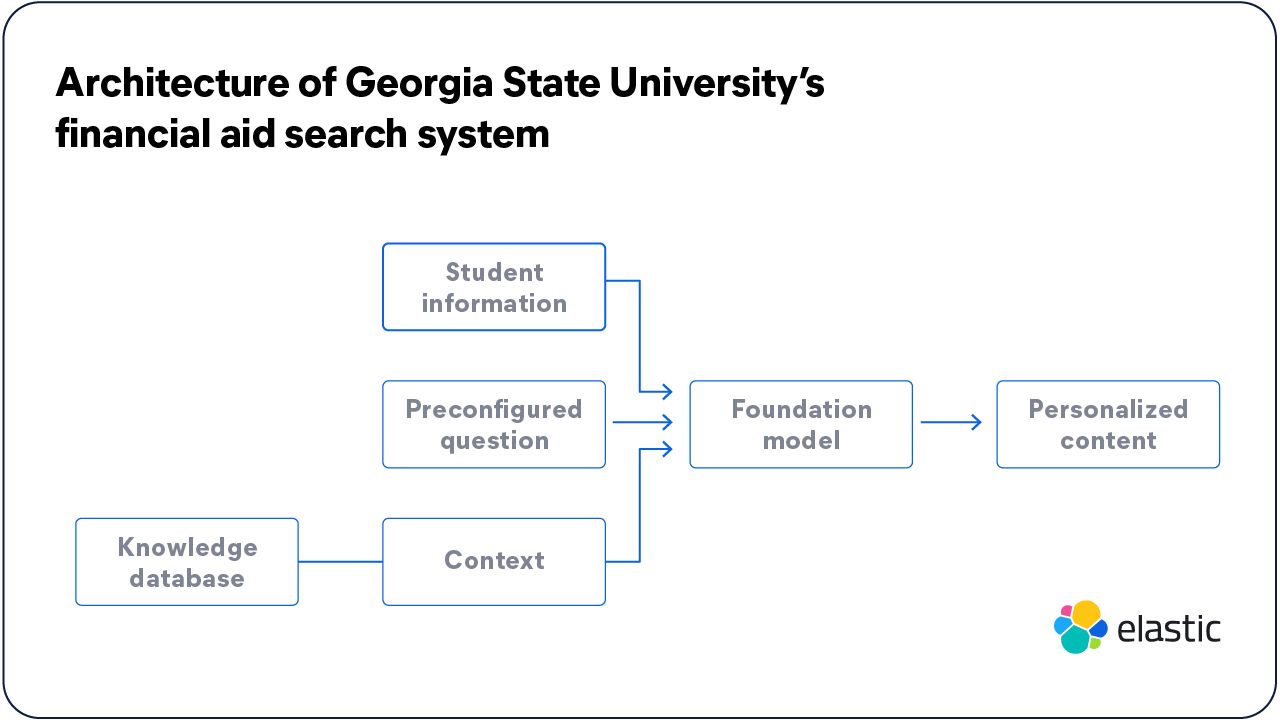
For the financial aid use case, GSU implemented a retrieval augmented generation (RAG) model in which documents, including students’ specific data, were split into smaller passages and indexed. This data was then used to enrich the AI model, enabling personalized guidance within student dashboards when they looked for answers about their financial aid status. Students could perform semantic searches that understood contextual meaning rather than relying on exact keywords. Klc explains, "We harvest content from several places, chunk and vectorize the text, and then undertake preprocessing using AI to create meaningful and relevant chunks."
The results
Unified observability and AI-powered search experiences
Elasticsearch Platform helped GSU achieve:
- Proactive reliability: Synthetic monitoring and real-time dashboards helped GSU detect and fix issues before users were affected.
- Unified visibility: Centralized operational data made insights accessible across IT and non-technical teams.
- AI-powered experiences: The RAG-based search prototype delivered personalized, context-aware financial aid guidance for students.
- Future-ready foundation: Unified observability and the Elasticsearch Platform positioned GSU to expand GenAI experimentation across campus operations.
Why Elastic
The Elasticsearch Platform offered the flexibility, scalability, and unified architecture GSU required. The platform supported large volumes of structured and unstructured data and gave the university the ability to build custom metrics and visualizations accessible beyond the IT team to create student experiences that scale. Its out-of-the-box observability solution, Elastic Observability, provided a single observability tool GSU could use across its environments.
GSU’s team singled out Elastic’s vector search and generative AI capabilities as the enabling technology for their next-generation search applications. By choosing Elastic, GSU not only solved its observability gap but also built a foundation for generative AI experimentation — making the outcome not just faster dashboards, but smarter student services.
Share
- Share on Twitter
Share on Twitter
- Share on LinkedIn
Share on LinkedIn
- Share on Facebook
Share on Facebook
- Share by Email
Share by Email
- Print this page
Print