Understanding vector databases: A strategic guide for IT leaders
Navigating modern retrieval, hybrid search, and the build-versus-buy decision for enterprise AI readiness


 Share on Twitter

 Share on LinkedIn

 Share on Facebook

 Share by Email

 Print this page
Print
Why search matters now: The mandate for modern retrieval
There’s a reason that enterprise search is too often underestimated and underutilized: For too long, it didn’t work. Many legacy search applications are limited by keyword search, which requires exact keyword matches for information retrieval. Even now, a third of employees have difficulty finding information, and of that third, 36% struggle to access relevant information.1
Inefficient search isn’t just frustrating. Among IT leaders, 79% cite their main goal in implementing search as increasing employee productivity and efficiency.2 Friction in search can cause slowdowns, which, in turn, can significantly impact customer service and enterprise security.
As such, search has become the crux of driving business in the modern world, and the foundation on which generative AI (GenAI) applications, instrumental in managing data, are built. Data is the stream of information and knowledge that keeps teams connected and the business running, if it’s easily accessible.
To meet the demands of modern business, IT leaders must look beyond traditional databases to the foundations of data retrieval. But modernizing retrieval raises a practical question: Build the capabilities in-house, or buy them as part of a unified platform?
The answer depends on what an organization needs to support and what it wants to take on itself. Vector databases, hybrid search, structured search, and reranking can be implemented as separate components, but each adds infrastructure, integration, and maintenance overhead.
This article explores how vector databases are powering the next generation of search experiences, backed by recent industry data, and examines the key use cases, benefits, and challenges organizations face as they modernize retrieval.
Strategic goals for enterprise search
Productivity isn’t the only goal for organizations investing in enterprise search: 41% of executives say they want to reduce operational costs, and 39% aim to improve the quality of employee decision-making.2
Together, these priorities highlight the value of fast, reliable access to organizational knowledge and show that search implementation is a strategic investment in business performance.
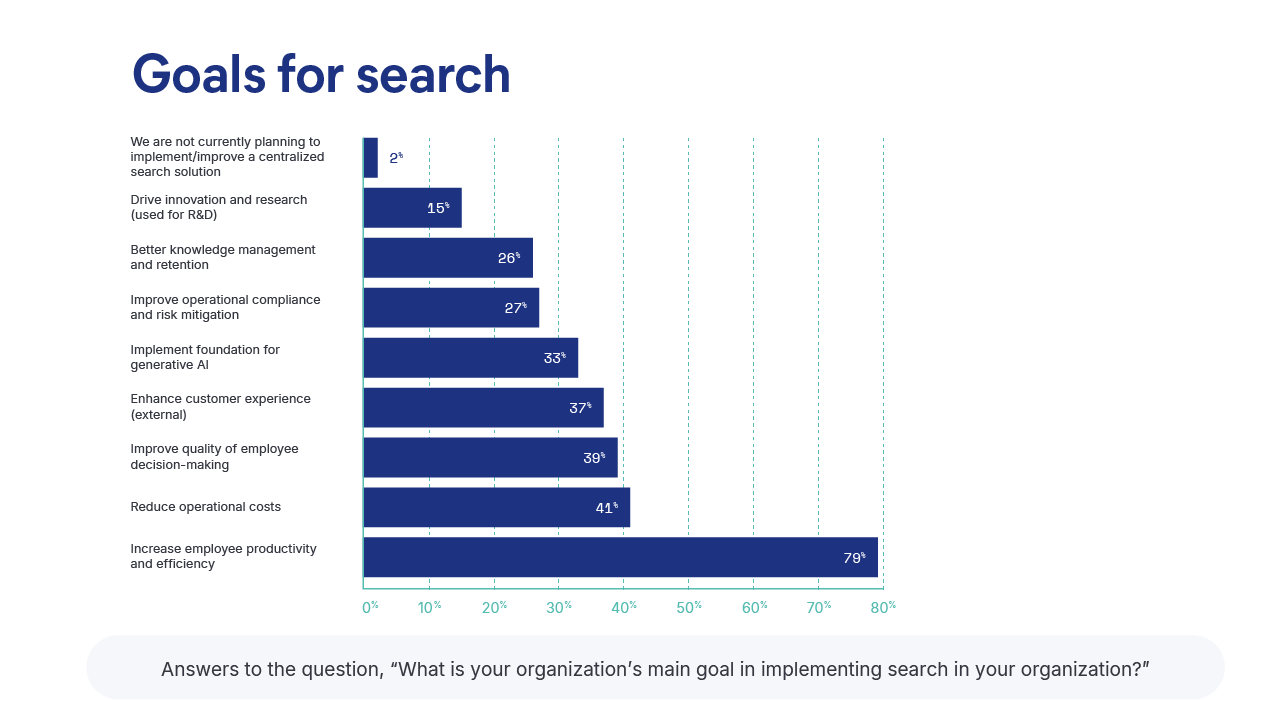
Enterprises have identified effective search as central to running a modern business. When employees can easily access the right information at the right time, organizations move faster, operate more efficiently, and make better decisions.
The current state of enterprise search technologies
As enterprise search evolves, organizations are adopting a range of search technologies to support different tasks and user needs.
Full-text search
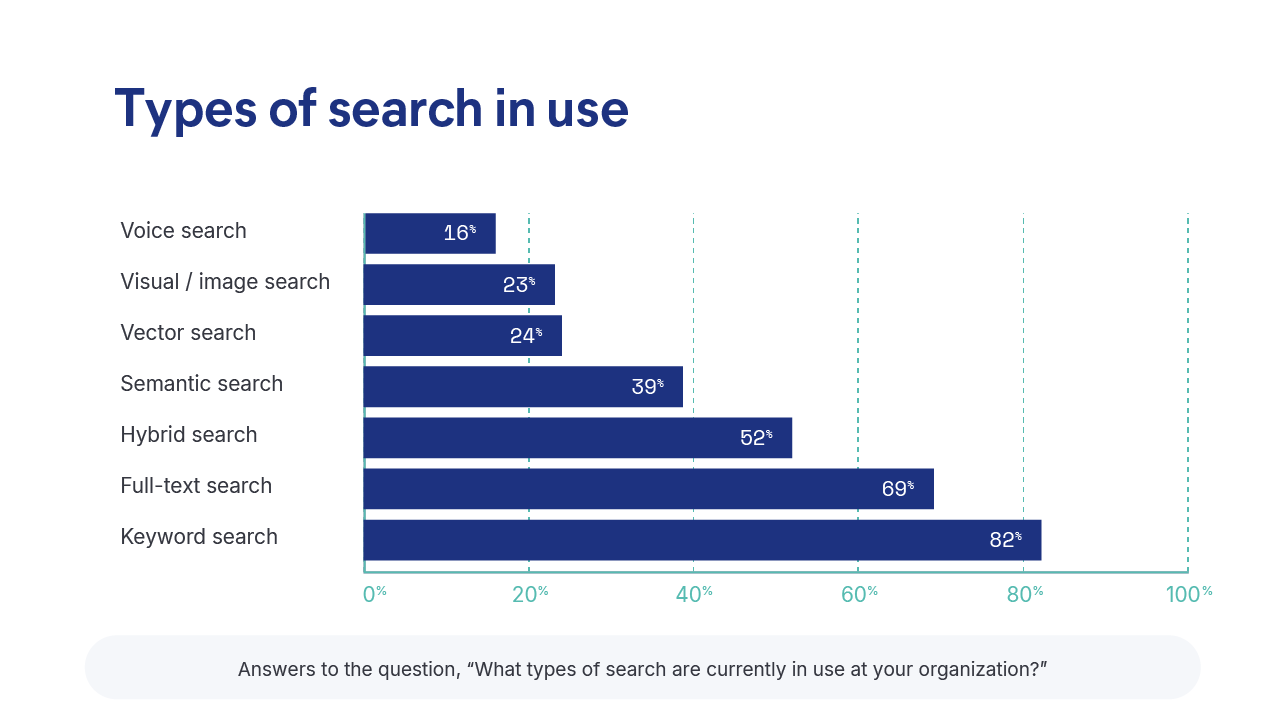
Full-text search goes beyond keyword matching to find specific information within large bodies of text, not only in structured fields like titles or tags. Full-text search analyzes the content of documents to identify relevant results based on a user’s search query. At 69%, full-text search is the second-most common type of enterprise search.2
Hybrid search
Hybrid search combines two or more search techniques, such as keyword search and semantic search, to deliver accurate, relevant results based on keyword matches and user intent. In other words, hybrid search uses two or more retrieval methods but combines them into a single ranked list. Hybrid search is used by 52% of organizations.2
Keyword search
Keyword search, which 82% of organizations use in enterprise search,2 matches query words exactly, returning results based on exact word matches, synonyms, or similar words. For example, a search for “fraud detection” might return documents containing those exact words, as well as variations like “detecting fraud” or “fraud prevention,” even if the overall context or intent differs from what the user meant.
Semantic search
Semantic search uses AI and natural language processing (NLP) to understand the context, intent, and meaning behind a user’s query. Semantic search, sometimes referred to as conversational search, enables users to enter queries in natural language and receive more relevant results. Currently, 39% of organizations leverage semantic search.2
Vector search
Vector search uses machine learning (ML) to capture the meaning and context of unstructured data, including text and images, and transform it into a numeric representation. Vector search builds on semantic search understanding and is not limited to text; it can process both structured and unstructured data. For this, vector search relies on a vector database. Currently, 24% of organizations use vector search.2
Visual or image search
Visual or image search lets users use images in search queries. One image query produces similar image matches. Currently, 23% of organizations rely on visual or image search.2
Voice search
Voice search technology relies on NLP and speech recognition to process a spoken query and return relevant results. Customer-facing apps such as Alexa and Siri currently use this technology. Voice search is used by 16% of organizations.2
While traditional search techniques remain in use, hybrid search techniques including AI-enabled search techniques are also gaining traction in enterprise adoption.
Hybrid search, semantic search, and vector search, though more technically complex than their legacy counterparts, are currently driving the industry forward. All three techniques remove a layer of friction from search applications by enabling natural language interaction.
Vector databases: The foundation for next-gen search
Vector databases are not just the foundation for GenAI applications; they are the ground-level necessity of a conversational AI-powered search experience.
As organizations generate and rely on increasingly large volumes of unstructured data, traditional database systems are reaching their limits. Text documents, images, videos, customer interactions, and application logs all contain valuable information — but extracting meaningful insights from this data requires more than simple keyword matching. This is where vector databases come in.
What is a vector database?
A vector database stores information as numerical representations of data objects, called vector embeddings. Embeddings capture the meaning, context, and relationships within data, enabling machines to understand similarity between concepts rather than just exact words or tags. This capability gives vector databases their key advantage: the ability to manage unstructured and semi-structured data such as text, images, audio, and multimedia content at scale.

Vector databases enable semantic and similarity search. At a high level, a vector database transforms searchable information into vectors. A vector is an array of numbers that encodes the meaning of a piece of text as coordinates in a high-dimensional space, so items with similar meaning sit close together. When a user submits a query, an embedding model converts it into a vector that captures the query’s meaning and context.
A nearest neighbor algorithm then matches vectors of existing documents against the query. Instead of matching exact terms, the algorithm identifies related results based on meaning and context extracted from the query. That’s how a question like “How do I cancel my subscription?” can retrieve articles titled “Managing your billing settings.”
For organizations, vector databases are the key to delivering more intuitive, human-like search experiences that align with how people naturally ask questions.
As enterprises adopt AI-driven applications and natural language interfaces, intuitive search capabilities are becoming increasingly important. In fact, 31% of respondents cited natural language search as a growing priority within the past six months, underscoring the demand for systems that go beyond responding to syntax to interpret intent.2
Why IT leaders need vector databases
Semantic search, recommendation engines, retrieval augmented generation (RAG), intelligent copilots, and hybrid search architectures all rely on the ability to quickly compare and retrieve related data across massive datasets.
In modern organizations, knowledge is scattered across systems such as collaboration tools, cloud drives, documentation platforms, messaging platforms, CRMs, PDFs, and code repositories. Vector search, or hybrid search, is ideal for this kind of cross-platform retrieval. For information technology decision makers looking to power intelligent enterprise search and AI-driven knowledge retrieval, vector databases provide the foundation.
Vector databases are purpose-built to handle the massive computational scale required to perform high-speed similarity searches across vast volumes of unstructured data, returning relevant results in milliseconds.
Vector databases make diverse data types searchable through a common framework and enable conversational interactions. This type of retrieval reduces the time employees spend hunting for information and increases the discoverability of institutional knowledge. Efficiency goes up, and so does productivity.
With the foundation of a vector database, organizations can scale AI-powered search experiences without sacrificing performance, accuracy, or user experience.
For IT leaders evaluating the future of enterprise search and AI readiness, vector databases are a strategic enabler of modern, intelligent data systems.
Top 3 vector database use cases
The most common enterprise search use cases show that organizations are prioritizing internal efficiency and faster access to institutional knowledge. According to Elastic’s State of Search & AI 2026 report, the top vector database use cases are:
- Searching internal knowledge bases (74%)
- Website search (66%)
- Customer service and FAQ experiences (51%)
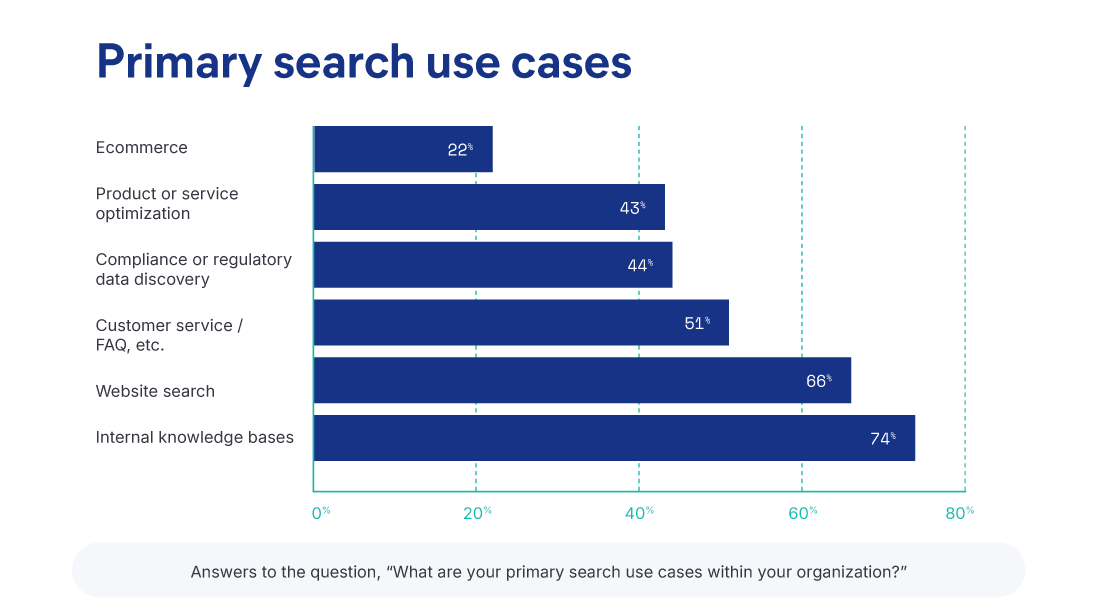
Effective search across all these use cases relies on a strong data foundation, which is where vector databases come in. By converting varied data from both structured and unstructured sources into embeddings, vector databases provide the foundation for AI-powered applications that use natural language retrieval to improve efficiency. By understanding complex relationships across data, vector databases help search systems interpret intent and deliver conversational user experiences.
Searching internal knowledge bases
For many organizations, plugging proprietary data into AI tools is not an option. Whether they are concerned about compliance, security, or privacy, these organizations must be able to take advantage of AI-powered search while protecting their data.
Vector databases are particularly effective for powering internal knowledge bases, creating searchable closed systems that deliver immediate organizational value. In fact, teams that begin their search journey internally achieve a 73% implementation success rate compared to the 61% average, largely because internal environments allow teams to build organizational buy-in and fine-tune data infrastructure before tackling customer-facing applications.2
Website search
Website search is a major vector database use case for organizations with large and growing volumes of content, documentation, ecommerce catalogs, or support resources.
Traditional keyword search struggles when users phrase questions differently from the site’s indexed terminology. Vector search closes this gap by understanding intent and contextual similarity. For example, a customer searching “AI compliance risks” can surface content discussing “governance and regulatory concerns for GenAI.”
As users increasingly expect conversational interactions, website search powered by vector databases can improve content and product discoverability, increase self-service resolution rates, and speed up session times, ultimately driving higher conversion and engagement metrics.
Customer service applications
From AI chatbots to recommendation engines, content discoverability determines the quality of a user’s interaction. Again, vector databases are the foundation of AI-driven applications and semantic retrieval, enabling more advanced experiences, such as:
- Personalized recommendations
- Conversational website assistants
- AI-generated summaries
- Multilingual semantic search
- Context-aware navigation
Because vector databases establish similarity relationships, they are fundamental to ecommerce and recommendation systems that link products, user behavior, and content. This capability allows organizations to move beyond simple “people also bought” recommendations toward more nuanced personalization engines.
Benefits and challenges of vector and hybrid search
Benefits of implementing vector and hybrid search
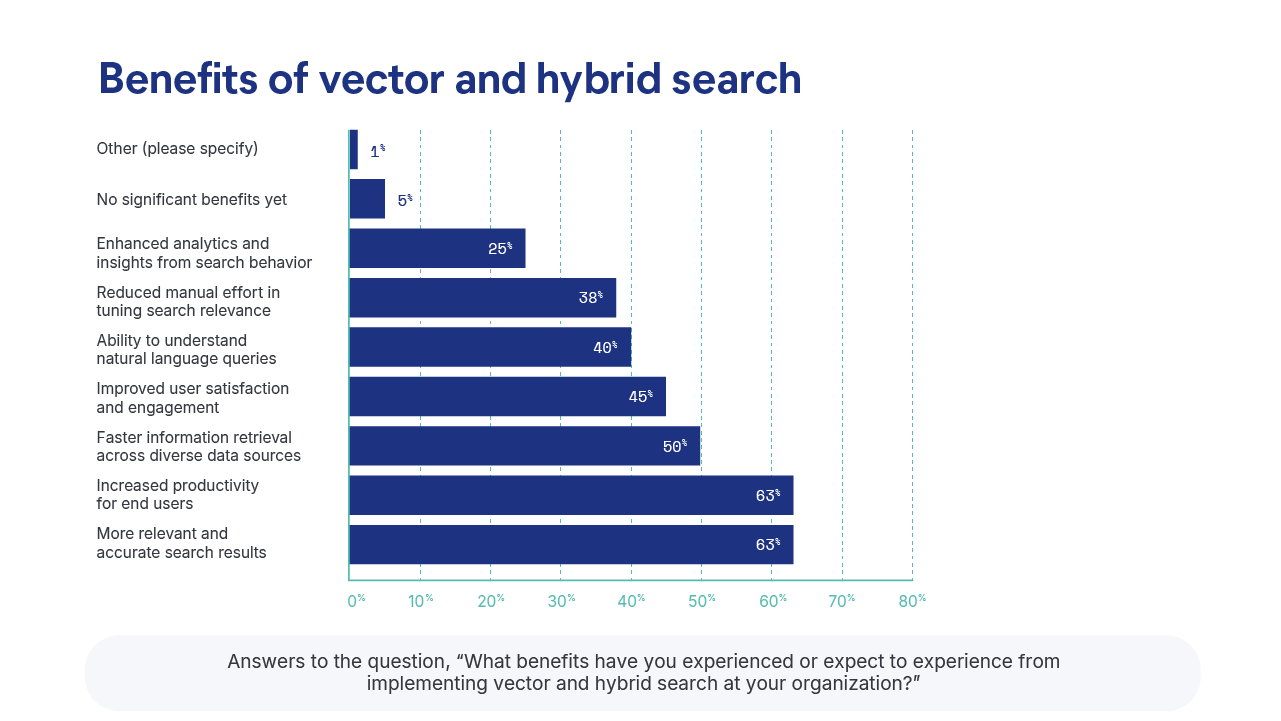
Hybrid and vector search are rapidly becoming essential components of modern enterprise search strategies because they combine the strengths of traditional keyword search with the contextual intelligence of AI-driven retrieval.
Increased search result accuracy and relevance
While keyword or lexical search excels at exact matches, vector search enables understanding of meaning, intent, and conceptual relationships among pieces of information. By combining these two types of search, hybrid search delivers more accurate and relevant results, particularly across large volumes of unstructured enterprise data. In fact, 63% of respondents identified more relevant and accurate search results as the primary implementation benefit of vector or hybrid search.2
Increased productivity
For employees, vector databases result in less time spent searching and more time acting on information. Users can ask questions conversationally instead of relying on precise terminology and still retrieve relevant content. This flexibility improves productivity, reduces friction in knowledge discovery, and enhances decision-making across teams. In customer-facing environments, hybrid and vector search can also improve support experiences by surfacing more contextually relevant answers faster, helping organizations resolve issues more efficiently. Respondent data backs up this benefit: 63% identified increased productivity for end users as a primary implementation benefit, and 50% identified faster information retrieval across diverse data sources.2
Foundation for faster information retrieval
For IT leaders, the benefits extend beyond user experience. Hybrid and vector search provide the retrieval foundation necessary for GenAI applications, intelligent assistants, recommendation systems, and RAG architectures. These systems depend on the ability to identify semantically related information in real time, something traditional search infrastructure was never designed to handle at scale.
By adopting vector-enabled search architectures, organizations position themselves to support both current search demands and the next generation of AI-driven enterprise applications.
Challenges for vector database implementation
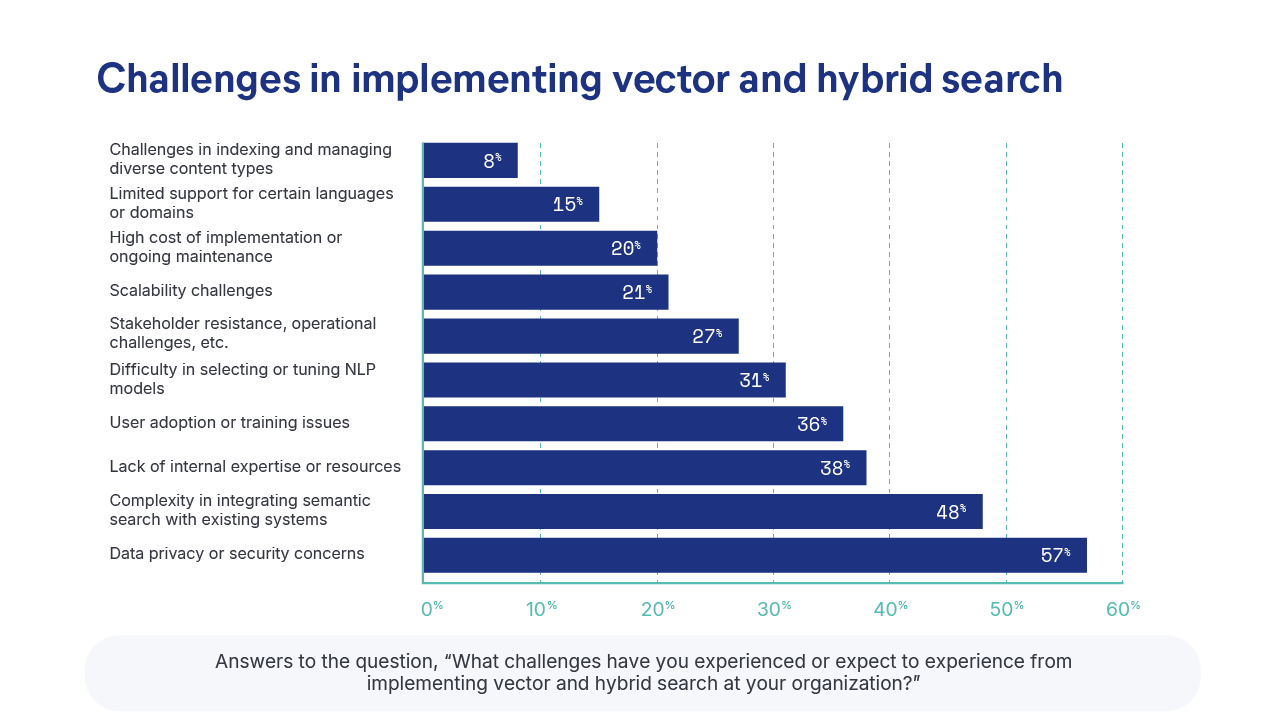
While vector and hybrid search technologies offer significant advantages, implementation remains a complex undertaking for many organizations. This is in part because organizations must weigh the benefits of building their own capabilities or buying them.
Cost of building natively
Building looks cheap until it doesn't. Early on, teams stitch together open source tools — FAISS, pgvector, a separate keyword index, some orchestration glue code — and it works at POC scale. The hidden costs hit later: maintaining embedding pipelines, relevance tuning across multiple systems, scaling the vector index without blowing up infrastructure costs, reranking logic, permission management across data sources. What started as "free" becomes two or three full-time engineers just keeping the plumbing running.
Not to mention, enterprise requirements are expensive to build. Security controls, access permissions, compliance, audit trails, multitenancy — these are table stakes for enterprise deployment but genuinely hard to build into a custom vector stack.
In some cases, buying a database causes less strain on resources.
Data privacy and security concerns
The biggest barrier cited by IT leaders is data privacy and security concerns, identified by 57% of respondents.2 Because vector search systems often process large volumes of sensitive enterprise data, including internal documents, customer interactions, and proprietary knowledge, organizations must ensure robust governance, access controls, and compliance frameworks are in place before deploying AI-driven search capabilities at scale.
As semantic search becomes increasingly tied to GenAI and RAG systems, concerns around data exposure, permission management, and regulatory compliance only intensify, amplifying the need for closed internal knowledge bases.
Integration complexity
Beyond security, nearly half of respondents (48%) pointed to the complexity of integrating vector and hybrid search into existing systems.2 Many enterprises continue to operate across fragmented legacy environments where data resides in disconnected repositories, applications, and storage systems.
Implementing semantic search requires not only deploying new infrastructure but also unifying data pipelines, modernizing indexing strategies, and ensuring interoperability between traditional search systems and AI-powered retrieval layers. When a team has a separate vector database, a keyword search layer, an orchestration service, and a model pipeline, every one of those is a failure point, a latency source, and a maintenance burden.
For organizations with deeply entrenched legacy architectures, this transition can be both technically demanding and resource-intensive. That leaves teams with a fundamental choice: Buy the capabilities they need, or build and maintain them themselves.
A possible solution is a unified retrieval platform. Instead of stitching together separate systems for hybrid search, vector search, structured search, and reranking, teams can get all four capabilities natively in one platform.
Lack of internal expertise
At the same time, 38% of respondents cited a lack of internal expertise or resources as a major challenge.2 Vector databases, embedding models, and hybrid retrieval architectures represent a relatively new and rapidly evolving area of enterprise IT.
Successfully deploying and maintaining these systems often requires specialized knowledge in AI infrastructure, machine learning operations, and large-scale data engineering, which are skill sets many organizations are still developing internally. As a result, IT leaders are increasingly tasked with adopting new technologies, as well as building the teams and operational capabilities needed to support them long term.
The action plan for IT directors
Search, like user expectations, has evolved. Keyword search is no longer the de facto search mechanism — hybrid search, powered by vector databases, represents the more flexible future of enterprise knowledge retrieval. Successfully deploying generative and agentic AI applications requires a data foundation that scales with the growing volume of enterprise content and data, namely, vector databases.
Vector databases are where responsible data management begins. Successful adoption relies on thorough technical execution and clear ROI frameworks; 57% of leaders expect a return on investment within 12 months.2
So where do you start?
- Identify high-friction areas: Audit your existing search workflows to pinpoint where users encounter “no results” or irrelevant data, focusing on high-impact zones like internal knowledge bases or customer service portals. Prioritize these use cases. They offer the most immediate and measurable return on investment through improved employee productivity and efficiency.
- Audit your data architecture: Evaluate whether your current infrastructure, legacy or otherwise, can handle the compute required for vector embeddings and high-performance semantic retrieval. This audit should assess your readiness to manage unstructured data and determine whether specialized vector databases are necessary to support low-latency search results.
- Prioritize secure, hybrid platforms: Seek out search platforms that offer out-of-the-box hybrid search capabilities, merging traditional keyword matching with advanced vector search to simplify integration. Ensure these platforms provide robust security controls and data privacy measures to address common implementation concerns while reducing the burden on internal expertise.
1 Gartner, “Market Guide for Enterprise AI Search,” September 2025.
2 Elastic, “The State of Search & AI 2026,” 2026.
Share
- Share on Twitter
Share on Twitter
- Share on LinkedIn
Share on LinkedIn
- Share on Facebook
Share on Facebook
- Share by Email
Share by Email
- Print this page
Print