Whole-of-state cyber defense: How AI-driven security helps US states protect what matters most

 Share on Twitter
Share on Twitter

 Share on LinkedIn
Share on LinkedIn

 Share on Facebook
Share on Facebook

 Share by Email
Share by Email

 Print this page
Print
Summary
- State and local governments in the United States face growing cyber threats, but there are uneven security resources across agencies.
- A whole-of-state security model enables shared visibility, coordination, and resilience without sacrificing data sovereignty.
- AI-driven security analytics help understaffed teams detect real threats faster and operate at scale.
- Open, distributed architectures make it possible to protect citizen services while controlling cost and complexity.
Why are US states rethinking how they defend against cyber threats?
Short answer: Because attackers exploit fragmentation faster than governments can respond
This shift toward collective cyber defense is a cornerstone of the new federal vision. The March 2026 National Cyber Strategy for America explicitly calls for a "new level of relationship between the public and private sectors" and demands "unprecedented coordination across government" to protect the American people. By prioritizing the "security and resilience of the systems that underpin our military, intelligence, and civilian enterprises," the strategy signals that local and state security is no longer an isolated concern; it is a matter of national economic and social prosperity.
State governments today oversee a vast and diverse ecosystem, including executive agencies, counties, cities, school districts, higher education, and public safety organizations. Each plays a critical role in delivering citizen services, yet many operate with different tools, staffing levels, and security maturity.
Attackers understand this imbalance. Rather than targeting the most mature state systems directly, they often compromise smaller, under-resourced entities first, using them as entry points into larger environments.
This reality is driving a shift toward a whole-of-state cybersecurity approach.
What is a whole-of-state cybersecurity model?
Short answer: A collaborative security strategy that treats the entire state ecosystem as a shared defensive perimeter
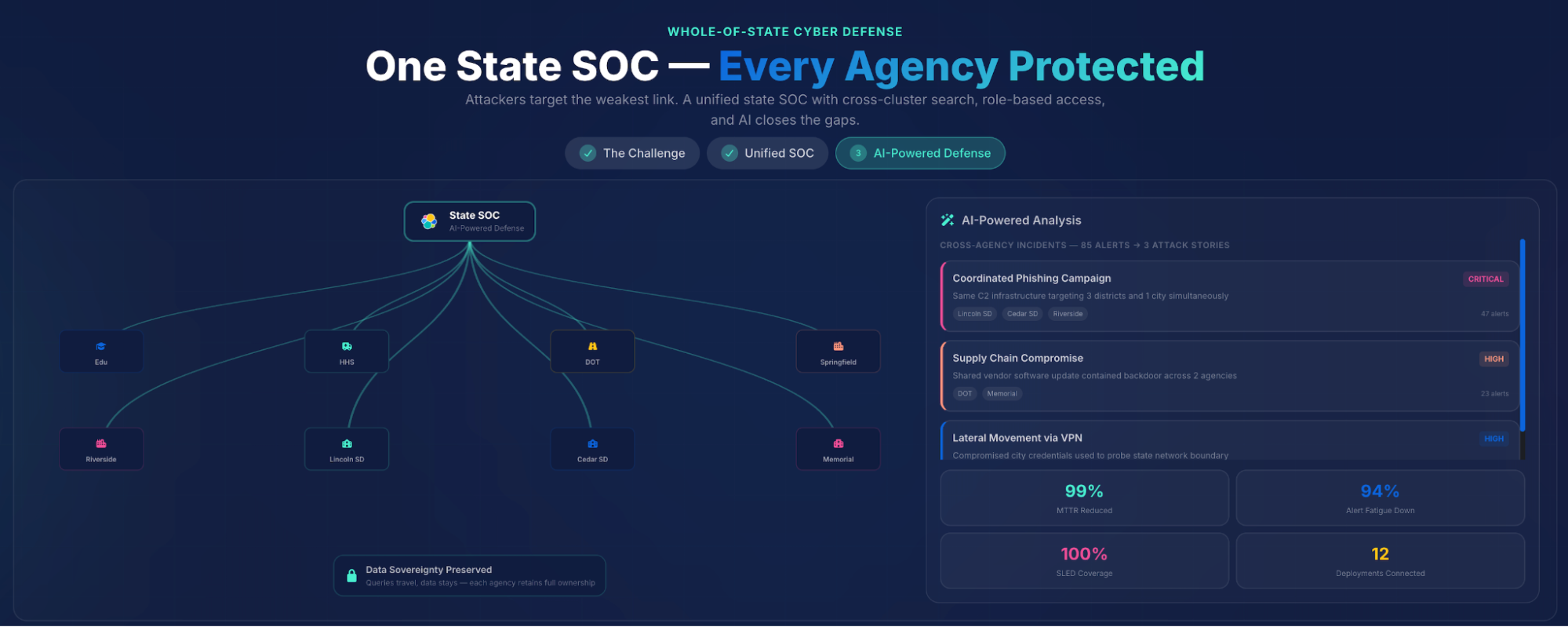
Traditionally, state agencies, local municipalities, and school districts have operated as individual "islands" of security. A whole-of-state approach breaks down these silos, allowing shared threat intelligence, unified tooling, and coordinated incident response.
Instead of every agency or district operating independently, states coordinate tooling, visibility, and response across jurisdictions. Larger state security teams can share capabilities and expertise with smaller local entities, raising the baseline of protection for everyone.
The result is a move from fragmented defense to collective resilience.
This model is increasingly supported by federal frameworks. For instance, the CISA State Cybersecurity Governance Case Studies (2026) highlight how states like Georgia and Virginia have successfully used formal governance structures to manage cyber risk as a collective strategic priority. These studies demonstrate that by establishing clear policies and shared resources, states can protect the most vulnerable local entities without infringing on their operational independence.
Why does the weakest link matter in public sector security?
Short answer: Because cyber defense is only as strong as its most vulnerable endpoint
This isn't just a theoretical risk. Recent analysis from Deloitte (2026): Whole-of-state cybersecurity: Protecting the public information ecosystem reveals that cybercriminals are increasingly bypassing hardened state data centers to target "cyber-underserved" entities. These include K-12 districts and small municipalities that serve as the literal front doors to a state's digital ecosystem. These entities often lack the budget for elite defense, yet they are connected to the same vital networks. This creates a vast and vulnerable attack surface that Deloitte identifies as the single greatest challenge to state-wide resilience.
A breach in any one of these organizations can disrupt statewide services or expose sensitive citizen data. A whole-of-state model addresses this risk by enabling:
Shared detection and response: Threats are identified early before they can move laterally through the network.
Coordinated action: Organizations move away from siloed incident handling toward a unified defense posture.
Consistent protection: Security standards remain high regardless of an individual agency's size or budget.
When one organization is protected, the entire ecosystem benefits.
How does a whole-of-state approach protect citizen services?
Short answer: By enabling real-time coordination before incidents become crises
Cyber incidents in the public sector are not abstract IT problems. They can halt 911 dispatch, delay emergency response, close schools, or expose student and citizen personally identifiable information (PII).
With shared visibility and standardized workflows, security teams can:
Detect attacks as they propagate across agencies
Coordinate response across state and local boundaries
Keep essential services running during incidents
This operational alignment is critical for maintaining public trust.
Can states achieve economies of scale without sacrificing autonomy?
Short answer: Yes, but only with the right architecture
Pooling resources does not mean forcing every agency into a single, centralized system. Modern whole-of-state strategies rely on distributed architectures that balance efficiency with governance.
This enables:
Reduced tool sprawl and licensing redundancy
Lower operational complexity
Better use of taxpayer and tuition dollars
At the same time, agencies retain control over their own data and policies.
Why do distributed security architectures matter for state governments?
Short answer: Because sensitive data cannot always be centralized
Traditional security information and event management (SIEM) platforms often require moving large volumes of log data into a central repository. For state governments, this can introduce massive costs, data egress fees, and complex compliance risks.
A distributed data mesh approach allows teams to search and analyze data where it already resides while still providing statewide visibility. This reflects the current federal gold standard. For example, the CISA Continuous Diagnostics and Mitigation (CDM) Program uses Elastic to enable CISA to access federal agencies’ cybersecurity data via a unified dashboard without moving that data or removing ownership from the originating agency.
By adopting this same architecture, states can achieve:
Data sovereignty: Keeping sensitive student or citizen data within its originating department to satisfy local privacy mandates
Policy-aware access controls: Ensuring that shared visibility is always aligned to jurisdictional and agency boundaries
Affordable long-term retention: Supporting strict mandates like M-21-31 by using searchable "frozen" data tiers rather than relying on expensive, inaccessible cold storage
This architecture makes collaboration possible without compromising the privacy, governance, or budgets of individual agencies.
Why does open security matter in a whole-of-state strategy?
Short answer: Because whole-of-state cyber defense requires integration across agencies without forcing uniform tools or vendor lock-in
State and local organizations operate with different budgets, policies, and legacy systems. An open security model enables collaboration by allowing agencies to participate without abandoning existing investments.
Open security enables:
Vendor-agnostic data ingestion, so agencies can share security signals regardless of existing tools
Standards-based integrations, allowing systems to work together across jurisdictions
Community-driven detections, providing transparency instead of opaque black-box analytics
For state, local, and education (SLED) organizations, openness reduces long-term risk, preserves agency autonomy, and makes sustained statewide collaboration achievable.
How does AI become a force multiplier for understaffed security teams?
Short answer: By helping teams focus on what matters most
State CISOs consistently cite staffing shortages as one of their biggest challenges, but the strategy for solving this has shifted. According to the NASCIO Top 10 Priorities for 2026, artificial intelligence has officially overtaken cybersecurity as the number-one policy priority for State CIOs for the first time in over a decade. This signals a transition from seeing AI as a future trend to treating it as the primary operational tool for managing risk across the state ecosystem.
This includes:
Alert triage, correlating hundreds of alerts into a small number of high-confidence incidents
Guided investigation, reducing noise and analyst fatigue
Faster response, enabling teams to act before threats escalate
By shifting analysts from triage to decision-making, AI extends the reach of limited teams.
Can AI-driven security be used responsibly in the public sector?
Short answer: Yes, the system can leverage context engineering to ensure every AI output is grounded in verified, local data.
Public sector organizations face strict privacy and compliance requirements, which is why a one-size-fits-all approach to AI often fails. To maintain trust, agencies are moving toward context engineering. Rather than relying on simple prompts, context engineering is the technical discipline of dynamically assembling the right data, policy guardrails, and institutional knowledge for AI in real time.
By using this approach, the system ensures that:
Policy is enforced at the data layer: AI only "sees" the context it is authorized to access, ensuring that redaction and PII protections are absolute.
Institutional memory is preserved: AI draws from past incident reports and state-specific standard operating procedures (SOPs), preventing hallucinations that are common in generic models.
- Sovereignty is maintained: Because context is assembled dynamically from your own secure data stores, sensitive information is never used to train public models.
What does whole-of-state cyber defense enable long term?
Short answer: A whole-of-state strategy is not just about better tools; it is about fundamentally changing how governments defend themselves.
By combining open, distributed architectures with AI-driven security analytics, states can align with the vision set forth in President Trump’s Cyber Strategy for America (March 2026). This national framework prioritizes the rapid adoption of agentic AI to autonomously detect, divert, and deceive threat actors at scale. For state leaders, this enables a shift from reactive firefighting to a proactive, coordinated defense that can:
Extend protection to under-resourced agencies: Bringing elite, AI-powered defense to small towns and school districts that cannot hire dedicated security teams
Improve resilience against coordinated attacks: Identifying patterns across the entire state ecosystem to stop a multiprong campaign before it spreads
Operate more efficiently despite staffing constraints: Automating routine triage so human analysts can focus on high-level strategy and recovery
Protect the services and data citizens rely on every day: Ensuring that critical infrastructure remains resilient against increasingly sophisticated foreign threats
In an environment where threats move faster than traditional bureaucratic boundaries, collective defense is no longer optional; it is a matter of national security and economic survival.
Frequently asked questions
What is whole-of-state cybersecurity?
A collaborative security model where state, local, and education organizations share visibility, tooling, and response capabilities to defend the entire ecosystem.
Why are small agencies often targeted first?
Attackers exploit limited staffing and weaker defenses in smaller organizations to gain access to larger state systems.
Does whole-of-state security require centralizing all data?
No. Modern approaches use distributed architectures that allow data to remain within its originating agency while still enabling shared analysis.
How does AI help public sector security teams?
AI automates alert correlation, investigation, and response guidance, allowing small teams to operate more effectively.
Learn more
- The AI arms race in cybersecurity: Why your SOC needs to evolve now
- Elastic named a Leader in The Forrester Wave™: Security Analytics Platforms, Q2 2025
- Public Sector Guide to Cybersecurity in the AI Era
- The Texas A&M University System protects students, emergency responders, and leading research institutions with Elastic Security
The release and timing of any features or functionality described in this post remain at Elastic's sole discretion. Any features or functionality not currently available may not be delivered on time or at all.
In this blog post, we may have used or referred to third party generative AI tools, which are owned and operated by their respective owners. Elastic does not have any control over the third party tools and we have no responsibility or liability for their content, operation or use, nor for any loss or damage that may arise from your use of such tools. Please exercise caution when using AI tools with personal, sensitive or confidential information. Any data you submit may be used for AI training or other purposes. There is no guarantee that information you provide will be kept secure or confidential. You should familiarize yourself with the privacy practices and terms of use of any generative AI tools prior to use.
Elastic, Elasticsearch, and associated marks are trademarks, logos or registered trademarks of elasticsearch B.V. in the United States and other countries. All other company and product names are trademarks, logos or registered trademarks of their respective owners.
Share
- Share on Twitter
Share on Twitter
- Share on LinkedIn
Share on LinkedIn
- Share on Facebook
Share on Facebook
- Share by Email
Share by Email
- Print this page
Print