What's stopping your search-powered AI apps from delivering?
330+ IT leaders shared what's blocking search-powered AI in the enterprise. Here's what the data reveals about the five biggest obstacles and how to move past them.


 Share on Twitter
Share on Twitter

 Share on LinkedIn
Share on LinkedIn

 Share on Facebook
Share on Facebook

 Share by Email
Share by Email

 Print this page
Print
Big AI visions, real data gaps
What does search-powered AI actually look like inside most organizations right now? For the majority, it remains more potential than production.
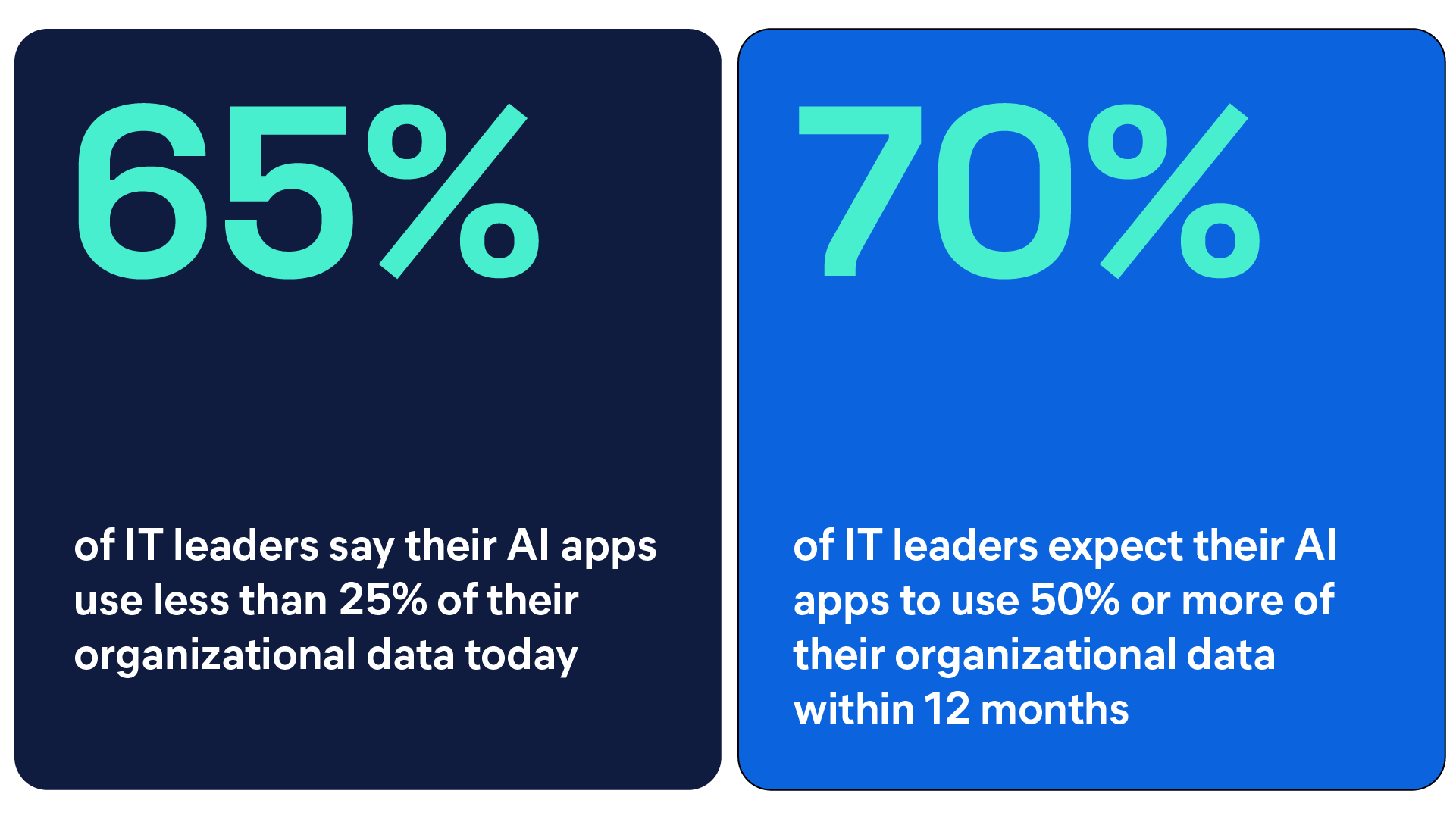
According to Elastic’s The State of Search & AI 2026 report, based on a survey of more than 330 IT leaders, 65% of respondents say their AI apps currently use less than 25% of their organizational data, and 27% use less than 10%. That creates a striking gap between the AI ambition leaders hold and the underlying data foundation.
That boundary is expected to shift fast. Seven in 10 respondents plan to have AI apps working with more than 25% of organizational data within 6 to 12 months. Moving that needle requires deliberate investment in the infrastructure that determines what data your AI can actually reach and retrieve.
What is driving this gap?
A mix of interconnected hurdles stands in the way: complex data integration, inconsistent data quality, and security concerns around expanding AI access to sensitive systems.
Progress happens when you treat data access as a foundational infrastructure priority. Focus on indexing pipelines, access control models, and retrieval architecture before scaling AI applications.
Search is no longer just a feature
Organizations are recognizing the untapped potential of their data. While much of it remains disconnected from AI applications today, priorities are shifting. Projected growth in data utilization depends directly on search infrastructure that can reach, retrieve, and return the right information at the right time.
Search is the foundation for reliable AI experiences. When you treat search as core infrastructure, you close the gap between ambition and production.
How to maximize your existing data footprint
Map your organizational data against a simple framework: what is accessible, what is clean and fresh, and what is sensitive. From there, build retrieval architecture incrementally, expanding access as trust and infrastructure mature.
Platforms that unify vector search, keyword search, and full-text search in a single system, such as Elasticsearch, reduce integration overhead. Fewer moving parts means fewer failure points, faster iteration, and lower operational costs as you scale.
Budget and resource constraints block progress
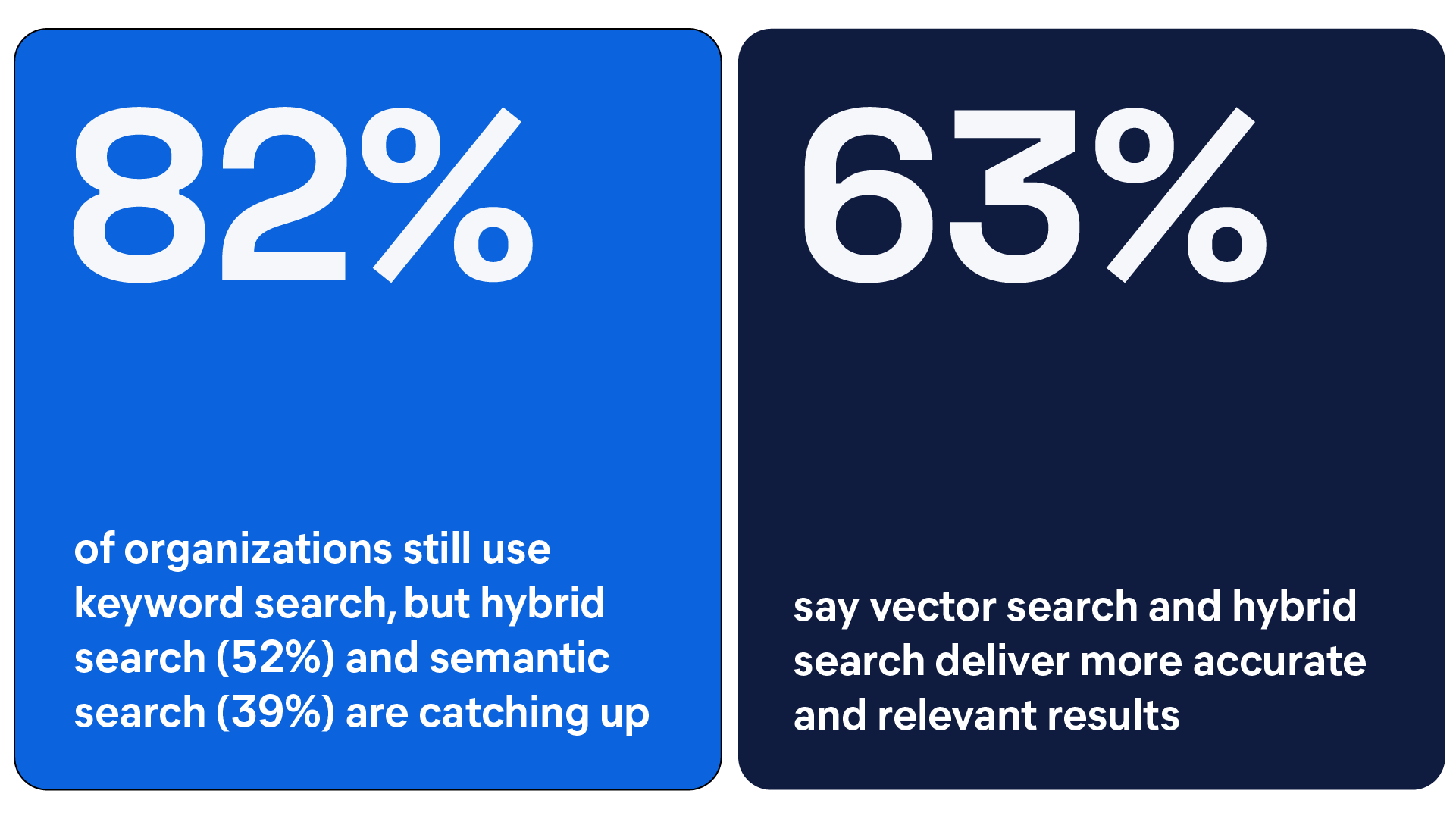
Search technology inside enterprises has evolved far beyond basic keyword matching. While keyword search remains dominant (used by 82% of respondents), adoption of hybrid search (52%) and semantic search (39%) is growing rapidly. Nearly a quarter of organizations already deploy visual or image search.
This is not adoption for its own sake. Among organizations using vector and hybrid search, 63% report more accurate results and increased end-user productivity, and 50% cite faster information retrieval across diverse data sources as a primary benefit.
The cost barrier runs deeper than budget
Budget tops the list of blockers keeping AI apps from reaching production, cited by 53% of respondents. But money is only part of the story. Many organizations fall into a cycle: They need to demonstrate ROI to secure funding, but they need funding to build proof of ROI. Breaking that loop requires smarter project scoping, not just a bigger budget.
Skill gaps present another hurdle. Nearly half of respondents (48%) cite a lack of internal expertise as a primary challenge in building AI apps. The specialized knowledge needed for search-powered AI, such as vector embeddings, retrieval augmented generation (RAG) architectures, semantic search tuning, and machine learning (ML) model selection, remains scarce.

Cost-effective paths forward
To build cost-effectively, simplify your architecture. Unify vector, keyword, and full-text search into one platform to eliminate the cost of managing separate tools. Lean on vendor support and external expertise during early phases while upskilling your team. Finally, leverage consumption-based pricing models to keep infrastructure costs aligned with actual usage.
Security and compliance concerns slow adoption
Security and compliance shape how fast organizations adopt advanced search technology. Technical teams must balance rapid innovation with data protection and strict regulatory requirements.
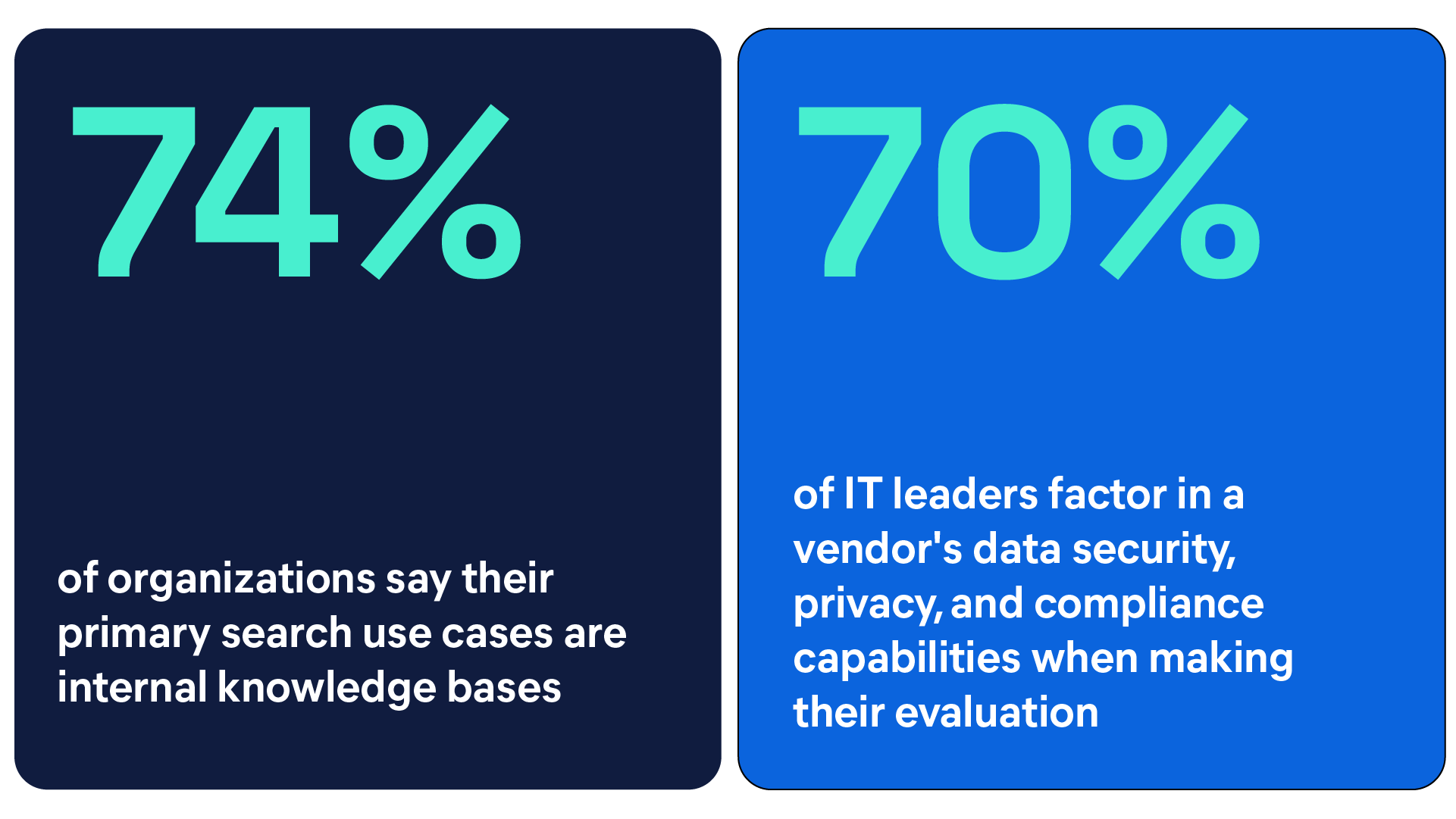
Data privacy, security, and compliance rank as the second most critical factor in search vendor selection (70%), closely following cost (73%). Organizations planning the most aggressive data expansion also report the highest privacy concerns.
Regulatory compliance across industries
Regulations like GDPR, HIPAA, and local data sovereignty rules dictate what data AI can access, how it is stored, and who can retrieve it. Security must be built into the foundation from day zero.
If you operate across multiple regions, deployment flexibility is essential. Using a platform with flexible deployment options, including on-premises, cloud, and hybrid configurations, allows you to meet local requirements without re-engineering your core architecture.
Building secure, compliant search-powered AI architectures
Establish security requirements before selecting technologies. Look for platforms with native document-level security, role-based access controls, and comprehensive audit capabilities.
Start by deploying search-powered AI on internal knowledge bases. This creates a lower-risk environment to validate security architectures before expanding to customer-facing or regulated data.
Breaking free from vendor lock-in and integration complexity
User expectations move fast. Over the last six months, 31% of IT leaders reported increased demand for natural language search, and 26% required real-time or near real-time results.
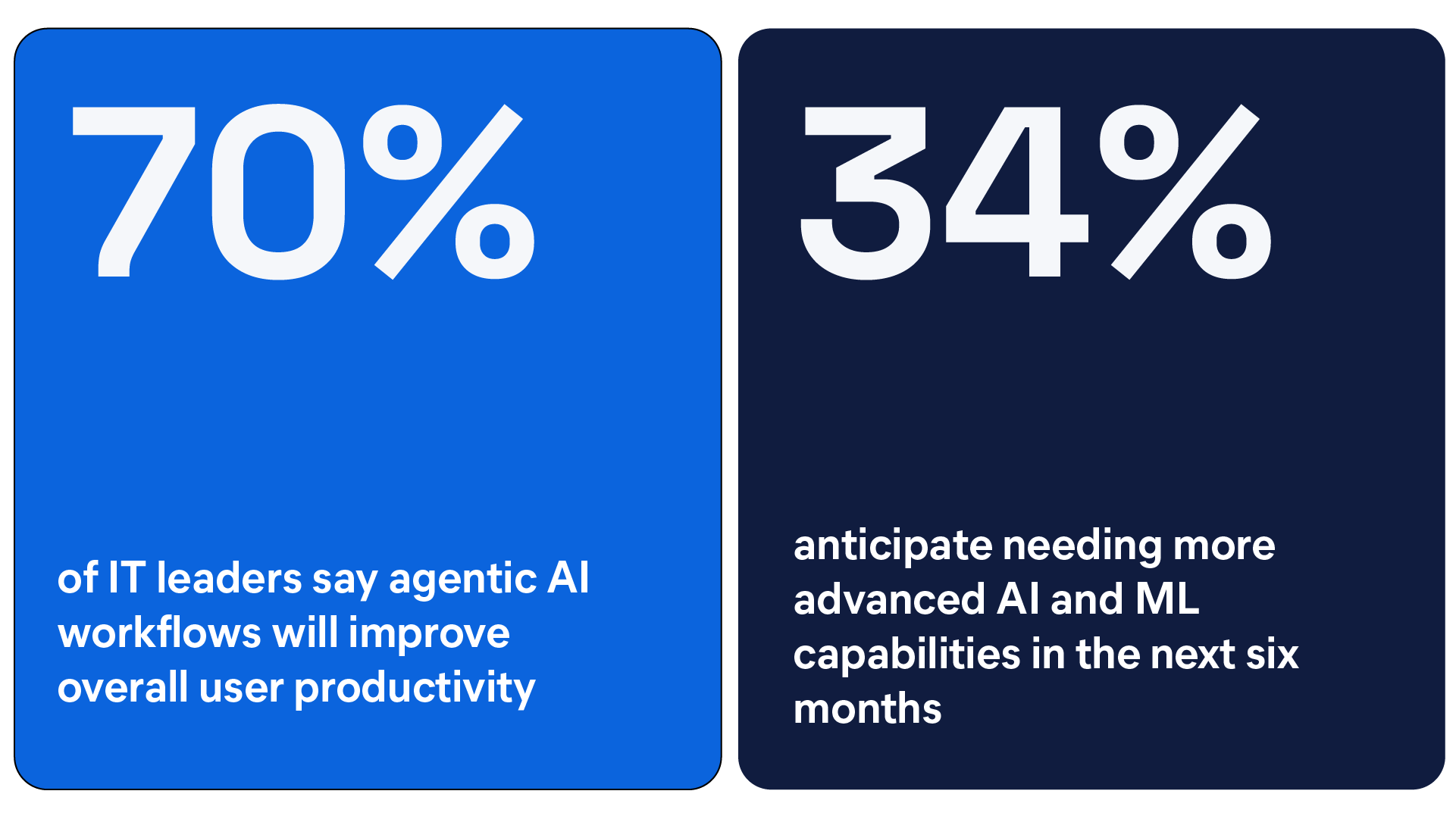
Looking ahead, 34% of respondents anticipate needing more advanced AI and ML capabilities over the next six months, 24% expect to integrate with more business systems, and 21% need to support larger, more diverse datasets.
The hidden tradeoffs of proprietary tools and point solutions
Vendor lock-in risks grow when proprietary platforms lock down infrastructure, model choices, and deployment environments. Cloud hyperscaler search solutions often lock you into a single cloud ecosystem with generic capabilities, offering no path to hybrid or on-premises deployment.
Point solution vector databases create a different set of challenges. They help accelerate initial prototypes but can stall in production because they require external embedding pipelines, lack hybrid retrieval depth, and lack enterprise security. When your use case expands beyond basic similarity search, point solutions often force a costly rebuild.
How open, flexible platforms reduce integration friction
A unified platform handling vector, keyword, and full-text search in a single query eliminates custom glue code. It removes the burden of managing separate embedding pipelines, reranking layers, and index configurations.
Agentic AI workflows depend on this level of reliable retrieval. An AI agent without access to accurate, timely data cannot reason or act effectively. Building on a unified platform gives you the agility to ship agentic AI capabilities faster.
IT leader optimism: 57% expect AI ROI in 12 months
Most AI search projects never reach production.
- 68% of respondents report that fewer than 25% of their AI search projects launch
- Nearly 40% of respondents state that fewer than 10% make it across the finish line
Why? Communication gaps between engineering and leadership.
Thirty-seven percent of respondents struggle to explain progress clearly to stakeholders and 56% face major challenges in aligning executive expectations with technical feasibility. Half deal with shifting project goals midstream.
Moving forward with clarity
Despite these hurdles, confidence in business value remains high: 57% of IT leaders expect to see ROI on search and AI investments within 12 months. Teams that have deployed vector search and hybrid search report measurable gains in relevance and productivity.
The business value is clear. The key question is how fast your organization can move from evaluation to production. Teams that solve data access, security, and leadership alignment today will lead the market over the next 12 months.
Share
- Share on Twitter
Share on Twitter
- Share on LinkedIn
Share on LinkedIn
- Share on Facebook
Share on Facebook
- Share by Email
Share by Email
- Print this page
Print