Search and AI
Elasticsearch powers ecommerce discovery, customer support, enterprise search, AI agents at scale, context engineering, and more.
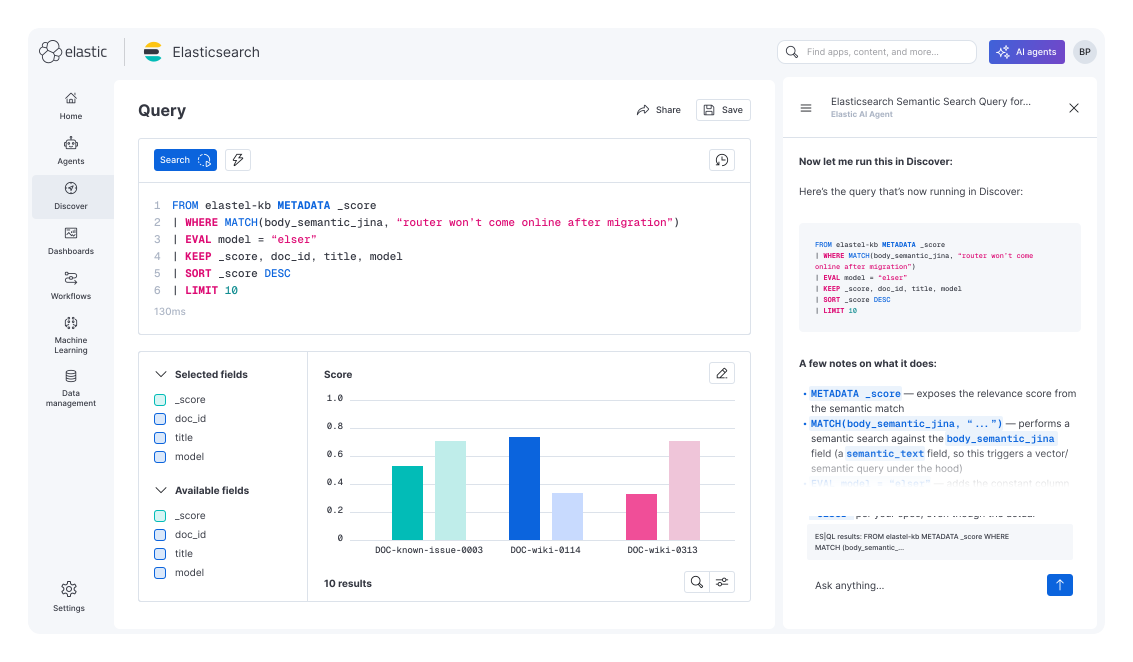
One search database behind every experience
AI runs on search, and Elastic is built for it. Whether you're shipping product discovery, deflecting support tickets, or grounding agents, you get a unified platform with a vector store, keyword engine, query engine, and permissions layer, all built in.
Agentic AI
Build reliable agents in minutes, powered by complete and fresh context, synced from any enterprise source.
Ecommerce search
Turn browsers into buyers with a relevance stack you control from retrieval to reranking, at 200M+ SKU scale.
Customer support search
Deflect cases and power self-service with semantic search for support and internal teams, secured with RBAC and doc-level controls.
Vector database
Ship in minutes and scale affordably to hundreds of billions. Store dense and sparse vectors with hybrid retrieval handled for you, including optimized defaults, Jina AI and native models, and managed GPU inference.
Website and application search
Deliver relevant search across all your content, from knowledge bases and marketplaces to job boards and media.
Geospatial
Turn location into insight. Run fast geospatial queries with spatial indexing, distance sorting, and area filters.
Get started in minutes
Your app or agent, served in real time and production-ready
Ingest and index any data via API
Point any source at the endpoint and index text, images, audio, video, or PDFs. A semantic_text field auto-embeds at ingest with Jina AI models on managed GPUs, no separate pipeline to build.
Retrieve with hybrid search
One query combines lexical and semantic results across modalities on a single index. Add filters, aggregations, and document-level security in the same call.
Build and ship agents
Deploy an agent over your data with Elastic Agent Builder. Wrap queries as reusable ES|QL tools, keep multi-turn memory, and connect external clients over MCP and A2A.
Search that performs in production
From ecommerce at scale to AI agents, see what teams built and what it delivered.
"Elastic is the ideal AI partner for our business. They ensure that the initial semantic search is highly accurate and efficient so that we can optimize the performance of subsequent integrations with large language models."
"Elastic is the ideal AI partner for our business. They ensure that the initial semantic search is highly accurate and efficient so that we can optimize the performance of subsequent integrations with large language models."
Steve Hafif, CEO
500M
Technical data points searched
30%
Quarterly customer growth
Elastic recognized across search and AI
Independent analysts evaluate Elastic on the dimensions that matter to search and AI buyers: relevance, scale, and deployment flexibility.



Join the conversation!
Get hands-on with open repos, community forums, and developer guides — everything you need to build with Elasticsearch.
Frequently asked questions
Is Elasticsearch open source?
Yes, Elasticsearch and Kibana are open source under the AGPL license. Built on Apache Lucene, we support open source projects like OpenTelemetry, Logstash, and Beats. This fosters a community of innovation and collaboration, ensuring Elasticsearch continues to evolve in new and exciting ways. The AGPL license reinforces our open source principles, ensuring security, extensibility, and community-driven progress.
Can Elasticsearch power enterprise search across multiple data sources?
Yes. Elasticsearch connects to your data sources, databases, SaaS apps, cloud storage, and custom systems and brings everything into a single index you can search with one query. A library of prebuilt connectors, an open web crawler, and ingest APIs handle getting data in and keeping it in sync.
Once your data is in, every source shares the same relevance model and the same security model. That means hybrid, lexical, and semantic search across all your content at once, with document-level permissions so each user only sees what they're allowed to. One index, one query, one set of controls, no stitching together separate systems per source.
Does Elasticsearch support document-level security and access control?
Yes. Role-based access control (RBAC) governs what users and applications can do, and you can layer on document-level and field-level security: field-level security restricts which fields a user can read, and document-level security restricts which documents they can read. A role can define both on a per-index basis, and document-level security works by attaching a query to a role, so permissions apply at search time and results always respect each user's authorization.
Is Elastic a vector database?
Elasticsearch is the world’s most widely deployed vector database. It stores and searches dense and sparse embeddings and handles filtering, compression, and semantic search out of the box. It also offers Elasticsearch Vector Database, a serverless offering optimized specifically for vector workloads, where the expert-level tuning is set by default.
But Elastic goes beyond a pure vector store. It combines vector and keyword search into hybrid retrieval in a single query, with the filtering, security, and scale of a complete search platform. So you can use Elastic purely as a vector database or as the retrieval layer behind semantic search, RAG, and AI agents, on one system instead of stitching a standalone vector store together with everything else.
How does Elasticsearch enable context engineering?
Elasticsearch is built for relevance at scale, which is the foundation of context engineering. It brings together vector, keyword, and structured search with analytics, inference, and observability in a single platform. This makes it easy for developers to store, retrieve, and rank structured and unstructured business data with precision, so agents always get the right context.
With Agent Builder, Elasticsearch takes this further by bringing chat, retrieval, tool creation, and orchestration directly into the platform. Developers can build, test, and scale context-driven agents in minutes using their own data, models, and tools, all supported by Elasticsearch relevance, security, and performance.
Do I need separate products for keyword, semantic, and hybrid search?
No. Elasticsearch does all three in one platform. Keyword (lexical) search, semantic (vector) search, and hybrid search that combines them run on the same engine, the same index, and the same query language, no separate products to buy or stitch together. A single hybrid query can blend keyword and semantic results and rank them together with reciprocal rank fusion.
Can I self-host or deploy Elastic on my own infrastructure?
Yes. Elasticsearch runs where you need it: fully self-managed on your own infrastructure, on Elastic Cloud (hosted), or as a fully managed serverless offering. You can also deploy on-premises or in air-gapped environments, keeping data in place to meet your architecture and compliance requirements without fragmenting your stack.
How does Elastic support generative AI and RAG?
Elasticsearch is the most deeply integrated open stack combining a scalable distributed datastore, vector database, hybrid search, Jina AI models, and an agent builder. It simplifies building best-in-class search and AI applications that deliver trusted answers at scale, regardless of where data resides. Its open, extensible architecture gives developers full control across the entire development lifecycle, including data, design, models, security, and deployment. Elasticsearch unifies structured and unstructured data, along with vectors in a single, low latency, efficient query engine, and Jina AI models to deliver precise hybrid relevance for results that match the user's real intent. Built for production, Elasticsearch scales predictably with near real-time performance and cost efficiency on-prem or in the cloud, powering even the most demanding workloads.
How does Elastic support ecommerce use cases?
Elasticsearch helps shoppers find products by meaning, so a search for "warm winter jacket" surfaces relevant results even without those exact words. Elasticsearch combines vector and keyword search with personalization, query rules, synonyms, and filtering across structured and unstructured product data, improving discovery, ranking, and conversion at the speed and scale retail traffic demands.