LLMs, LEGO, and LED lights: How an Elastic engineer stays energized and leads with curiosity
How a senior engineering manager builds the future of agentic AI
.png)

 Share on Twitter
Share on Twitter

 Share on LinkedIn
Share on LinkedIn

 Share on Facebook
Share on Facebook

 Share by Email
Share by Email

 Print this page
Print
Sean Handley, senior engineering manager on the Search team, thinks working in tech feels like magic. As a kid, he found himself enthralled by magic tricks, wanting to understand how things work. Then, when his family got their first desktop computer in the late 90s, the same impulse took over, spurring him to create web pages instead of magic tricks.
“I was a kid, too,” Sean says of his time outside the hours he would spend making games and animations and learning programming languages. “I climbed trees, I got into trouble. But there was a spark there that grew into what I do now.”
Following that spark in the early days of his career, Sean always found himself working on the cutting edge of emerging technologies, from video software to cloud applications. At one point, he says, he worked on a project with a team that built a whole public cloud platform with network, volume, storage, and its own data center.
“That was a great job, from a technical, geeky point of view,” he says, “because our work went from down in the building, working with racks, servers, and networking, and then all the way up through the infrastructure layer to the user applications running at the top.”
Eventually, this curiosity and experience with open source software and infrastructure led him to his role at Elastic, where he works on the Search Inference team.
Now, he spends his days working with his team on machine learning and large language models (LLMs), shaping the future of search as we know it. At its core, his work still starts with that same childhood impulse to ask questions and figure out how things work.
Here is how Sean Handley gets ready to build.
How do you get your space ready to build?
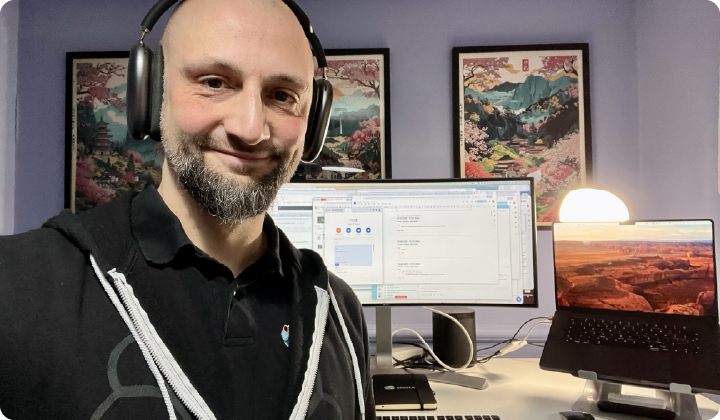
“I’ve been working remotely for going on 15 years,” says Sean Handley. He’s realized in that time that the most valuable commodity anyone can bring to work is their full attention. “Protect it, manage it, and use it wisely,” he says. “I make it my mission to disable unnecessary notifications or other sources of distraction so I can get into a steady flow state when I'm working on a task. Admittedly, as a manager, there are a lot of interruptions in my work week, but I make it a habit to carve out regular focus time on my calendar.”
To stay focused and attentive, Sean has curated an environment that keeps him energized.
Ideally, Sean would spend more time in nature, revisiting hobbies like climbing, which never fail to energize and invigorate his brain. But with kids and a home outside of the city, he doesn’t get out as much as he’d like. “The only downside of a career in tech is how much time you spend indoors,” he says. So instead, he finds ways to bring the outside in — from a grip spring to an LED lamp on his desk.
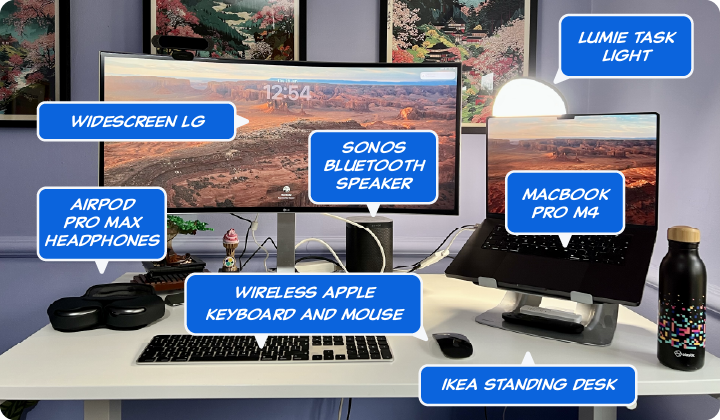
Living in Manchester, England, his Lumie Task lamp is essential, especially in the winter. “When I’m working in the evening, and the sun has been gone for a couple of hours, it keeps you feeling awake and stops you from sort of feeling sleepy in the second half of your day,” he says. “It’s good for your circadian rhythms to have the light on you, and the light in your eyes definitely psychologically makes you feel better.”
Another energizing hack: his standing desk. Shifting from sitting to standing at his trusty IKEA model keeps him alert instead of sluggish, Sean says. “It's like one of these with a hand crank. I know some people have these amazing automated ones, but this one has worked well for me for more than 10 years.”
When it comes to his desk setup, Sean’s Widescreen LG monitor sits at the center of his desk and pairs with his MacBook Pro M4. When he’s not standing, his Secret Lab chair keeps him supported through long workflows.
For his accessories, Sean says, “I'm kind of all in on Apple, except for my monitor. So I have AirPods Pro. I prefer the AirPods Pro in the summer because they're light. The AirPods Pro Max are a little bit warm in the summertime, but I really like how immersive they are, and they've got really good quality noise canceling.”
He also has a bookshelf full of engineering books. He recommends The Software Engineer’s Guidebook by engineering manager and software engineer Gergely Orosz (also known as The Pragmatic Engineer). It’s a guide that goes beyond the basics into how engineers work in teams, which can be helpful for anyone at any stage in their career, says Sean.
His office isn’t all wires and computers. He keeps it decorated with his completed LEGO projects, which he’s been building since he was a kid. His favorite? An ornithopter from the Dune franchise that sits right on the windowsill as if it’s about to fly away — though Manchester is quite different from Arrakis.
You’re ready to build. What are you building?
Before landing at Elastic, Sean worked in multiple industries — always across products that leveraged the latest technology and pushed innovations to their limits. He has recently brought his curiosity and problem-solving skills to Elastic.
Being on the Search team for the past year, Sean is proud to be working with such innovative products. “Elastic's a really interesting product,” he says. “We’re lucky enough to have quite a large user base and be around at a time when relevance technology really matters for what's emerging with GenAI.”
He’s most proud of his work launching the Elastic Inference Service. “This is the system that allows us to provide access to machine learning models like LLMs, embeddings, and rerankers seamlessly within the Elastic product. This helps to power semantic search, chat assistants, and agentic workflows in Agent Builder.”
With the buzz around agentic AI and agentic workflows not dying down anytime soon, Sean is eager to see where the tech will take him and his team next.
Working with GenAI has been a whirlwind over the past couple of years. Sean is looking past the hype into the future, and he’s betting that AI agents are here to stay.
“I see software engineers already using agents to automatically work on tasks. I think over time this will become more sophisticated and standardized, so engineers will have a typical setup of agents with specific roles to play in the software engineering experience. This means more time understanding the nature of the problem being solved, specifying how best to solve it, and ensuring the solution is meeting the needs of the business.”
This focus on understanding the tech deeply has always been at the heart of Sean’s love for technology. Like watching a magic trick, Sean is waiting eagerly to see what the industry does next.
If you’re excited about what’s unfolding in tech and want to help shape what comes next, explore opportunities on our careers site.
The release and timing of any features or functionality described in this post remain at Elastic's sole discretion. Any features or functionality not currently available may not be delivered on time or at all.
In this blog post, we may have used or referred to third party generative AI tools, which are owned and operated by their respective owners. Elastic does not have any control over the third party tools and we have no responsibility or liability for their content, operation or use, nor for any loss or damage that may arise from your use of such tools. Please exercise caution when using AI tools with personal, sensitive or confidential information. Any data you submit may be used for AI training or other purposes. There is no guarantee that information you provide will be kept secure or confidential. You should familiarize yourself with the privacy practices and terms of use of any generative AI tools prior to use.
Elastic, Elasticsearch, and associated marks are trademarks, logos or registered trademarks of elasticsearch B.V. in the United States and other countries. All other company and product names are trademarks, logos or registered trademarks of their respective owners.
Share
- Share on Twitter
Share on Twitter
- Share on LinkedIn
Share on LinkedIn
- Share on Facebook
Share on Facebook
- Share by Email
Share by Email
- Print this page
Print