Elastic Security integration with Google Distributed Cloud: Closing the velocity gap in air-gapped environments
_(1)_(1).png)

 Share on Twitter
Share on Twitter

 Share on LinkedIn
Share on LinkedIn

 Share on Facebook
Share on Facebook

 Share by Email
Share by Email

 Print this page
Print
The rules of cyber defense have shifted. Threat actors are increasingly using advanced automation to accelerate reconnaissance, evade static signatures, and orchestrate rapid intrusions across critical infrastructure, software supply chains, and insider pathways.
This has created a critical velocity gap: when adversaries compress attack timelines from days to minutes and defenders rely on manual triage across fragmented legacy tools, the defense falls behind. To secure our most critical infrastructure, defense missions, and sovereign data, public sector organizations need unified, automated security operations purpose-built for the environments they protect.
Advancing sovereign mission assurance and compliance in air-gapped environments
For sovereign and highly regulated customers, operating in completely disconnected, air-gapped environments is a foundational mandate for mission assurance, strict data residency, and regulatory compliance.
While an air-gapped architecture enforces strict isolation against external network exposure, maintaining sovereign mission assurance also requires on-premises security analytics, live telemetry correlation, and continuous threat intelligence to detect sophisticated supply chain compromises, advanced attackers, or insider threats. Historically, security teams in disconnected environments have had to maintain numerous standalone tools for log management, endpoint detection, host forensics, and incident tracking—creating visibility blind spots and heavy operational toil. Google Distributed Cloud air-gapped addresses this by providing local compute parity on-premises, enabling organizations to maintain advanced telemetry correlation, strict data residency, and continuous compliance without external network exposure.
Redefining security with Elastic and Google Distributed Cloud air-gapped
Elastic Security is deeply integrated into Google Distributed Cloud (GDC) air-gapped infrastructure to deliver this sovereign mission assurance. With the launch of our next-generation Security Information and Event Management (SIEMv2) and Endpoint Detection and Response (EDRv2) architecture on Google Distributed Cloud's Operator Infrastructure Release (OIRv2), Google Cloud and Elastic have embedded unified security operations directly into the platform—transitioning security from periodic, human-driven assessments to continuous, workload defense delivered entirely within the air-gapped environment.
By unifying fragmented legacy tools into a single architecture, we reduce the operational burden of managing disparate systems, lower host resource overhead across infrastructure nodes, and uphold a unified Zero Trust Strategy for Google Distributed Cloud. We solve this natively ensuring sovereign customers don’t have to stitch together custom log forwarders or brittle connectors.
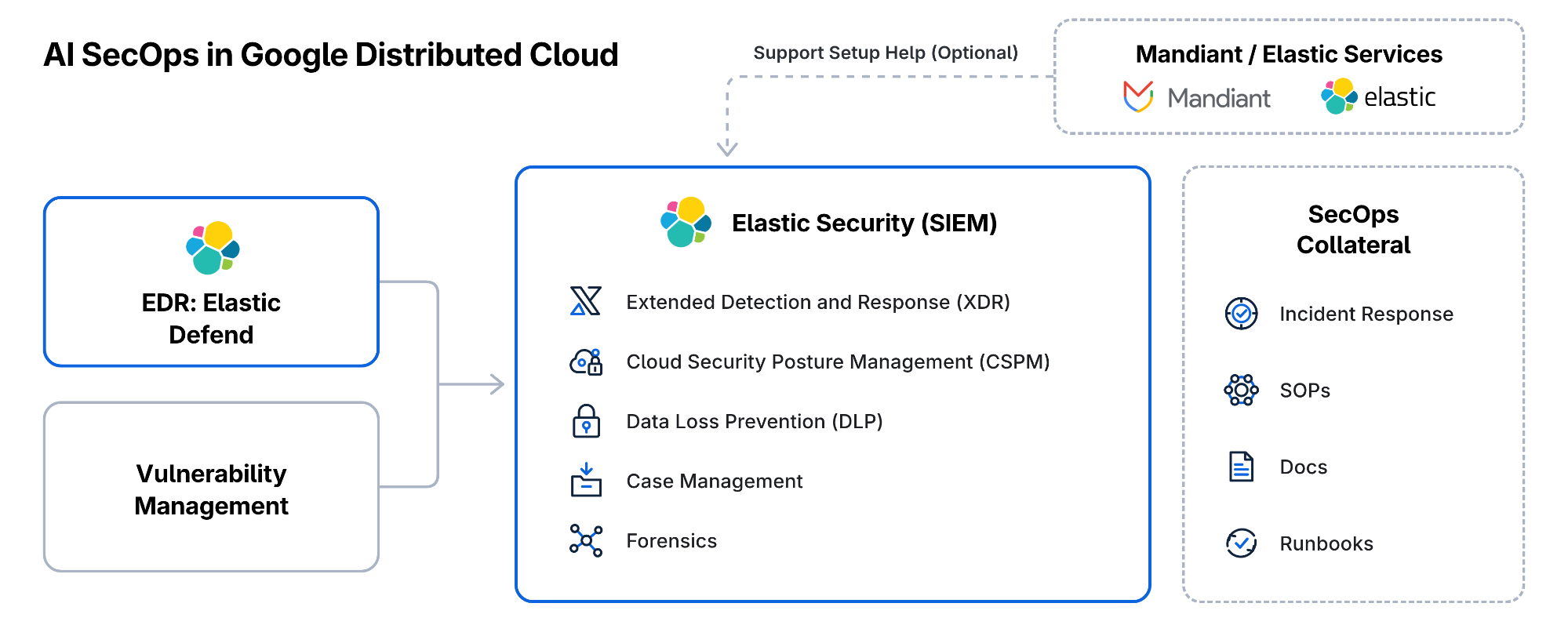
The collaboration integrates proven security capabilities powered by Elastic Security and Google Cloud, providing unified protection, detection, investigation, and response across Google Distributed Cloud air-gapped environments, inclusive of:
Security Information and Event Management (SIEM) – Ingests, normalizes, and correlates high-volume infrastructure, network, and audit telemetry into a common schema to effectively detect threats across systems and data in an air-gapped environment. Defenders can leverage pre-built detection rules mapped to MITRE ATT&CK, behavioral analytics, and rapid investigative views from a single console.
Endpoint Detection and Response (EDR) – Provides active, kernel-level visibility and behavioral protection through a single unified agent to detect and stop advanced memory exploits, polymorphic malware, and lateral movement before execution. This is a key differentiator in reducing high resource overhead with numerous legacy agents in disconnected environments.
Threat Intelligence – Equips completely disconnected environments with curated frontline insights, indicators of compromise, and adversary tactics, techniques, and procedures (TTPs) developed by Mandiant experts to proactively hunt across the threat domain.
SecOps Foundation – Delivers the operational foundation to build and scale security operations programs, including built-in case management, incident response plans, documentation, runbooks, and standard operating procedures paired with Mandiant service offerings to accelerate deployment.
The path forward
Disconnected networks relying on manual, human-paced triage across legacy tools cannot keep pace with modern cyber threats. By launching integrated SIEMv2 and EDRv2 capabilities on Google Distributed Cloud air-gapped, Google Cloud and Elastic are empowering sovereign nations, defense agencies, and regulated organizations to shift from fragmented, reactive monitoring to unified, automated defense today.
See a demo of this collaboration in action at the Google Public Sector Summit in Washington, D.C., on October 20, 2026. Google and Elastic will be on-site to show how Elastic Security supports Google Distributed Cloud air-gapped environments—bringing unified prevention, kernel-level detection, behavioral analytics, and native workflow automation to sovereign customers.
Take the next step to modernize your sovereign cloud defense:
- Google Public Sector Summit on October 20: Register today.
- Contact Sales: Reach out to register your interest in security operations in Google Distributed Cloud.
- Learn More: Read Google’s comprehensive Google Distributed Cloud - Zero Trust Whitepaper.
- Discover: Learn about Elastic’s deep integration with Google Distributed Cloud air-gapped, where Elastic is a critical partner providing an embedded security layer for customers.
The release and timing of any features or functionality described in this post remain at Elastic's sole discretion. Any features or functionality not currently available may not be delivered on time or at all.
In this blog post, we may have used or referred to third party generative AI tools, which are owned and operated by their respective owners. Elastic does not have any control over the third party tools and we have no responsibility or liability for their content, operation or use, nor for any loss or damage that may arise from your use of such tools. Please exercise caution when using AI tools with personal, sensitive or confidential information. Any data you submit may be used for AI training or other purposes. There is no guarantee that information you provide will be kept secure or confidential. You should familiarize yourself with the privacy practices and terms of use of any generative AI tools prior to use.
Elastic, Elasticsearch, and associated marks are trademarks, logos or registered trademarks of elasticsearch B.V. in the United States and other countries. All other company and product names are trademarks, logos or registered trademarks of their respective owners.
Share
- Share on Twitter
Share on Twitter
- Share on LinkedIn
Share on LinkedIn
- Share on Facebook
Share on Facebook
- Share by Email
Share by Email
- Print this page
Print