Key trends, attacker behaviors, and defensive innovations security teams need to know

 Share on Twitter
Share on Twitter

 Share on LinkedIn
Share on LinkedIn

 Share on Facebook
Share on Facebook

 Share by Email
Share by Email

 Print this page
Print
Nearly two-thirds of businesses say they’ve already been hit by a deepfake attack.1 This figure signals a shift security teams can no longer treat as emerging. Adversaries are compressing the reconnaissance-to-execution timeline from weeks to minutes, and social engineering, long the softest edge of enterprise defense, is where the compression is most visible.
The core tactics haven't necessarily changed: Phishing, business email compromise, and impersonation still dominate the initial-access playbook. Rather, the economics are changing in favor of adversaries. AI has stripped out the cost, time, and skill barriers that once forced attackers to choose between reach and precision. Today, a single operator with a handful of prompts can produce spear phishing campaigns at the scale of commodity phishing, with an unsettling level of personalization.
For security teams, the assumptions that shaped detection engineering, analyst training, and user-awareness programs over the past decade are now out of date. In this post, we explore how AI is reshaping social engineering, why traditional defenses are lagging, and how security teams can rebuild their approach around real-time context, behavioral analytics, and agentic response.
Why the social engineering threat model has shifted
Social engineering is a manipulation-over-intrusion approach. Rather than breaking a system, the attacker convinces a person to click a link, approve an access request, hand over a credential, or wire a payment. The fundamentals haven't changed with AI, but the velocity has.
Adversarial reconnaissance on a single target used to take a skilled researcher roughly 40 hours. AI tools now perform a comparable job in minutes, aggregating public data, correlating it across sources, and generating a target profile ready for exploitation. Criminal operations that previously required dedicated teams have compressed the entire workflow into a single-operator model.
This has two second-order effects that matter for security teams. First, attackers are pivoting to supply chain targeting: rather than hitting well-defended enterprises directly, they map the smaller, less-guarded partners with the same access. Second, the volume of highly personalized attacks is rising fast enough to overwhelm signature-based filters and human triage capacity.

The attack types AI is accelerating
AI is making traditional fraud tactics cheaper, faster, and harder to detect.
Spear phishing at scale: Why sophistication and volume are no longer a tradeoff for attackers
Spear phishing is a targeted attack aimed at a specific person or role, built on real research about that target as opposed to a generic message blasted to thousands of inboxes. It's been an effective method, but properly researching one target took significant time. Attackers had to choose between reach and precision … but now, they can do both.
An AI-equipped attacker can pull together a company’s org chart, help desk staffing, public code repositories, and employees’ social footprints, and then generate a personalized message to hundreds of targets at once. Research from KnowBe4 shows that of the phishing attacks it analyzed in 2026, 86% were AI-driven.2 Netskope puts the average phishing click rate at 8.4 out of every 1,000 per month.3 Volume and quality are a major challenge for SOC teams.
Identity, not malware, is where most of these attacks actually land. AI makes identity-based attacks and spear phishing far more convincing because attackers can build detailed profiles of their targets in minutes. A bogus help desk impersonation attempt built from real internal knowledge is difficult to flag, even for trained experts.
AI can do what now?! The real risks of AI in social engineering
Scale, personalization, speed, and automation are lowering the barrier for attackers while making fraud detection more complex for defenders. Lisa Jones-Huff, director of security solutions architecture at Elastic, is joined by ethical hacker Freakyclown (FC) and principal solutions architect Joe Murin to explore AI in social engineering.
Smishing in social engineering: The unsuspecting format
Smishing (a merging of terms “SMS” and “phishing”) is a type of social engineering attack carried out via text message. Rather than a suspicious email, the target receives a text (e.g., an MFA code request, a message from someone posing as IT, or a delivery notice) with a link or callback number designed to steal credentials.
Text lacks the authentication infrastructure of email systems, meaning there are fewer built-in signals telling recipients that something is a potential scam. Verizon’s 2026 Data Breach Investigations Report shows that people are up to 40% more likely to fall for social engineering threats carried out by text or phone calls compared to email.4
Deepfakes in social engineering: How real-time AI impersonation is misunderstood
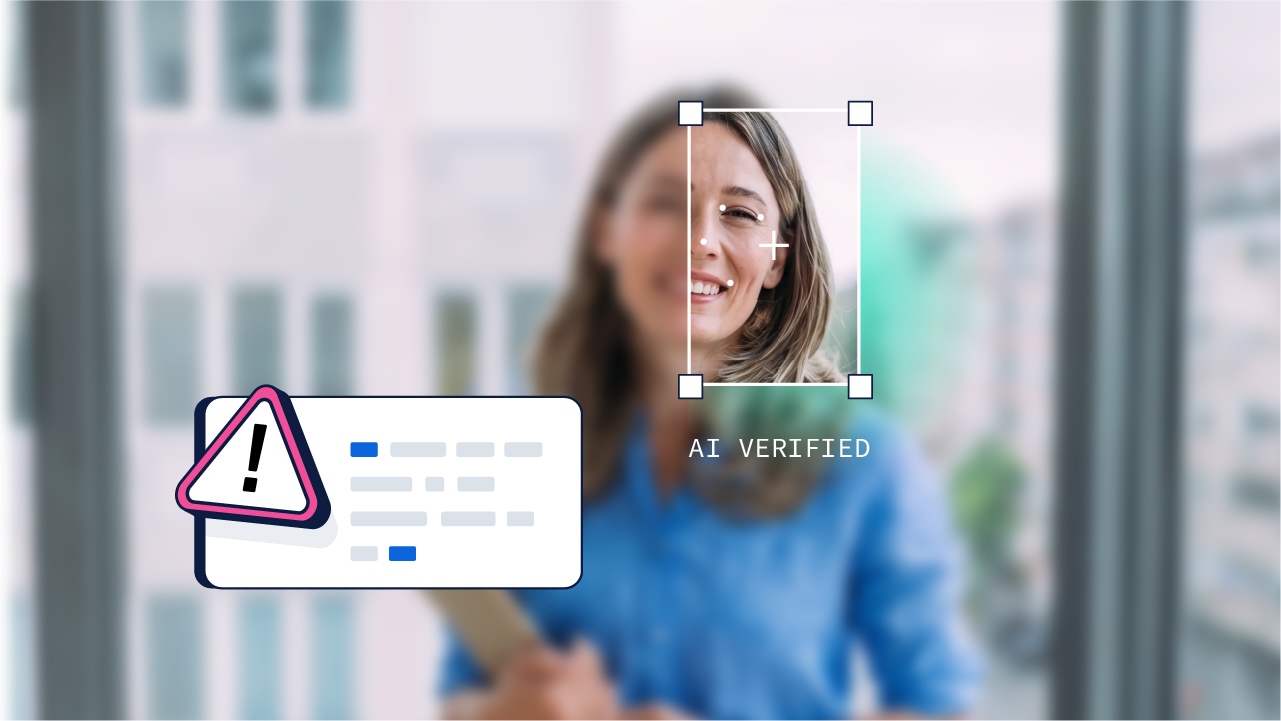
A deepfake is a manipulated piece of audio, video, or imagery generated with AI to mimic a real person’s appearance or voice convincingly. Creating deepfakes used to require advanced editing or animation skills; today, however, it’s as simple as feeding AI tools a few seconds of audio or video likeness from a call to generate a realistic fake.
Deepfakes tend to enter social engineering schemes at the final step. After an employee receives a payment request that seems off, they may follow up and seek some form of verification. Fraudsters can then deploy a personalized voice message or video to convince victims to hand over their information.
High-fidelity, AI-generated impersonation has advanced quickly in the past few years, making them a real threat. Deepfakes may be one of the most fear-inducing types of social engineering, but strong security fundamentals backed by AI can still detect and protect against deepfake technology.
Why traditional detection can't keep up
Legacy detection assumed adversary output was constrained by human effort. Signature-based email filters, static awareness training, and rule-based fraud engines all rely on adversary patterns changing slowly enough for defenders to catch up.
AI has broken that assumption. When attackers can regenerate lures, domains, and payloads at machine speed, defenders need detection that reasons over behavior rather than matching artifacts.
AI can do what now?! What an ethical hacker says about deepfakes and AI
Lisa Jones-Huff, director of security solutions architecture at Elastic, sits down with ethical hacker Freakyclown to explore deepfakes in social engineering and what security teams should be worried about.
How to defend against AI-fueled social engineering
Several security solution capabilities are directly relevant, and indeed essential, to defending against the AI-powered social engineering threat model:
Behavioral analytics grounded in unified telemetry: Correlating identity events, endpoint activity, email signals, and cloud sign-ins in a single data model allows the platform to flag a legitimate-looking login followed by an unusual OAuth consent grant, a pattern recognized as a leading indicator of Entra ID compromise.
AI-driven detection tuned to adversary tradecraft: Machine learning models need to be retrained monthly against millions of samples, delivering high-percentage true-positive rates against novel malware families, including novel AI-generated loaders. This shifts detection away from static signatures toward the behavioral patterns AI-equipped adversaries can't easily regenerate around.
Alert distillation and agentic investigation: Rather than surfacing hundreds of loosely related alerts from a phishing wave, features like Elastic’s Attack Discovery use generative AI to correlate signals into prioritized attack narratives with MITRE ATT&CK® mapping. Analysts are upleveled beyond the drudgery of alert triage to instead read the AI-summarized case, verify the reasoning, and approve the response.
Transparent, model-agnostic AI: Security teams should be able to see the prompts and queries behind every AI decision, choosing the LLM they trust, and deploy in the region or environment their compliance obligations require. This matters when AI is being used to make judgment calls on identity-based attacks that carry direct regulatory consequences.
Threat intelligence: Original research on social engineering campaigns like Elastic Security Labs’ disclosure of EDDIESTEALER and ARECHCLIENT2 threats should feed directly into detection rules and analyst workflows. Teams are shipped advanced protections against the very techniques threat researchers are documenting, not just situational awareness.
With these capabilities built into a security solution, teams stop reacting to individual phishing incidents and start disrupting the campaigns behind them.

What security teams should prioritize now
Defending against AI-fueled social engineering isn't a tooling problem to solve with a single product but rather an operating-model shift. Security leaders evaluating their current posture should consider the following priorities:
Consolidate identity telemetry. Entra ID, Okta, and cloud IAM logs should be first-class citizens in your detection platform, not secondary sources analysts have to correlate manually.
Baseline user and service-principal behavior. OAuth consent grants, unusual client IDs, and rare geographic sign-ins are among the most reliable indicators of post-phishing compromise in current threat data.
Instrument the browser and endpoint together. Browser credential theft is the connective tissue between social engineering and downstream cloud compromise. Endpoint memory protection and browser telemetry belong in the same detection surface.
Move response from playbook to platform. Automation that lives outside your data creates delay. Native, AI-assisted response, with a human on the loop, matches the speed at which AI-driven attacks now execute.
Verify AI decisions. Any AI capability making security judgments on your behalf should expose its reasoning. If your team can't audit it, they can't defend it.
The bottom line for security operations
The economics of social engineering have changed. Reconnaissance, personalization, and impersonation are now cheap, fast, and available to any adversary. The defenses that worked when attackers were constrained by human effort will not hold against attackers augmented by AI.
Security teams don't need a longer list of tools. They need a platform that unifies the data, applies AI where it best augments analyst workflows, and reduces the time from detection to verified response. That's the shift Elastic Security is built for, and it's the shift the current threat data suggests can't wait.
See how Elastic Security enhances protection against the latest AI-fueled social engineering attacks.
1Infosecurity Magazine, “Deepfake Attacks Hit Two-Thirds of Businesses,” September 2025 (citing Gartner survey data).
2BusinessWire, “KnowBe4 Research Finds 86% of Phishing Attacks are AI Driven,” April 2026.
3Netskope, “Cloud and Threat Report: 2025,” 2025.
4Verizon, “2026 Data Breach Investigations Report,” 2026.
Share
- Share on Twitter
Share on Twitter
- Share on LinkedIn
Share on LinkedIn
- Share on Facebook
Share on Facebook
- Share by Email
Share by Email
- Print this page
Print