Buyer’s guide for the AI SOC
Exploring why "AI-native" matters in your SOC

 Share on Twitter

 Share on LinkedIn

 Share on Facebook

 Share by Email

 Print this page
Print
As organizations introduce AI into their SOC, the question is not simply whether a single tool uses AI, but how intelligently the pieces work together to improve the overall security operation. A SOC embedded with AI functionality is essential to bring together the people, processes, data, and technologies required to continuously detect, investigate, and respond to threats in today’s AI era.
While an AI SOC depends on the broader security stack, a team’s SIEM solution is a critical component of that ecosystem, serving as a central foundation for collecting and analyzing security data and turning it into actionable signals. In fact, of all solutions used by security operations teams, their SIEM is the most likely place where they’ll use AI features.1
An AI-native SIEM platform is a security information and event management system where artificial intelligence is built into the core architecture, not layered on top as a chatbot or add-on. This guide explains what "AI-native" really means, how it improves threat detection and response, and the requirements that separate genuine AI-native SIEM platforms from marketing claims.
If you're evaluating how to best defend against AI-powered attacks, use this guide to pressure-test vendors on data foundations, detection quality, analyst productivity, and governance.
Why AI-native SIEM matters now
AI-fueled threats are bringing a new ferocity to today’s threat landscape. Adaptive malware can evade detection in real time; generative AI scales phishing, social engineering, and credential theft with unprecedented precision; adversaries can reach domain control in under a minute; and now, malware itself can weaponize prompt injection to deceive AI-powered security tools and disrupt or evade analysis.
Meanwhile, security teams face growing telemetry volumes across endpoints, identities, cloud workloads, applications, and networks … and the costs of making that data actionable leaves it out of reach for most customers. Static rules and signatures can't reliably separate subtle malicious behavior from legitimate activity.
Like their adversaries, analysts are also turning to AI to help expedite detection and response in an attempt to fight fire with fire. But there’s a problem: General, out-of-tool chatbots like Claude, ChatGPT, and Gemini are being used more prominently (75% using) than native AI features built directly into their security tools (66% using)1. Why are security analysts turning to “sidecar AI” over the native AI features built into their security tools? Top reasons include:
Sidecar AI’s ability to handle a broader range of tasks (58%)
Cost-managing token use or licensing spend of native solutions (48%)
Ease of use (40%)
This isn’t just a productivity problem… it’s also a new risk vector. When analysts turn to sidecar AI to fill the gaps in their existing security tools, they may be moving sensitive security data, context, and workflows outside the environments designed to protect them. What begins as a way to work faster and more flexibly can introduce new challenges around data exposure, governance, consistency, and oversight.
What AI-native actually delivers
This is where an AI-native solution holds the key: By bringing the flexibility and breadth analysts want directly into the security workflow, organizations can give their teams the benefits of AI without forcing them to step outside the tools and controls built for security.
An AI-native SIEM helps security teams by:
Easing the data import and normalization process
Identifying emerging attack patterns across disconnected signals
Prioritizing the alerts/incidents that matter most
Accelerating investigation and response
Automating repetitive analyst work to reduce burnout
The critical evaluation question isn't whether a SIEM includes AI. It's how effectively the platform applies AI to detection, investigation, response, and analyst productivity, and whether those capabilities rest on high-quality data, transparent reasoning, and strong integrations.
What is an AI-native SIEM platform?
An AI-native SIEM platform is built with AI woven into each of the data ingestion, normalization, detection, correlation, investigation, and response workflows. The embedded AI reasons across all ingested data, not just isolated alerts.
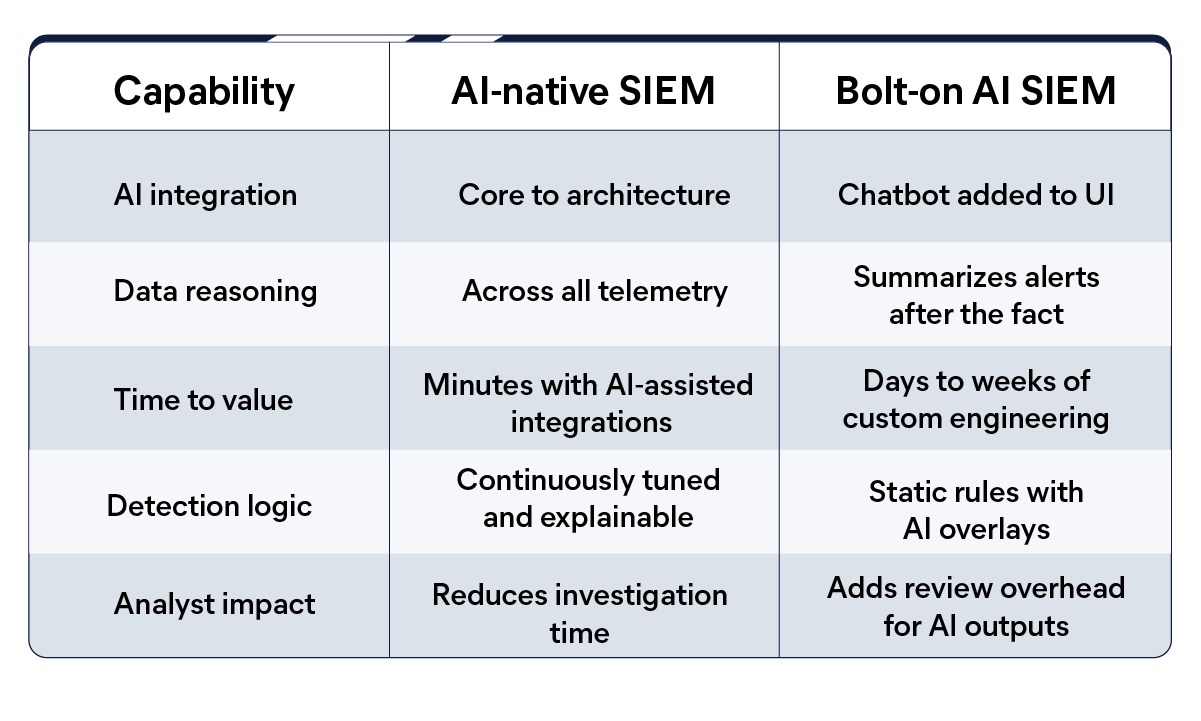
AI-native vs. bolt-on AI SIEM
How AI improves security threat detection and response
AI improves security threat detection and response in six measurable ways:
Detects novel threats: Behavioral analytics identify zero-days, living-off-the-land (LoTL) techniques, and AI-generated attack variants that signature-based rules miss.
Correlates weak signals: AI stitches scattered alerts across email, endpoints, cloud, and network into coherent attack chains, reducing dwell time.
Prioritizes alerts by risk: Risk-based scoring surfaces high-impact incidents first, cutting alert fatigue.
Automates first-pass investigation: AI enriches incidents, generates attack timelines, and recommends next steps before an analyst engages.
Enables natural language queries: Analysts hunt threats and pivot through data using plain-English questions instead of complex query syntax.
Recommends and executes response actions: With policy guardrails, AI can safely automate containment, isolation, or ticket creation.
The essential foundation for all of these is data quality. Broad, normalized visibility across the attack surface gives AI enough context to reason accurately.
Key requirements of SIEM for AI
Use these requirements to evaluate whether a SIEM is genuinely AI-ready:
1. Data foundations and AI readiness
Security telemetry needs to be transformed into contextual intelligence that AI can reason over. An AI-native SIEM should:
Ingest telemetry across cloud, SaaS, identity, endpoints, network, OT, and applications
Provide extensive out-of-the-box integrations with frequent connector updates
Normalize telemetry using an open, extensible schema, such as Elastic Common Schema (ECS) or Common Event Format (CEF)
Automatically enrich data with identity, asset, vulnerability, threat intelligence, and business context
Retain years of searchable, actionable data without expensive rehydration
Correlate events into a unified security graph
Let AI reason across all ingested data, not just individual alerts
2. AI-powered detection and threat discovery
Detection must extend beyond signatures and static rules. An AI-native SIEM should:
Ship robust out-of-the-box detections mapped to MITRE ATT&CK
Detect behavioral anomalies, insider threats, credential abuse, and LoTL techniques
Correlate weak signals into high-confidence incidents
Continuously tune detections to reduce false positives
Recommend new detection content from threat intelligence and observed attacker behavior
Keep detection logic transparent, explainable, and customizable
Support real-time and historical analytics at scale
3. AI-assisted investigation and response
The investigation experience should reduce analyst effort, not add more dashboards. An AI-native SIEM should:
Automatically enrich incidents with relevant context
Generate attack timelines and visualize attacker progression
Summarize investigations in natural language
Recommend root cause and next investigative steps
Enable natural language search alongside traditional query languages
Support interactive threat hunting across years of historical telemetry
Perform first-pass investigations before analysts engage
Preserve investigation knowledge to compound team expertise
4. Architecture and governance
AI capabilities need a secure, scalable foundation. An AI-native SIEM should:
Support cloud-native, hybrid, and multi-cloud deployments
Meet regional data residency and compliance requirements
Provide fine-grained role-based access control and multitenancy
Offer efficient long-term storage of actionable telemetry
Keep customer data isolated and protected when using AI
Give organizations control over AI usage, governance, and model access, since a vendor-mandated model you can’t inspect or replace is a new form of lock-in
Ensure AI recommendations are auditable and explainable
Keep a model you can run on your own infrastructure ready to take over if a cloud provider is unavailable or refuses a legitimate request mid-incident
5. Automation and autonomous operations
Automation should extend beyond static playbooks toward intelligent, adaptive workflows. An AI-native SIEM should:
Automate enrichment, triage, documentation, and reporting
Support analyst-triggered and autonomous response actions
Include native SOAR capabilities, not a bolt-on, alongside integration with ITSM, identity, endpoint, cloud, and collaboration platforms
Orchestrate multi-step investigations across tools
Enable AI agents to collaborate on investigation, prioritization, and recommendations
Adapt continuously based on analyst feedback and environmental context
6. Analyst experience and productivity
The platform should make analysts more effective while reducing burnout. An AI-native SIEM should:
Reduce repetitive manual work through AI-assisted automation
Enable junior analysts to investigate incidents with senior-level guidance
Minimize context switching with a unified experience
Capture institutional knowledge from every investigation
Keep analysts in control through explainable recommendations and approval workflows
How SIEM defends against AI attacks
AI-powered adversaries use adaptive malware, deepfakes, automated reconnaissance, and generative phishing that evolves in real time. Defending against them requires an AI-native SIEM that can detect and respond just as fast.
An effective AI-native SIEM defends against AI attacks by:
Unifying visibility across the attack surface: Blind spots and data silos are where AI-enabled attacks succeed. Centralizing cloud, identity, endpoint, network, and application telemetry with an open schema prevents this gap.
Correlating scattered signals into attack chains: AI stitches together low-signal indicators that traditional rules miss.
Running behavioral analytics on identity and endpoint activity: Catch credential abuse, lateral movement, and LoTL techniques that signatures overlook.
Automating alert triage: AI-driven triage analyzes large sets of alerts together, correlating them against suspicious activity across the environment rather than treating each as isolated.
Enabling agentic response: Autonomous or analyst-approved response actions contain threats before attackers reach domain control.
Explaining every decision: Transparent, auditable AI reasoning prevents the AI itself from becoming a threat vector.
Data retention and searchable archives
Many SIEMs force customers to choose between data volume and query speed. Legacy platforms drop data before analysis, restrict retention through per-device or per-byte licensing, or lock actionable data in cold archives that require slow, costly rehydration.
An AI-native SIEM should let SOC teams:
Uniformly analyze data stored across clouds and geographies without backhaul delays
Optimize retention, performance, and cost independently
Search years of archives in seconds or minutes
The frozen tier in Elasticsearch, for example, enables seamless searches across all data tiers in seconds or minutes while reducing storage costs.
Compliance considerations
Compliance obligations vary by industry and geography. Common frameworks include:
HIPAA: Log retention and audit requirements for protected health information
PCI DSS: Log management requirements for payment card data
SOX: Log retention requirements for public company financial controls
GDPR, FedRAMP, NIST: Regional and sector-specific frameworks
Prioritize a SIEM that ships with data integrations for compliance-relevant technologies, supports real-time compliance monitoring, and can alert or respond autonomously to violations. If point-of-sale terminals, development servers, or other critical systems fall under compliance scope, evaluate file integrity monitoring (FIM), malware detection, and endpoint security capabilities.
Success metrics for an AI-native SIEM
Evaluate vendors on measurable outcomes, not feature lists. Ask a prospective vendor how customers have improved their outcomes across the following categories:
Mean time to detect (MTTD)
Mean time to investigate (MTTI)
Mean time to respond (MTTR)
False-positive reduction
Analyst productivity
Tier 1 analyst workload reduction
Time spent writing and tuning detections
Threat hunting efficiency
Analyst retention and satisfaction
Total cost of ownership
Build the SOC of tomorrow
Attackers are using AI to compress attack timelines from days to minutes. Traditional SOCs, stitched together tool by tool, weren't built for this tempo. Every disconnected console and rehydration fee is a gap adversaries can and are exploiting.
The path forward isn't merely an AI-equipped SIEM solution. It's an open, unified, agentic platform where AI investigates, correlates, and stages a response while analysts stay on top of the loop to judge and approve.
If your current architecture can’t keep pace with an attacker that runs on software, it’s time to rearchitect with an AI-native SIEM at the core of your security operations.
Explore Elastic Security to see how your team can keep up in the AI era.
Frequently asked questions
How does AI improve security threat detection and response?
AI improves security threat detection and response by identifying novel and behavioral threats that signature-based rules miss; correlating weak signals across email, endpoints, cloud, and network into coherent attack chains; prioritizing alerts by risk; automating first-pass investigation; enabling natural language queries; and safely automating response actions under policy guardrails. The result is faster mean time to detect, investigate, and respond, with less analyst burnout.
What are the key requirements of a SIEM for AI?
The six key requirements of an AI-native SIEM are: (1) unified data foundations with an open schema and years of searchable retention, (2) AI-powered detection with explainable logic and MITRE ATT&CK coverage, (3) AI-assisted investigation with natural language search and automated timelines, (4) secure, scalable architecture with data isolation and governance controls, (5) automation that spans triage through autonomous response, and (6) an analyst experience that reduces burnout and captures institutional knowledge.
How can a SIEM defend against AI attacks?
A SIEM defends against AI attacks by unifying visibility across the attack surface, running behavioral analytics on identity and endpoint activity, correlating scattered signals into attack chains, automating alert triage, enabling agentic response actions that match attacker speed, and keeping every AI decision explainable and auditable. This combination detects adaptive malware, deepfakes, and generative phishing that static defenses miss.
What's the difference between AI-native SIEM and bolt-on AI?
An AI-native SIEM is built from the ground up with AI in the core architecture, so it can reason across all ingested data and continuously tune detections. A bolt-on AI SIEM adds a chatbot or generative summary layer on top of a legacy platform. Bolt-on AI typically increases analyst review overhead because outputs need constant verification.
What is a security data lake, and how does it fit with SIEM?
A security data lake is a centralized store for years of raw security telemetry at lower cost than traditional SIEM storage. It fits with SIEM when the platform can natively search the lake without bulk rehydration, so analysts can investigate historical incidents in seconds instead of hours.
1Elastic, “AI Adoption in the SOC,” 2026.
Share
- Share on Twitter
Share on Twitter
- Share on LinkedIn
Share on LinkedIn
- Share on Facebook
Share on Facebook
- Share by Email
Share by Email
- Print this page
Print