Airgentic built a guided, agentic AI experience on Elasticsearch's hybrid retrieval, turning website questions into donations and enrollments, as well as resolved cases for a children's charity, a land registry, and a major college.
Summary
Airgentic builds conversational, agentic AI that turns a website visitor's question into a completed task, like a donation made, a course enrolled in, or a council request resolved. But an AI answer is only ever as good as the material retrieved before it's written, so its founders — veteran search engineers — built the platform on Elasticsearch from day one. Using Elastic's Linear retriever to blend keyword and semantic search into a single, tunable ranking, Airgentic gives organizations like Starlight Children's Foundation, Land Services South Australia, and Intrim answers that are both accurate and grounded — and most importantly, built to move people to act for good. Here's how this Aussie startup turns search queries into change for good.
Airgentic's edge is what happens before the answer
A supporter lands on the Starlight Children's Foundation website during the Super Swim campaign and types the type of thing people actually type: "Help my friend raise money."
No campaign name.
No fundraiser's surname.
No mention of a participant fundraising page.
Just intent, in plain, slightly emotional language. A traditional keyword search engine would struggle — the word "sponsor," as well as the team name, isn't there, and the page the person needs is titled with no similarity to what they asked. A pure semantic engine might grasp the sentiment and then confidently surface a three-year-old blog post because it feels related. Either way, the supporter hits a dead end at exactly the moment their intent is highest.
Closing that gap between how a person asks and where the answer actually lives is the problem Brett Matson spent most of his career on. It's also the problem that convinced him to build his current company on Elasticsearch before he'd built anything else at all.
"Airgentic was built on Elastic from day one, because I'd already made the mistake of not using it."
The mistake worth making once
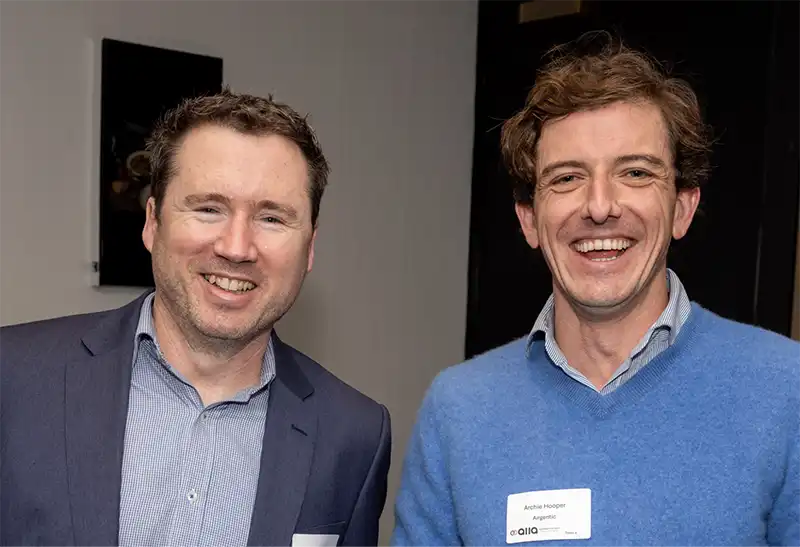
Brett Matson cofounded Airgentic with Archie Hooper after a decade building search engines together. The two met at Funnelback, a search product Matson helped create at the Commonwealth Scientific and Industrial Research Organisation (CSIRO) around a CSIRO-developed ranking algorithm. Later, they spun out and sold to universities, governments, and companies like Southwest Airlines and Westpac before Funnelback was acquired. When large language models (LLMs) arrived, the pair saw the obvious next move: Combine a search engine with an LLM to answer questions grounded in an organization's own content — retrieval augmented generation, or RAG.
Matson's instinct was that most companies rushing into RAG were getting the hard part wrong. The hard part wasn't the language model, but actually the retrieval, because an AI answer is only ever as good as the material fed to it (even before a single word is generated).
Plus, in a prior POC, he’d learned the expensive way. In 2023, Matson built a basic version on Pinecone, a less mature vector database. Vector search understands meaning — for example, ask for jobs and it’ll find you the career page. It’s useful, but on its own, not enough.
"Vector search alone is hopeless. It might surface a 10-year-old PDF buried in a newsletter just because it mentions something semantically similar, but it has no understanding that the careers page is the authoritative source, not the old newsletter."
Funnelback had the opposite shape: strong keyword ranking with all structural signals, like URL depth, title weighting, and document recency, but no semantic understanding. What Airgentic needed was both simultaneously: lexical and semantic retrieval, merged into one ranking, with control over how much each contributes depending on the query.
That is a hybrid search problem, and it's the reason Elasticsearch was never a later decision to be weighed against Pinecone or Funnelback.
The linear retriever: A playground of well-built LEGO bricks
For a long time, Airgentic combined its keyword and vector results using Elasticsearch's reciprocal rank fusion (RRF). Then, at the start of 2026, after the release of Elasticsearch 9, Matson moved the platform to using the linear retriever.
The idea sounds almost too simple to matter: Express the final ranking as a weighted combination of retrievers, and decide how much influence each one gets.
Airgentic runs two child retrievers under the linear retriever, all hosted on Microsoft Azure: a CM25 lexical child that searches body text and boosted titles, and a kNN semantic child that matches meaning. Each child's score is essentially relevance multiplied by static website signals like URL depth and content boost. The linear retriever then normalizes each child's scores, applies the weights, and blends them into one ranked list. Crucially, those static signals are folded inside each child, rather than applied at the end, which stops a page from muscling into the candidate pool on structure alone.
A home page shouldn't win a donation query just because it has the shortest URL on the site. Airgentic's default informational preset leans slightly lexical — a keyword weight of 0.55 against a vector weight of 0.45 — because in help-and-how-to content, exact terms usually matter, while semantic matching quietly catches the paraphrases.
For Matson and Hooper, tunability is the difference between solving a customer's problem, and not. One of Airgentic's customers, Intrim, sells building products with model numbers like "CM25." Typed into a vector-only search, "CM25" returns nonsense; the embedding model doesn't know what CM25 is, so it shatters the string into characters and matches on those.
With the linear retriever, however, Airgentic detects that a query looks like a product model number and shifts the weighting hard toward keyword search for that query.
"What the linear retriever gives you is a playground of well-built LEGO bricks — all the hard work is done, and you just have to put them together in the right way. It's been genuinely transformative for our product."
That control also lets Airgentic handle the ambiguity real users bring. When Land Services South Australia went live, the team returned after week one with a fundamental observation: Many citizen questions are inherently ambiguous. "What is the cost of a land title?" has no single answer, because it depends on factors like paper versus digital or whether the title follows a subdivision. Part of Airgentic's job is to know which clarifying question to ask, and then, once the specifics are pinned down, construct a precise query rather than a broad one.
As Matson puts it, it's both a ranking problem and a query-construction problem working together.
"Airgentic's chatbot has improved the user experience and outcomes for many of our visitors, particularly members of the general public who infrequently interact with our services, but when they do, it tends to be for matters of personal importance. In doing so, it has noticeably reduced call centre demand. The expert agent model is especially valuable in title ownership matters, where the right answer often depends on a customer's exact context and requirements."
Top 25, then the model chooses
The generative layer sits on top of that retrieval, and Airgentic is deliberate about how the two meet. Rather than taking the top 10 results and stuffing them into a prompt, the platform pulls the top 25 to get a broader spread. Then, it uses a language model to pick out which of those — say, results 3, 8, 9, and 19 — are genuinely most relevant to this specific question.
It extracts content from those pages and passes it to a second LLM call, which writes the response. So, better-ranked source material means a more accurate, more grounded answer going out.
This is where the story stops being about search and starts being about what search enables. Airgentic didn't stay a question-answering tool for long.
"What used to be a single transactional question-and-answer exchange is now a long-running conversation with a business goal at its conclusion."
The platform evolved into a set of specialist agents, each expert in one task.
At Starlight Children's Foundation, that plays out across several: A Frontline Agent handles broad questions and keeps people moving instead of stranding them in menus; a Donation Concierge helps a supporter find the right swimmer, team, school, or workplace page and reach the correct donation link in as few steps as possible; and finally, a Fundraising Coach equips participants to raise more, generating ready-to-send SMS, email, and social posts, and producing polite follow-up and sign-up. Then, team agents turn interest into registration and individuals into workplace or school teams.
The agent guiding a prospective student through a nursing inquiry does the same: Establish where they are and what they want, then — under an explicit instruction that it may not tell the user anything it hasn't retrieved from the website — search, answer, and lead the person toward enrolling or asking for a callback.
The through-line, across a charity supporter and international student alike, is that the AI never invents. It retrieves first from approved website content and PDFs and answers from what it finds — which is why the quality of the retrieval layer is the quality of the product.
One index, one ranking layer, one experience, no duplication
Most organizations Airgentic meets run a search engine and a separate chatbot on the same website — both crawl and index the same content, both try to answer questions, and neither are usually aware of the other (meaning the team is typically left footing the bill of two products).
Matson's reaction was blunt: why isn't this just one thing?
Now, Airgentic increasingly deploys a single combined interface, composed of a search bar, filters, scopes, and images, and all powered by a finely tuned hybrid Elasticsearch ranking. It's one that quietly shifts into question-answering mode the moment a user asks a question instead of entering keywords. Airgentic's own internal proposals call it a "Unified Answer Layer": search plus LLM delivered as one governed service, with a full-page overlay, specialist on-site agents, website and PDF ingestion, source links on answers, and analytics — rather than a search box and a chatbot bolted onto the same page.
In essence, it captures the people who'd never click a chatbot but are happy to search, and the people who'd never search but will happily ask. One index, one ranking layer, one experience, instead of two systems duplicating each other's work and cost.
On top of that foundation, Airgentic has added a real-time voice alongside full conversational context, so a caller can interrupt — as they naturally would during a phone conversation with a real person — and be understood. A conversational-intelligence layer uses semantic clustering to group thousands of conversations by topic, route them to business units, and track sentiment. One customer, BCIT in Canada, runs around 4,000 conversations a month.
Nobody can read 4,000 transcripts, so clustering turns them into organizational signals, which Matson calls “an absolute goldmine of business intelligence”.
What the numbers say
At Land Services South Australia, Airgentic’s second customer, contact centre load fell by an estimated 15%–20% within months of going live. The more telling detail is human: there was initially some scepticism about whether AI was really the answer.
Now, that concern is unfounded. The team now logs in regularly to refine agent behaviour, feed its tacit knowledge into the prompts, and watch unanswered questions trend towards zero.
At BCIT, the analytics specialist responsible for measuring the incremental return of adding Airgentic to his existing Funnelback deployment has put it at around 5,000% per month. Intrim in Wollongong, which replaced Algolia with Airgentic, reported that approximately 94% of 3,400 conversations were fully answered over a two month period.
Technical highlights
- Linear retriever: With KNN (using 1,536 dimensional vectors) and BM25 retrievers, but since upgrading to Elastic 9.4 Airgentic are also now using.
- Search-as-you-type autocomplete: For example, title fields have a search_as_you_type subfield, enabling responsive autocomplete and partial-prefix matchings.
- Dynamic typed facets: Fields are automatically mapped as keywords, numbers, dates, date ranges, or booleans according to their prefixes, allowing Airgentic to create customer-specific filters without defining every field in advance.
- Native date-range fields: Airgentic is using Elasticsearch’s date_range type, which can represent things such as events, enrolment periods, or availability windows with both a start and end date. For example: "What contemporary art exhibitions are on in the first three weekends of August?"
- Multi-fields: The same value can be indexed in different ways, such as a URL or facet being available both as an exact keyword and as analysed text for searching.
- Hierarchical URL and path search: The path_hierarchy tokenizer lets Airgentic search and filter progressively through URL structures, useful for site sections, content hierarchies, and scopes.
- Custom linguistic analysis: Text is lowercased and passed through minimal English stemming, helping singular and plural forms such as “career” and “careers” match without aggressive stemming.
- Product-model-aware tokenisation: A custom analyser splits letters, numbers, hyphens, and underscores in product codes, improving searches for model numbers and compatible products.
- Field-level relevance controls: The explicit boost, url_length and url_depth fields give Airgentic inputs it can use to favour promoted or authoritative pages and demote deeply nested or less desirable URLs.
What's next?
The direction Matson is most animated about folds the conversational agent back into the search experience itself. Instead of returning a single paragraph and stopping, the agent reads the whole set of results, explains what's there, and hands the person clickable ways to narrow or broaden — doing the searching for them and guiding them to the right moment to act.
So many questions aren't knowledge questions at all; they're catalogue questions, where the useful answer isn't a sentence, but a path into the right options. Guiding people through that, Matson believes, is something almost nobody does well yet — "and it's where we're heading." Alongside it is voice: letting people simply speak to an agent, in any language, that knows an organization inside out, instead of navigating phone menus and holding queues.
Underneath the roadmap is a single conviction: A website visitor's question is a task waiting to be solved, not a query to be answered and forgotten. And when the retrieval underneath is strong enough, the technology can all but disappear — no menus, no dead ends, no forms that lead nowhere. Someone arrives wanting to donate, enroll, sign up, or lend a hand, and instead of getting lost, they're carried straight to the thing they came to do.
That's the change Airgentic is chasing: retrieval and AI working quietly in the background, in service of people who simply came to help.
See how Elasticsearch blends keyword and semantic search into one tunable ranking with the linear retriever, or start now with a free trial.