Building production-ready AI in India
Winners revealed at Elastic{ON} Mumbai for the Forge the Future Hackathon 2026

 Share on Twitter
Share on Twitter

 Share on LinkedIn
Share on LinkedIn

 Share on Facebook
Share on Facebook

 Share by Email
Share by Email

 Print this page
Print
Summary
- India's top developer teams engineered production-ready AI applications for the Forge the Future Hackathon 2026.
- Elasticsearch powered high-performance hybrid search, context engineering, and real-time log monitoring across the solutions.
- Winning builds solved real-world enterprise challenges across financial compliance, frontend observability, and healthcare claim processing.
- Final champions were crowned on stage at Elastic{ON} Mumbai following a live finale in Bengaluru.
What began weeks ago as a nationwide challenge across India culminated in an intense two-day finale at Elastic’s Bengaluru office. Out of 8,000 registrations and 300 initial idea submissions, 20 shortlisted teams gathered to turn design concepts into working, production-grade applications. Following the in-person implementation in Bengaluru, our top three finalist teams were invited to Mumbai to be recognized on stage and demonstrate their applications in the Elastic{ON} Creator Zone.
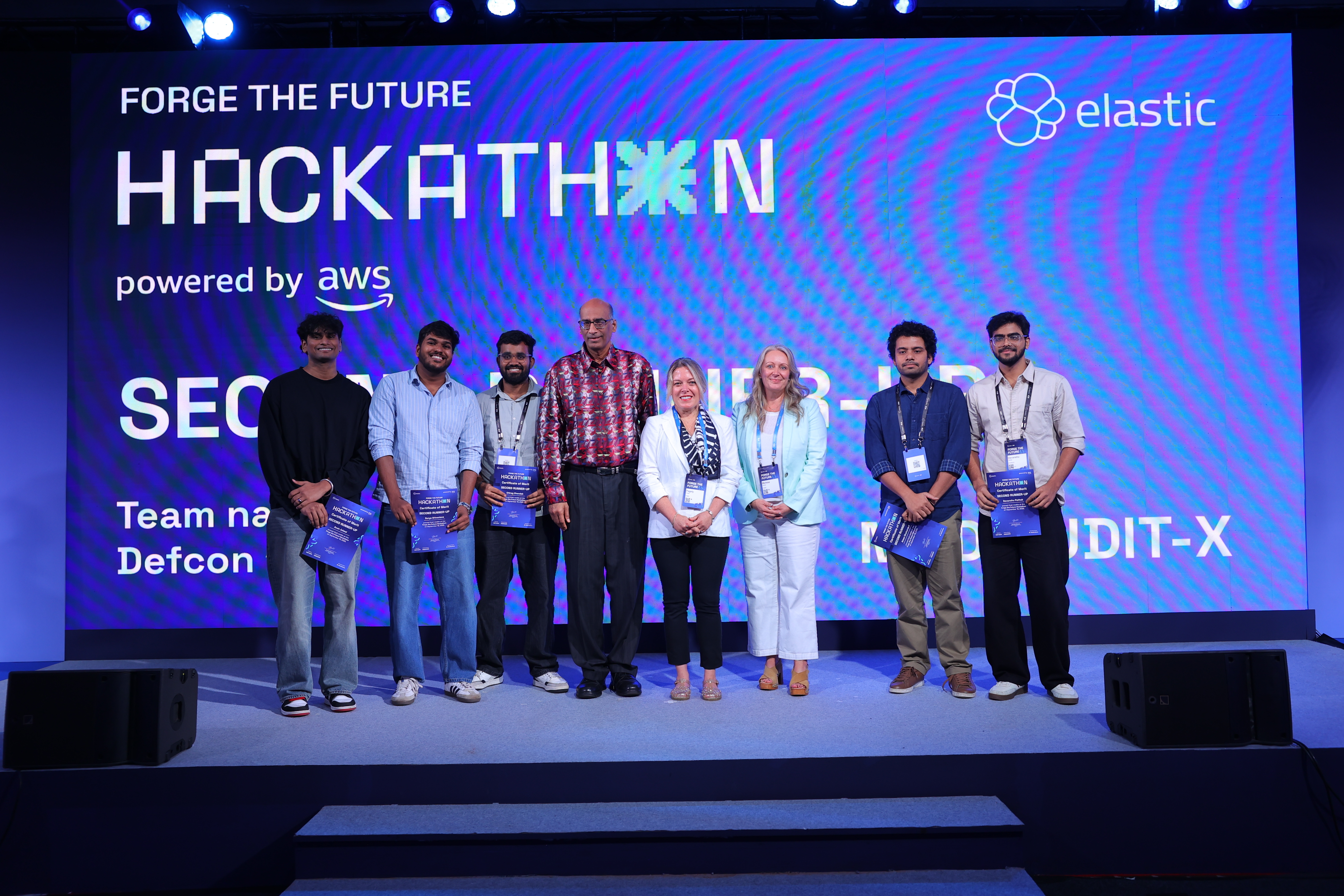
Announcing the champions, and recognising ingenuity across the floor
In addition to myself, serving on the judging panel was:
Sehaj Virk — Head of Strategy & GTM, Sarvam AI
Chokalingam M — Director of Frontier Technology, Nasscom
Ruchikka Chaudhary — Solutions Architect, AWS
Manasvi Jain — Partner Solutions Architect, AWS
Our focus was squarely on identifying robust, scalable systems built for complex enterprise workloads.
Across the board, the technical ingenuity from all 20 finalist teams was outstanding. We saw teams tackling critical operational challenges, from automated SOC platforms meeting strict statutory incident reporting timelines to deterministic guardrails using ES|QL that prevent AI models from taking unauthorized actions.
Participants demonstrated a natural instinct for context engineering, combining domain-specific reasoning with production-grade data pipelines, localized multilingual voice capabilities, and low-latency search. To win, teams had to prove that their applications were engineered for real-world reliability, handling live data flows, complex query logic, and unexpected edge cases without failing.
We were delighted to crown our three official winners on stage:
Grand Winner: Vigil built by Team Frustrated Engineers
First Runner-Up: Eyewitness built by Team Sandboxed
Second Runner-Up: MediAudit-X built by Team defcon1
A deep dive into the winning ideas
Grand Winner: Vigil (Team Frustrated Engineers)
Indian asset managers and mutual fund distributors handle tens of thousands of sales and customer calls daily. Regulatory bodies like Securities and Exchange Board of India (SEBI) and Association of Mutual Funds in India (AMFI) impose strict rules against unverified return promises or mis-selling.
Listening back through those recordings by hand is slow, so traditional audits still cover fewer than 30% of total calls. That leaves a wide compliance gap and real penalty risk.
Team Frustrated Engineers developed Vigil, an automated compliance auditing system that listens to sales call audio and instantly spots regulatory violations. The platform transcribes multilingual Indian speech, indexes the text, and runs hybrid search across official SEBI and AMFI guidelines. When a representative makes an unverified claim, Vigil automatically flags the exact audio timestamp and matches it to the specific regulation clause. This allows compliance teams to review evidence and verify violations in seconds rather than spending hours listening to call tapes.
First Runner-Up: Eyewitness (Team Sandboxed)
Traditional monitoring systems excel at reporting server crashes and database errors. However, silent frontend failures, like a broken checkout button or an unresponsive layout, often leave backend engineering dashboards looking completely green, even while real customers get frustrated, rage-click, and leave the site without completing their purchase.
Team Sandboxed built Eyewitness, an intelligent incident response agent that connects user behavior directly to engineering ticket systems. Elastic watches session signals such as dead clicks, rage clicks, and abandoned checkouts. When a session looks troubled, the system replays what the customer saw, confirms a real failure, and files a case with the moment it broke, a short clip, and the matching backend trail. AWS reviews those recordings. Sarvam can turn the summary into Hindi or Tamil for on-call teams. Engineers do not get another vague alert. They get the second it failed and the evidence to act and fix the bugs immediately.
Second Runner-Up: MediAudit-X (Team defcon1)
Processing medical insurance claims requires reviewers to manually cross-reference stacks of hospital paperwork, discharge summaries, and lab reports against complex insurance policies and treatment records. This manual labor causes severe approval delays for patients, creates administrative overhead for hospitals, and leads to inconsistent decision records.
Team defcon1 built MediAudit-X to move both sides of the same claim. Hospitals upload the documents and get a structured claim back. Reviewers get a recommendation with cited policy rules, treatment history, and drug-safety checks. Elastic holds the claim, searches the policy, and keeps the trail. AWS reads the paperwork and runs the review steps. It provides human reviewers with real-time recommendations and cited policy rules for every line item, before recording approved claims onto a secure, tamper-proof audit log for total transparency
Unlocking nation-scale innovation in India
The sheer ingenuity on display throughout this hackathon highlights India's position as a premier global hub for software craftsmanship and enterprise AI innovation. Operating in an ecosystem characterised by nation-scale digital infrastructure and complex multilingual requirements, Indian developers bring a unique capability to engineer systems that handle immense scale, data diversity, and strict operational constraints.
Rather than treating AI as an isolated experiment, participants demonstrated a natural instinct for practical execution, combining domain-specific reasoning with production-grade data pipelines.
This reflects a massive opportunity across the region: As enterprises move beyond basic generative pilots toward autonomous operational agents, India’s engineering community is uniquely equipped to design, build, and deploy the next generation of scalable, auditable AI applications.
Ecosystem partnerships driving real impact
This event was made possible through strong collaboration across India's technology ecosystem. Elastic partnered closely with AWS, who provided essential cloud computing and AI inference capabilities through Amazon Bedrock, SageMaker, and AgentCore. Ecosystem partner Sarvam AI enabled sovereign Indian-language speech and text integration, while Nasscom AI and HackCulture provided invaluable support for nationwide developer engagement.
Elastic{ON} Mumbai and Forge the Future Hackathon 2026 offered a fantastic look at how developers are applying AI to solve real enterprise problems. Congratulations again to all the winners for their outstanding builds and well-deserved victories!
Share
- Share on Twitter
Share on Twitter
- Share on LinkedIn
Share on LinkedIn
- Share on Facebook
Share on Facebook
- Share by Email
Share by Email
- Print this page
Print