Making Waves: Elastic named a Strong Performer in The Forrester Wave™: Extended Detection And Response Platforms, Q2 2026

 Share on Twitter
Share on Twitter

 Share on LinkedIn
Share on LinkedIn

 Share on Facebook
Share on Facebook

 Share by Email
Share by Email

 Print this page
Print
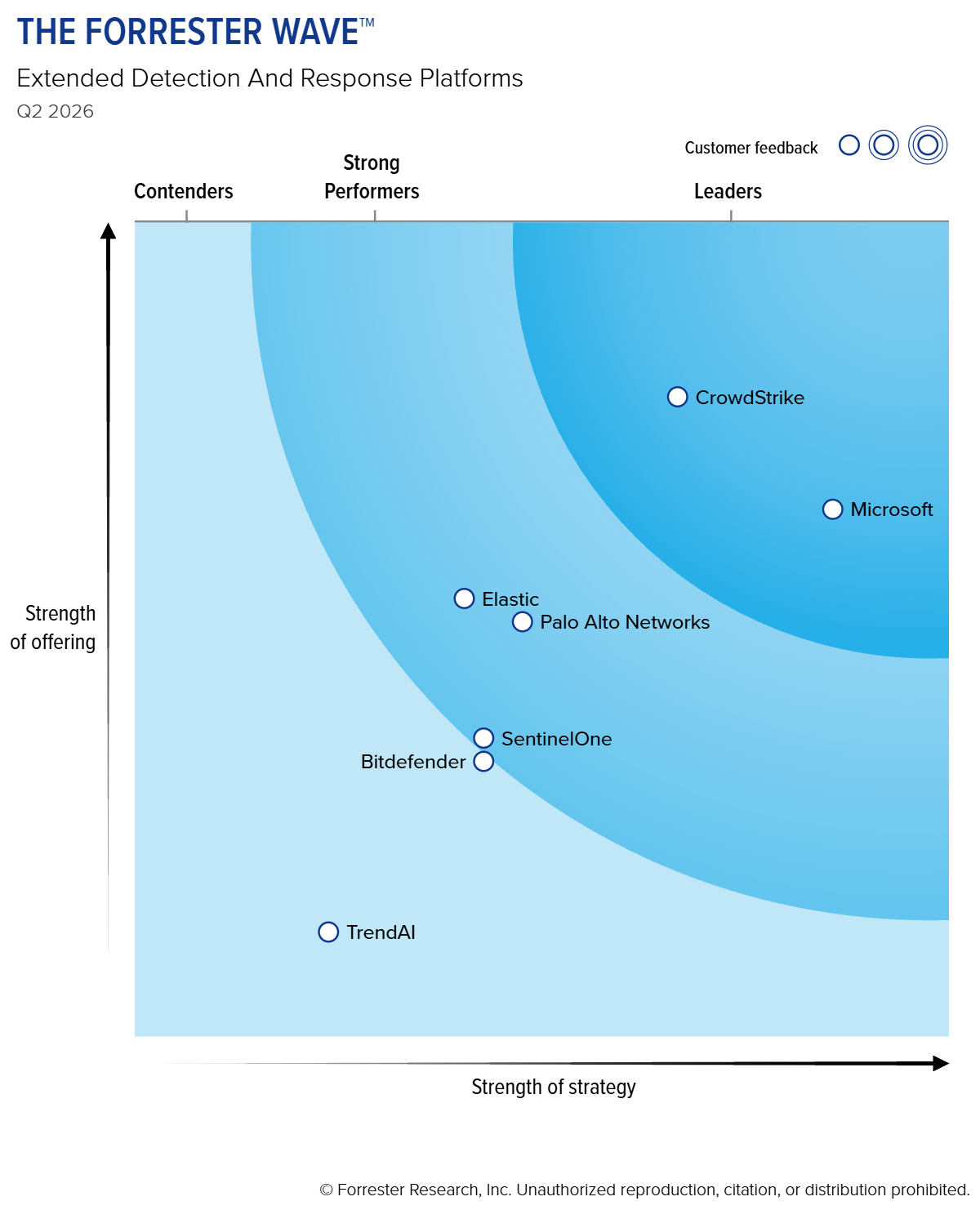
Elastic has been named a Strong Performer in The Forrester Wave™: Extended Detection And Response Platforms, Q2 2026 report. The report recognized our SIEM-replacement capabilities, open data architecture, AI innovation, and endpoint protection. Here's what Forrester found and why we believe it reflects what we've been building.
What the report found
Forrester evaluated vendors across strategy, current offering, and customer feedback. A few things stood out to us in our profile.
SIEM and telemetry ingestion
According to the report, “Elastic's SIEM-replacement features are strong as it ingests a wide-range telemetry at scale, including from its endpoint agent.” Security teams have to be able to correlate across cloud, endpoint, identity, application, and network data without fighting through siloed tools. Elastic is built for exactly that.
Flexibility as a differentiator
The report identified flexibility as Elastic's biggest differentiator. Security teams can ingest telemetry from virtually any source, tailor detections to their unique environment and risk profile, and build workflows that align with their existing processes rather than adapting to rigid platform constraints. Detection engineers can move faster, reduce vendor lock-in, and create security operations experiences that fit their organization instead of forcing their organization to fit the tool.
The report also pointed to our open data formats, core engines, strong training content, and flexible data management that make it heavily customizable. That's not marketing or sales lingo, it's what Elastic Common Schema (ECS), Open Cybersecurity Schema Framework (OCSF), and OpenTelemetry (OTel) support actually look like in practice.
AI in the SOC
In a market full of AI hype, the Forrester report also noted that Elastic has demonstrated a strong commitment to innovation with a focus on AI features like Automatic Migration and Attack Discovery.
Automatic Migration helps teams easily migrate dashboards and detection rules from their existing SIEM into Elastic without rewriting rules or rebuilding dashboards.
Attack Discovery correlates related alerts and surfaces higher-confidence attack narratives, so analysts spend time on actual incidents rather than working through an undifferentiated alert queue.
Endpoint protection
Elastic's endpoint protection was evaluated as on par compared to other vendors in the Wave, rooted in the Endgame acquisition and built on kernel-level visibility, behavioral prevention, and memory threat detection.
Elastic is the only vendor to achieve 14 consecutive months of 100% rates in AV-Comparatives’ Malware and Real-World Protection Tests, demonstrating tangible efficacy against real-world attack scenarios.
Customer feedback
Reference customers told Forrester they benefit from the open nature of the Elastic platform, as it provides transparency and control. They report that Elastic grows its list of integrations and that its analytics cover many use cases they need out of the box. They highlight fleet management as especially simple.
Why open architecture is a security strategy
Closed ecosystems create migration debt. Every proprietary data format, every vendor-specific detection language, every locked integration is work you'll eventually pay to undo. Elastic's approach is different: open standards in; open standards out. Your data stays yours, your detections are portable, and your security program doesn't depend on one vendor's roadmap decisions.
For CISOs evaluating long-term architecture, the cost of a platform switch to other vendors isn't the license; it's the detection content, the integrations, the analyst workflows, and the institutional knowledge built on top of whatever you're running today. Elastic’s open architecture reduces that switching cost whether you're moving in, expanding, or moving out.
Where Elastic Security is headed
Forrester noted that we envision an open, agentic SOC that will automate operations. We agree, and it's where our investment is going.
Agentic security operations means autonomous AI agents that can investigate alerts, correlate signals, and surface recommended actions with analysts making the calls that matter. The infrastructure for that is already in Elastic: native automation; composable, out-of-the-box AI skills; conversational detection engineering; and so much more.
But these capabilities aren’t just available in Elastic Security. The Elastic Security MCP App built on the open MCP Apps extension to the Model Context Protocol let an MCP tool return an interactive UI alongside its text response, rendered inline in Claude Desktop, Claude.ai, VS Code Copilot, Cursor, or any compatible host. This enables alert triaging, threat hunting, and case management all in the same tools analysts are already using.
Because Elastic Security runs on the same platform as observability and search workloads, security teams can correlate across operational and security telemetry without moving data between silos.
The platform built for this moment — not retrofitted to meet it
The industry's security stack was built before AI changed how fast attacks move. Breakout times are measured in seconds. Phishing campaigns built by large language models achieve click-through rates multiple times higher than traditional methods. The adversary is already operating at machine speed.
The modern threat environment exposes every friction point in the legacy security stack: per-endpoint fees that force coverage decisions no security team should have to make on a budget; bolted-on automation that breaks during the active incidents it was supposed to help with; proprietary AI that hides its reasoning when analysts need to validate a decision; and data architectures that put historical context behind rehydration delays exactly when an investigation needs it most.
Every one of those is a vendor-imposed barrier. Every barrier is time the adversary is already using. Elastic Security is built to remove barriers by providing unified SIEM, XDR, and native automation in one platform, no per-endpoint fees, no separate SOAR license, AI that shows its work, and real-time access to historical data without rehydration penalties. At Elastic, the agentic SOC isn't a future state. It's what happens when those barriers are gone.
Learn more about how customers use Elastic Security to power agentic security operations.
Read the full report
The Forrester Wave™: Extended Detection And Response Platforms, Q2 2026 is now available. Read the report.
Explore how Elastic Security enables autonomous agents to handle the full lifecycle from ingestion through response, and your analysts handle judgment, verification, and approval.
Forrester does not endorse any company, product, brand, or service included in its research publications and does not advise any person to select the products or services of any company or brand based on the ratings included in such publications. Information is based on the best available resources. Opinions reflect judgment at the time and are subject to change. This report is part of a broader collection of Forrester resources, including interactive models, frameworks, tools, data, and access to analyst guidance. For more information, read about Forrester’s objectivity here .
The release and timing of any features or functionality described in this post remain at Elastic's sole discretion. Any features or functionality not currently available may not be delivered on time or at all.
Share
- Share on Twitter
Share on Twitter
- Share on LinkedIn
Share on LinkedIn
- Share on Facebook
Share on Facebook
- Share by Email
Share by Email
- Print this page
Print