Distributed by design: Why Agile Combat Employment needs one platform, not a dozen


 Share on Twitter

 Share on LinkedIn

 Share on Facebook

 Share by Email

 Print this page
Print
Agile Combat Employment (ACE) scatters United States Air Force aircraft, Airmen, and support equipment across austere, thinly connected locations. Distributing assets creates a major manpower and expertise challenge: not enough specialists available at every site to operate, monitor, and maintain equipment. Instead, cross-utilized Mission Ready Airmen must operate without a specialist nearby. Closing this gap requires a unified data strategy, providing remote visibility into equipment health across the area of responsibility, so experts can augment on-site teams when complex issues arise.
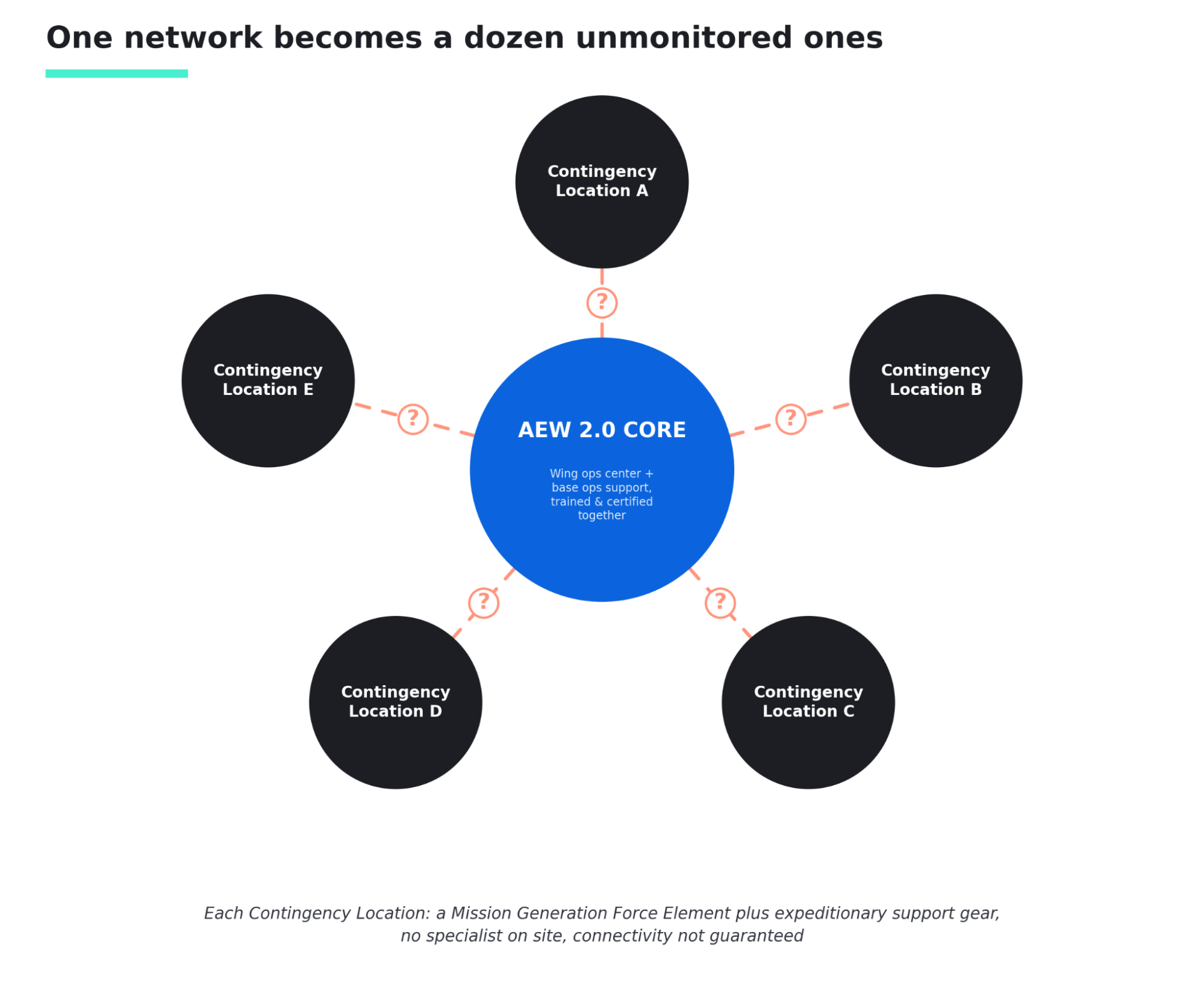
For the United States Air Force (USAF), ACE succeeds or fails on a fundamental question: Can we see across operational seams fast enough to act? The challenge is maintaining visibility as the USAF transitions from main operating bases to dozens of remote areas with limited connectivity activated on short notice.
ACE distributes forces across the area of responsibility (AOR) for survivability, but this increases the difficulty of placing specialized technical expertise at every node, threatening visibility when operators need it most.
Elastic solves this data problem by unifying, normalizing, and correlating heterogeneous data across sites, providing a common operational picture of equipment health, performance, and security. This enables remote experts to identify issues faster and augment on-site Airmen, ensuring distributed teams have the actionable context required to maintain mission execution.
What Agile Combat Employment demands
Air Force doctrine (AFDN 1-21) defines ACE as operational dispersal and proactive maneuver within threat timelines. Executing this requires centralized command, distributed control, and decentralized execution, meaning Airmen at austere sites cannot wait for information to travel back and forth to a main base before acting. Main operating bases feature established networks, security tools, and expert staff. ACE spreads operations across locations with variable equipment, limited bandwidth, and leaner teams. As locations multiply, placing specialists at every site becomes impossible.
ACE requires scalable visibility. Aggregating data across sites gives local operators immediate situational awareness while allowing centralized experts to see across seams, troubleshooting and restoring operations remotely when local capacity is exceeded.
Where the gap opens
Generating combat power at dispersed locations depends heavily on expeditionary support equipment, such as generators, fuel systems, ground communications, and diagnostic tools. As this gear becomes increasingly networked, it faces cyber risks common to industrial IT and OT environments having been built primarily for efficiency rather than hostile cyber environments.
Cyber threat advisories from CISA, NSA, and FBI highlight Advanced Persistent Threats (APTs) maintaining long-term access to critical infrastructure through administrative tools and living-off-the-land techniques to preposition for crisis disruption.
Disrupting support infrastructure impacts mission generation just as effectively as targeting aircraft directly. Maintaining telemetry across these systems enables remote experts to detect anomalies, correlate multi-site activity, and support on-site Airmen when threats exceed local expertise.
One platform, not a dozen
Elastic provides a common data layer anchored on three core principles built for distributed operations:
Built for performance: Elastic normalizes disparate data via the Elastic Common Schema (ECS), enabling rapid search and correlation across IT, networks, security tools, and support equipment as new sites come online.
Open by design: Multiple ingestion options (e.g., Elastic Agent, Beats, Logstash, and APIs) allow seamless integration of new and legacy data sources without platform redesigns.
Wired for innovation: Elastic Cloud Hosted is FedRAMP High authorized, while self-managed deployments operate in disconnected and air-gapped environments at all classifications. Elastic Workflows allows natural-language orchestration with human-in-the-lead approval for consequential actions, supporting decentralized execution with proper authority.
A true teammate for the Mission Ready Airman
ACE relies on Mission Ready Airmen cross-trained outside their primary specialty. While this reduces footprint requirements, Airmen may lack deep specialized experience when troubleshooting complex systems in remote environments.
Aligning with the Department of the Air Force’s 2026 AI Strategy, AI capabilities connected from enterprise to edge act as an active teammate that uplifts and levels up Airmen rather than replacing them. Functioning as a true force multiplier, AI empowers Airmen to operate with expert-level proficiency across unfamiliar domains. With technical data structured as an accessible knowledge base, AI agents diagnose faults, surface relevant procedures, and connect Airmen to remote specialists who view the same live telemetry to accelerate decision-making.
Recent GAO findings on maintenance delays emphasize that readiness depends on getting actionable data to personnel quickly. Elastic provides the data layer uniting telemetry across operational, maintenance, and security domains, ensuring AI serves as a powerful teammate that expands human capability while keeping ultimate control in the hands of the operator.
One collection, two missions
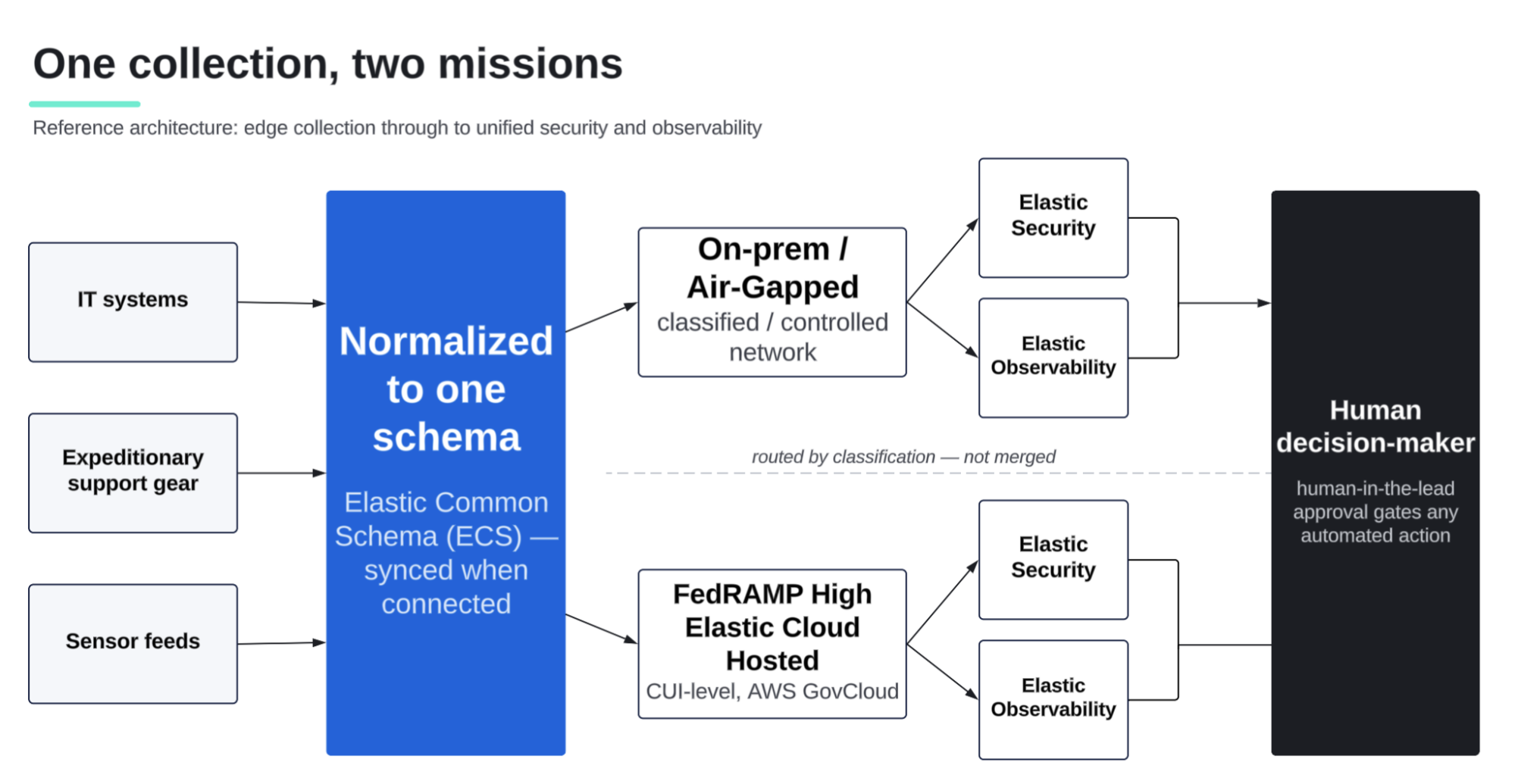
At each spoke, Elastic collects local IT, equipment, and sensor data to maintain autonomous edge operations even during denied or degraded connectivity.
When connected, cross-cluster search links nodes into a unified operational picture, allowing experts to correlate events across sites and distinguish isolated malfunctions from coordinated attacks. Correlating data across locations lets teams see across operational seams and act rapidly. Combined with AI agents and human-in-the-lead workflows, Elastic provides Mission Ready Airmen with unified visibility and the speed required to meet mission demands.
Closing the seams
Dispersal is still hard, austere locations are still austere, connectivity will be challenged, and Mission Ready Airmen will still be asked to accomplish more missions with fewer resources and less specialized expertise available at each location. What can change is whether the seams created by that distributed environment remain invisible until something breaks or whether those seams become visible, understood, and manageable before they impact the mission.
A common data layer connects edge operations with theater-wide expertise. Security, maintenance, and operational teams share a synchronized view to resolve issues before they impact combat generation. By pairing local operational independence with connected visibility, Elastic gives ACE the data foundation needed to maintain survivability and command authority across distributed operations.
Contact us to learn how Elastic can help strengthen visibility, readiness, and decision-making across distributed operations.
The release and timing of any features or functionality described in this post remain at Elastic's sole discretion. Any features or functionality not currently available may not be delivered on time or at all.
In this blog post, we may have used or referred to third party generative AI tools, which are owned and operated by their respective owners. Elastic does not have any control over the third party tools and we have no responsibility or liability for their content, operation or use, nor for any loss or damage that may arise from your use of such tools. Please exercise caution when using AI tools with personal, sensitive or confidential information. Any data you submit may be used for AI training or other purposes. There is no guarantee that information you provide will be kept secure or confidential. You should familiarize yourself with the privacy practices and terms of use of any generative AI tools prior to use.
Elastic, Elasticsearch, and associated marks are trademarks, logos or registered trademarks of elasticsearch B.V. in the United States and other countries. All other company and product names are trademarks, logos or registered trademarks of their respective owners.
Share
- Share on Twitter
Share on Twitter
- Share on LinkedIn
Share on LinkedIn
- Share on Facebook
Share on Facebook
- Share by Email
Share by Email
- Print this page
Print