Compliance work is overdue for a new approach
.png)

 Share on Twitter
Share on Twitter

 Share on LinkedIn
Share on LinkedIn

 Share on Facebook
Share on Facebook

 Share by Email
Share by Email

 Print this page
Print
Compliance has traditionally lived in dashboards, spreadsheets, screenshots, audit packets, and point-in-time reviews. Security teams know the reality is more dynamic. The evidence auditors need is often buried across identity providers, endpoints, cloud platforms, network controls, vulnerability scanners, alerts, and custom application logs — all generating live operational telemetry that static tools struggle to keep up with.
Elastic Security is introducing a new pattern for compliance inside Elastic Agent Builder: agentic compliance skills that reason over security telemetry, run Elasticsearch Query Language (ES|QL)-backed checks, explain evidence, identify data gaps, and help teams move from posture review to response workflow.
The first implementation is a PCI DSS v4.0.1 compliance skill.
Rather than shipping a standalone compliance agent, Elastic uses Agent Builder's composable skill model. The PCI skill brings together purpose-built tools for scope discovery, compliance evaluation, field mapping for custom data, and ES|QL execution. The result is an interactive compliance experience where users ask questions, validate scope, inspect evidence, and understand what still requires manual audit verification.
This is not "push-button compliance"; it is a practical step toward continuous, evidence-driven compliance operations.
Why compliance needs to move beyond dashboards
In compliance operations, dashboards remain useful. They give teams a fast read on posture, surface the biggest gaps, and create a shared starting point for compliance work. In practice, though, that starting point is rarely where the work ends.
An auditor wants to know which systems were in scope.
An analyst needs the underlying evidence for a failed control.
A platform engineer needs to understand why a source was marked as not assessable.
A compliance lead needs an executive summary that still carries the assessed time range, the fields that were checked, and the caveats that matter for audit defensibility.
Static dashboards are strong at the first view; they are much weaker at those follow-up questions.
Agentic compliance changes how teams work through that gap. Instead of clicking through panels and manually stitching evidence together, people can ask questions in plain language like what PCI DSS posture looks like for authentication over the last 30 days; whether requirement 8.3.4 is failing and what supports that conclusion; which PCI-relevant sources have weak ECS coverage; or what an executive scorecard would show with red findings called out.
The point is not to replace dashboards with a chat box. It is to make compliance answers explainable: what was evaluated, what evidence was found, where confidence is high or low, and what should happen next. That is the interaction model we are building toward — summary when you need orientation and evidence-grade depth when the next question arrives.
Starting with PCI DSS v4.0.1
Many PCI requirements depend on telemetry security teams already collect: authentication events, vulnerability findings, endpoint activity, network traffic, malware detections, configuration changes, and audit logs.
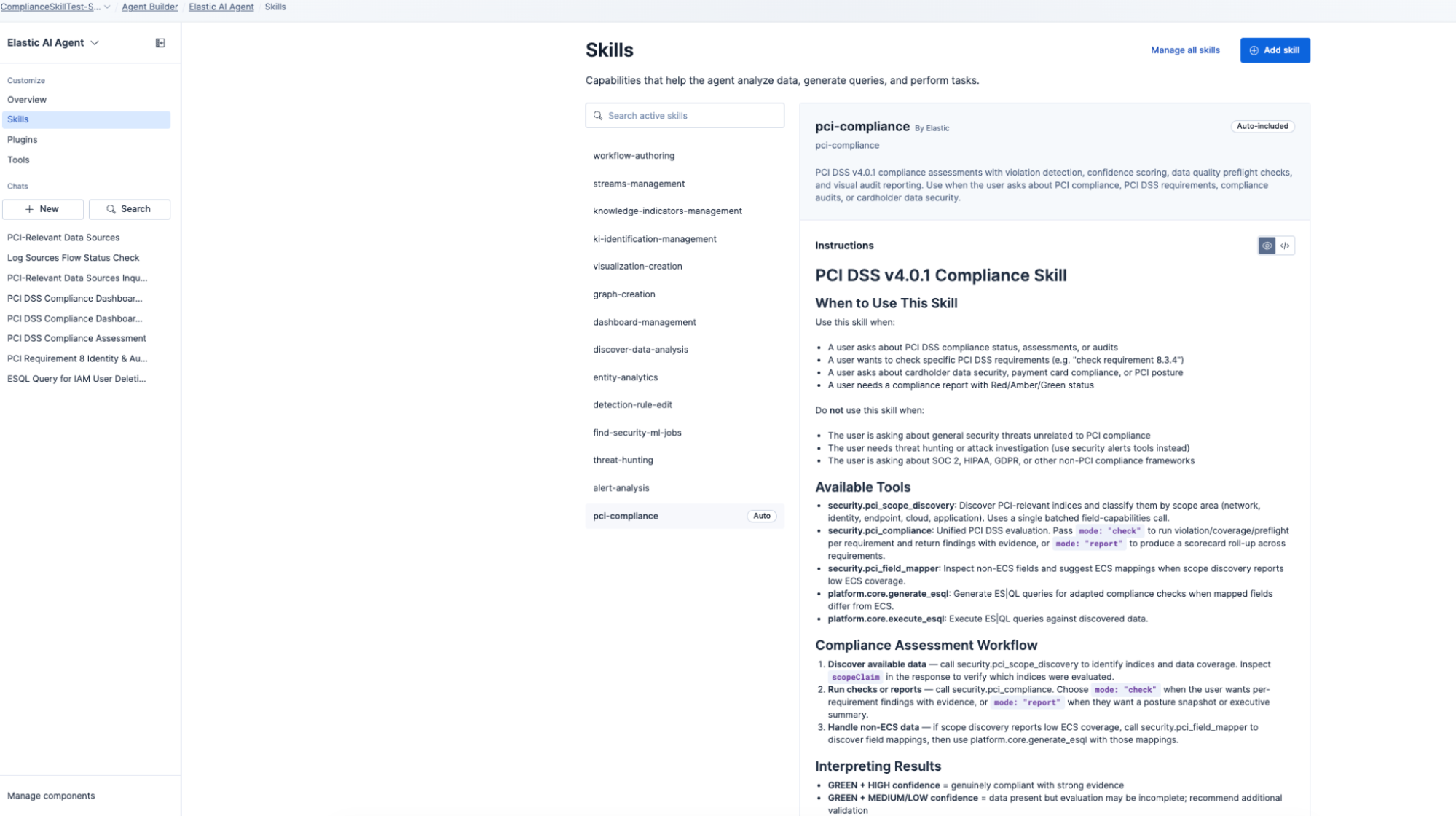
The PCI compliance skill in Agent Builder is designed around this operational reality. It helps users:
Discover PCI-relevant data across their environment
Evaluate PCI DSS v4.0.1 requirements with violation detection and confidence scoring
Generate report-style scorecards with red/amber/green status
Inspect supporting evidence via ES|QL queries and results
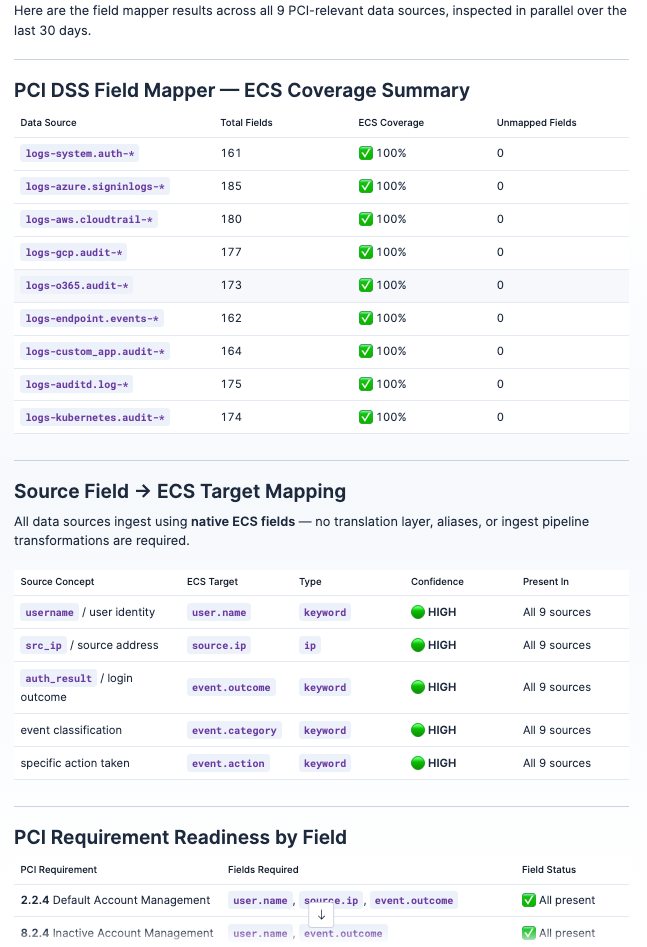
Identify data quality problems like missing ECS fields, custom field names, and coverage gaps
The skill is intentionally scoped as an evidence-oriented telemetry assessment. It does not replace a Qualified Security Assessor. It does not issue formal PCI attestation. Instead, it helps teams prepare stronger evidence, spot telemetry gaps earlier, and turn findings into response actions.
How the PCI compliance skill works in 4 steps
The skill follows a four-step natural investigation pattern: discover scope → evaluate posture → inspect evidence → address gaps.
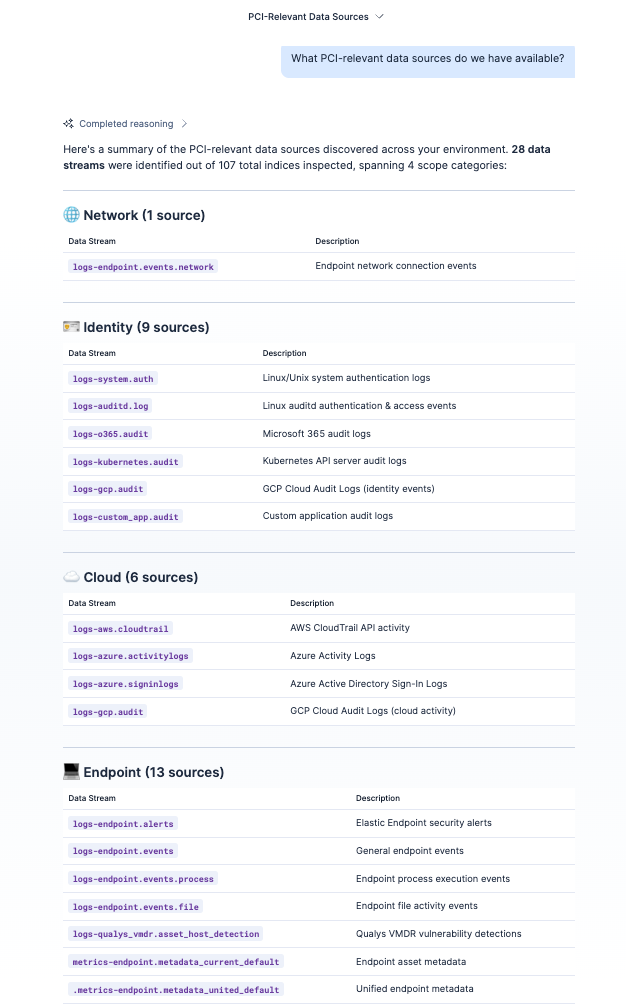
Step 1: Discover PCI-relevant data
The skill runs PCI scope discovery to identify relevant indices and classify them by category — network, identity, endpoint, cloud, application, and vulnerability data. It estimates ECS coverage per index so that teams can see whether a data source is ready for reliable checks or needs normalization work.
Step 2: Evaluate PCI requirements
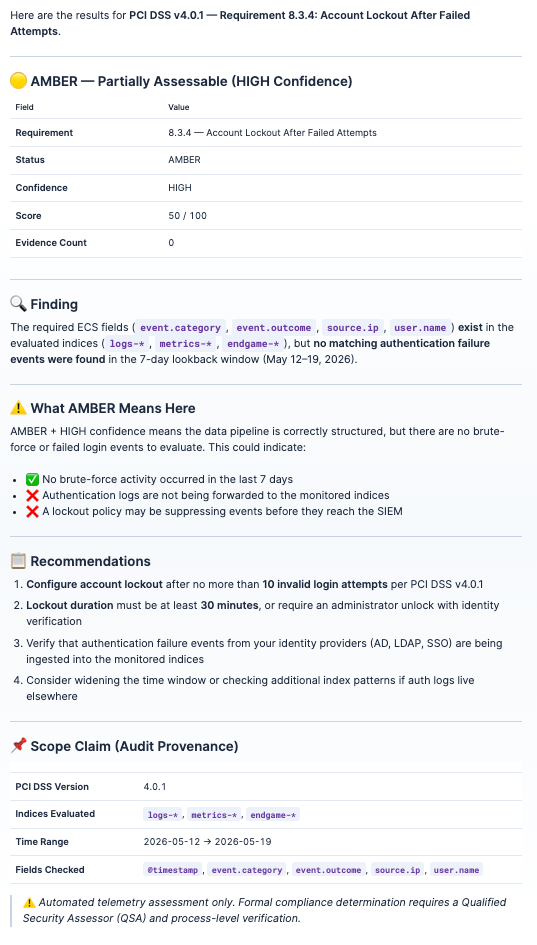
The skill runs compliance evaluations against one or more PCI DSS v4.0.1 requirements. Each check returns:
Status: GREEN (compliant), RED (violation detected), AMBER (partial data), or NOT_ASSESSABLE (missing fields)
Confidence: HIGH, MEDIUM, or LOW based on data quality and coverage
Evidence: specific findings with affected entities, counts, and time ranges
Recommendations: concrete remediation actions for noncompliant findings
Users can check a single requirement ("Check requirement 8.3.4") or run a full posture assessment across all requirements.
Step 3: Generate compliance reports
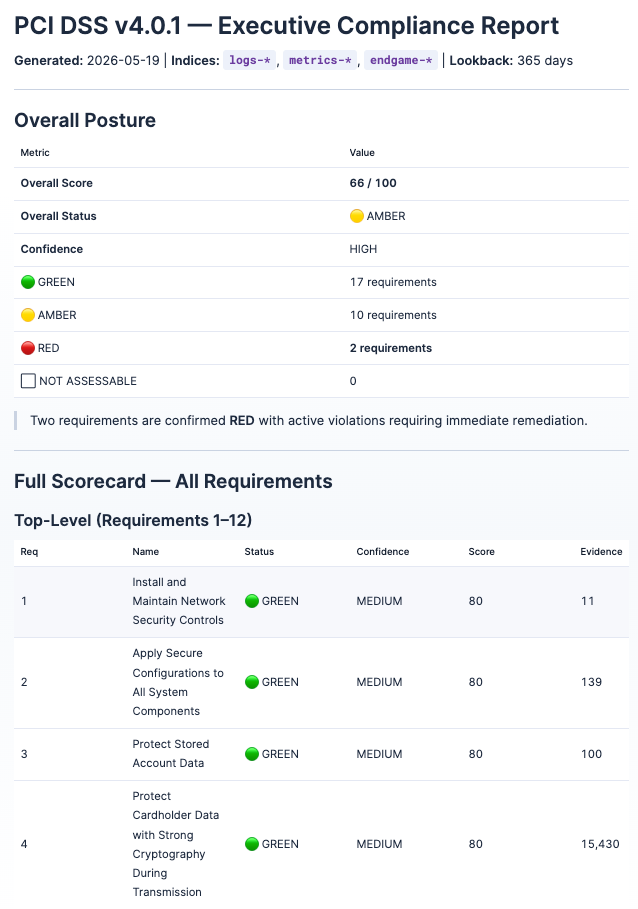
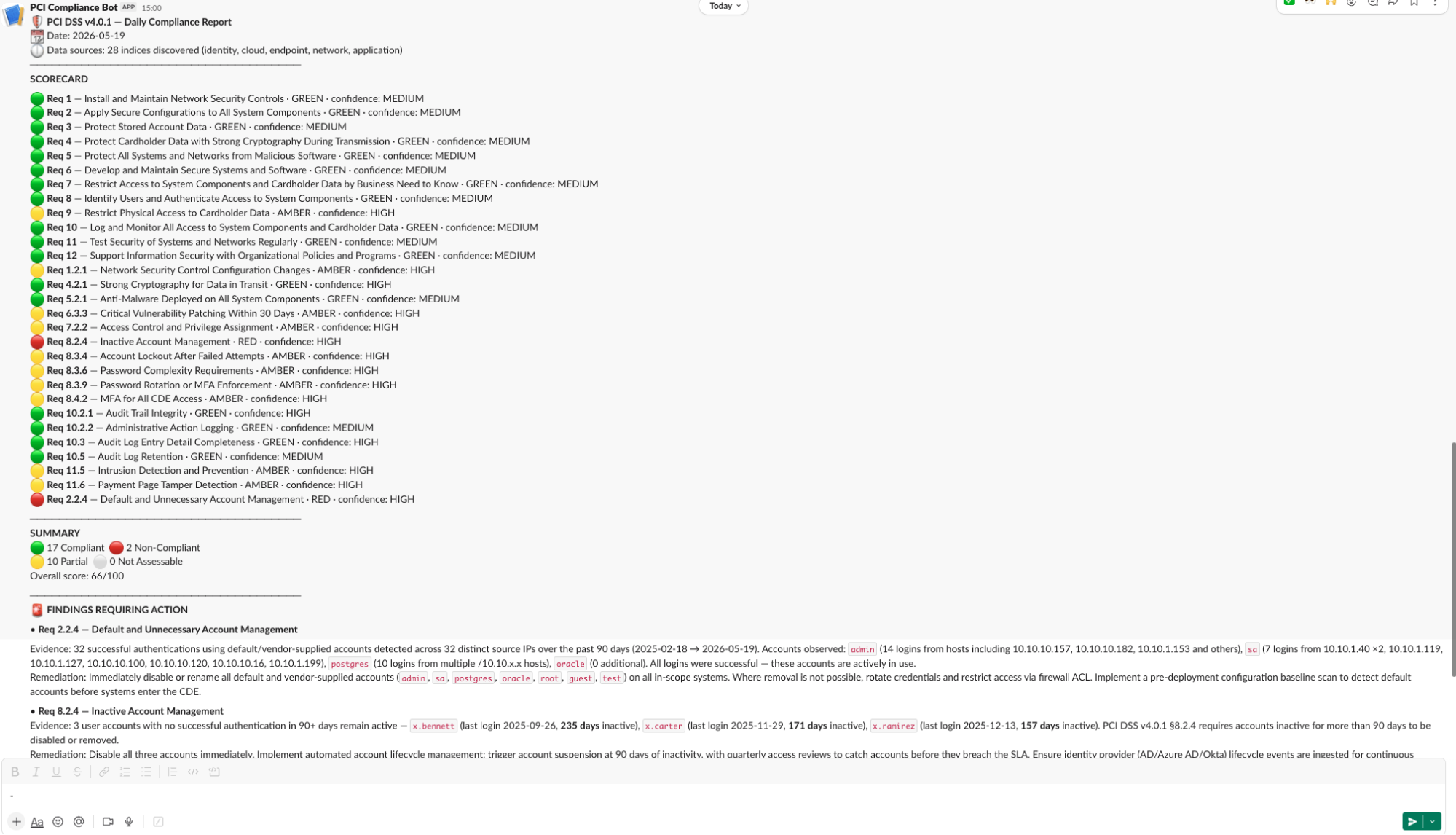
The skill produces an executive scorecard with an overall score, per-requirement breakdown, and visual red/amber/green summary.
Step 4: Handle non-ECS data
Not every organization has perfectly normalized data. The skill includes a field mapper that inspects custom indices and suggests ECS equivalents. If authentication logs use username instead of user.name, the field mapper identifies the mapping so that compliance checks can be adapted.
Scope claims: Making answers audit-aware
One of the most important design choices is the use of structured scope claims. Every PCI tool response includes metadata recording the PCI DSS version, assessed indices, time range, evaluated requirements, checked fields, and a non-attestation disclaimer. This gives the agent a concrete provenance record to cite in its answers.
That provenance is essential for compliance conversations. A result is only meaningful if users know what data was included and what was not.
A GREEN + HIGH confidence result means something different from GREEN + LOW confidence.
A RED result with supporting evidence means something different from a requirement that is NOT_ASSESSABLE because fields are missing.
An AMBER result may indicate partial telemetry, no matching events, or the need to widen the time range.
By surfacing scope and confidence alongside every result, Elastic helps users avoid two common compliance failure modes: false certainty and unactionable ambiguity.
From chat to automated compliance workflows
The PCI compliance skill is powerful in a chat conversation. But the real operational value unlocks when you pair it with Elastic Workflows. Workflows turn a one-time chat interaction into a compliance-as-code pipeline — scheduled checks, indexed results for trending, case management for violations, and stakeholder notifications — with zero manual intervention after setup.
Scheduled daily assessment
Workflows turn the PCI skill from an on-demand chat into compliance-as-code. The PCI DSS Daily Compliance Assessment example in the Elastic Workflow Library (security/compliance) runs on a daily schedule (06:00 UTC by default, plus a manual trigger), invokes the elastic-ai-agent skill with the pci-compliance skill, indexes each report to pci-compliance-results for trending, and posts the same summary to Slack or email via a connector you configure in consts.notification_connector_id.
The flow is three steps — assess → index → notify — implemented as run_assessment (ai.agent), index_report (elasticsearch.index), and send_notification (kibana.request). The full prompt, scorecard format, and on-failure retries live in the YAML; import the workflow from the repo rather than copying fragments into the blog.
Where to start: compliance README (prerequisites and setup order)
Automated violation case creation
For findings that need ownership and audit trail, using Workflows, the PCI Violation Case Creator runs a targeted PCI check (e.g., input requirements and default all), then opens a Kibana case only when the assessment output includes RED findings using an ‘if’ step on steps.run_check.output.message, not a second agent call. Cases are owned by securitySolution, tagged pci-compliance / violation, and include the full agent report in the description.
You can run it on demand or on a weekly schedule (Mondays 07:00 UTC in the example). See the linked YAML for the check prompt, case fields, and logging steps.
Compliance trending dashboard
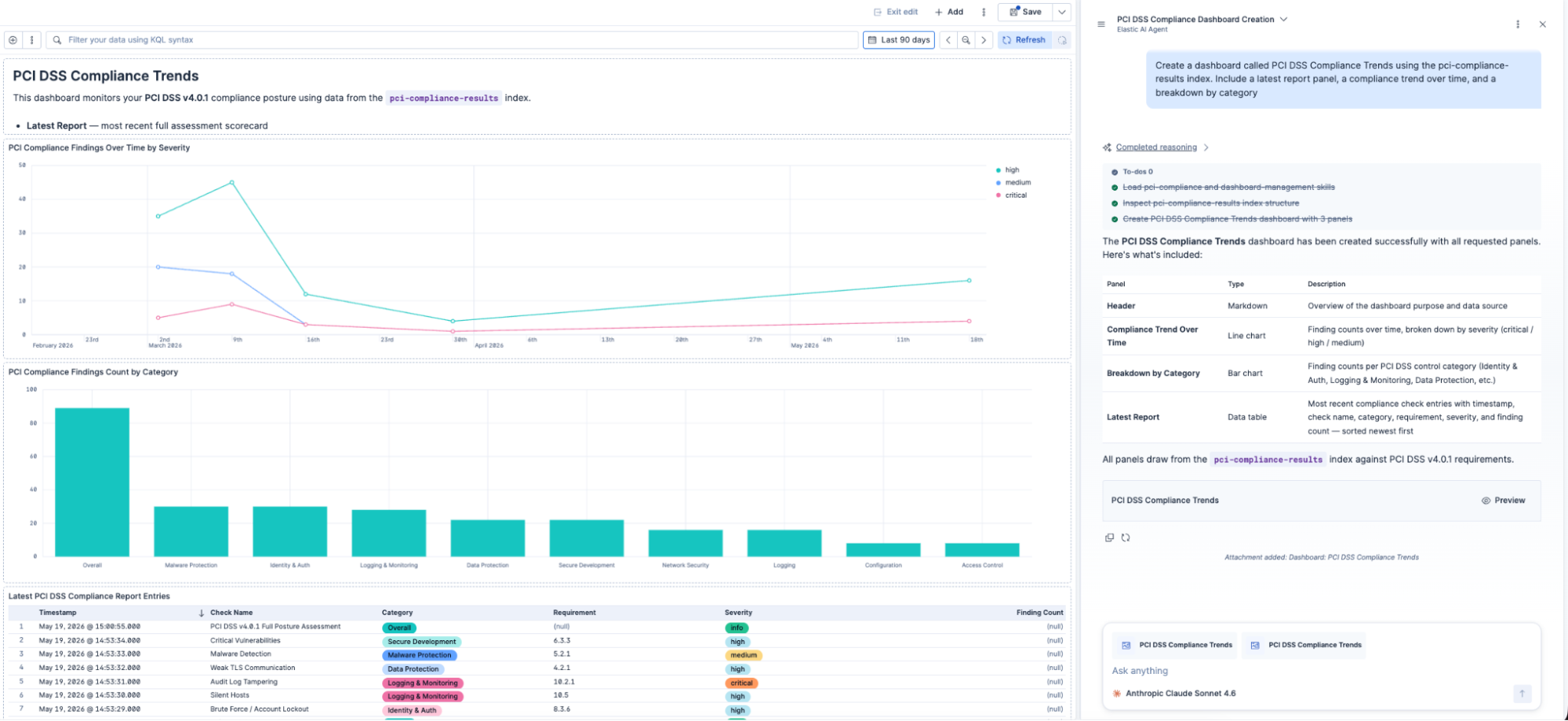
By indexing each daily assessment to pci-compliance-results, teams build a time series of compliance posture. A Kibana dashboard can then visualize:
Latest report content
Compliance score trends over time
Assessment frequency and coverage
Historical drill-down for audit preparation
The compliance-as-code pattern
Together, these capabilities create a complete operational loop:
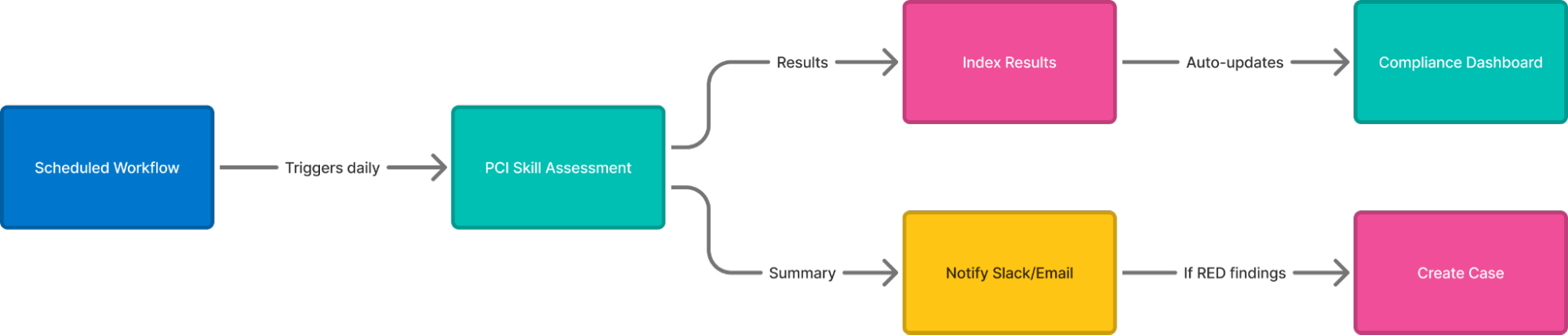
This shifts compliance from a periodic manual review to a continuous automated pipeline while preserving the transparency and inspectability that auditors require.
Built for responsible automation
The PCI compliance skill is designed with clear boundaries. PCI DSS includes requirements that cannot be fully validated from SIEM telemetry alone. Stored account data protections (Requirement 3), physical access controls (Requirement 9), and organizational policy requirements (Requirement 12) still require manual verification and QSA review.
Elastic's approach acknowledges that boundary. The skill includes non-attestation language and scope metadata, so users understand that automated checks are inputs to an audit, not a formal compliance determination.
It also accounts for data quality. Missing fields, low ECS coverage, overlapping index patterns, and short time windows can all affect results. The skill is designed to surface those limitations rather than hide them behind a simple green checkmark.
A pattern for future compliance skills
PCI DSS is the first step, but the architecture points to a broader direction. The skill-first model in Agent Builder allows compliance capabilities to be composed around framework-specific knowledge, purpose-built tools, evidence collection, field mapping, and response workflows. The same pattern can extend to other compliance frameworks where security telemetry provides meaningful evidence.
That future matters because organizations do not experience compliance as isolated frameworks. The same authentication event may support PCI, SOC 2, ISO 27001, or internal access-control reviews. The same vulnerability finding may matter to multiple audit programs. The same logging gap may weaken several controls. Agentic compliance creates a path toward asking framework-specific questions over shared operational evidence.
The new compliance experience
The future of compliance auditing should not be a scramble through static dashboards and screenshots. It should be asking precise questions against live operational data and receiving evidence-backed answers that teams can inspect, explain, and act on.
Elastic Security's PCI DSS v4.0.1 skill for Agent Builder — combined with the automation power of Elastic Workflows — introduces that experience. Compliance moves from a dashboard to a dialog. And with Elastic, that dialog is grounded in security telemetry.
Ready to see how this skill can accelerate your compliance operations? Try it yourself with an Elastic Security free trial today.
The release and timing of any features or functionality described in this post remain at Elastic's sole discretion. Any features or functionality not currently available may not be delivered on time or at all.
In this blog post, we may have used or referred to third party generative AI tools, which are owned and operated by their respective owners. Elastic does not have any control over the third party tools and we have no responsibility or liability for their content, operation or use, nor for any loss or damage that may arise from your use of such tools. Please exercise caution when using AI tools with personal, sensitive or confidential information. Any data you submit may be used for AI training or other purposes. There is no guarantee that information you provide will be kept secure or confidential. You should familiarize yourself with the privacy practices and terms of use of any generative AI tools prior to use.
Elastic, Elasticsearch, and associated marks are trademarks, logos or registered trademarks of elasticsearch B.V. in the United States and other countries. All other company and product names are trademarks, logos or registered trademarks of their respective owners.
Share
- Share on Twitter
Share on Twitter
- Share on LinkedIn
Share on LinkedIn
- Share on Facebook
Share on Facebook
- Share by Email
Share by Email
- Print this page
Print