Elastic 9.3: Chat with your data, build custom AI agents, automate everything


 Share on Twitter
Share on Twitter

 Share on LinkedIn
Share on LinkedIn

 Share on Facebook
Share on Facebook

 Share by Email
Share by Email

 Print this page
Print
Today, we are pleased to announce the general availability of Elastic 9.3 as the latest version of the Elasticsearch Platform — the world’s most popular open source platform for transforming both structured and unstructured data into trusted answers and outcomes.
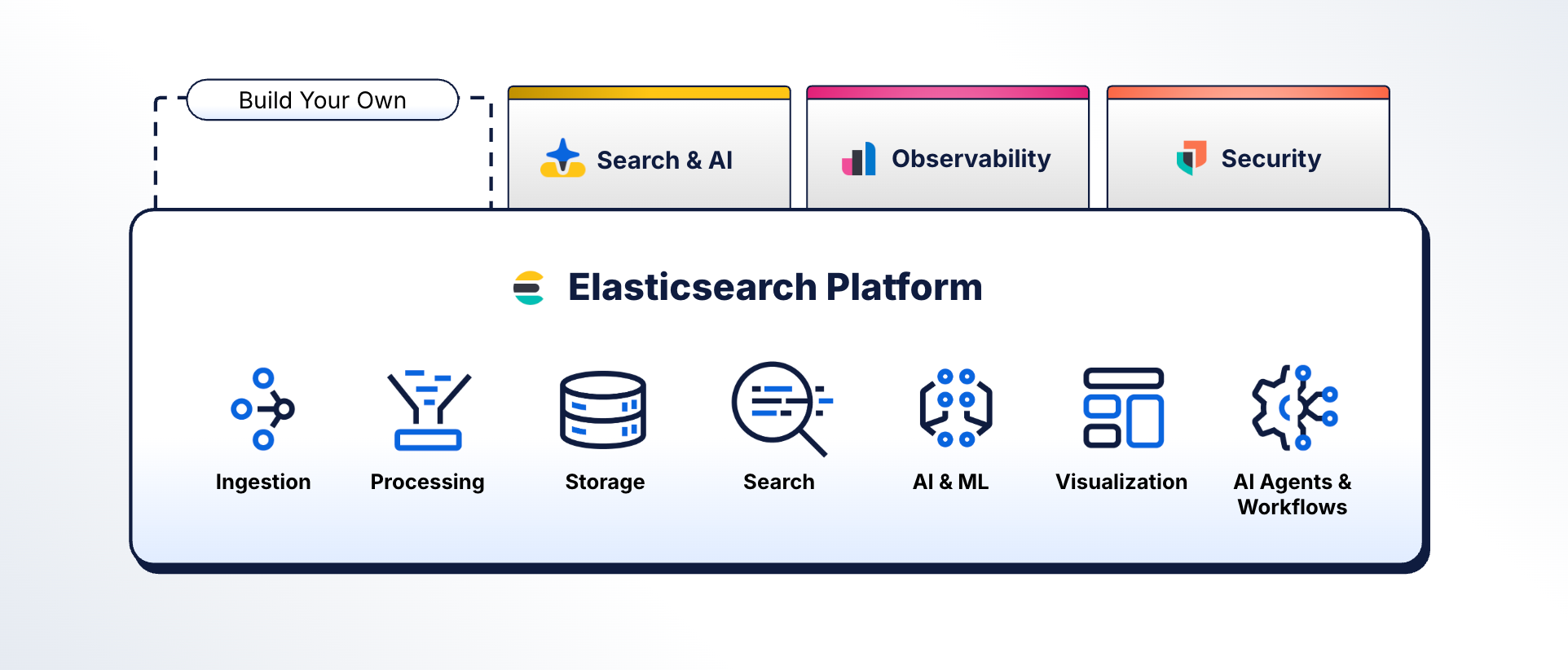
In addition to including new features that help developers with context engineering and agent building, Elastic 9.3 introduces a broad set of new capabilities to Elastic Search & AI, Elastic Observability, and Elastic Security.
So, what’s new in Elastic 9.3?
Elastic 9.3 includes a lot of exciting new features:
Elastic Workflows, now available as a technical preview, brings automation closer to your data by integrating workflow automation into the Elasticsearch Platform.
Elastic Agent Builder, now generally available, delivers a set of AI-powered capabilities that enable developers to natively chat with their Elasticsearch data and simplify the development of custom AI agents.
Three Jina AI models (jina-embeddings-v3, jina-reranker-v2-base-multilingual, and jina-reranker-v3) are now generally available via the Elastic Inference Service (EIS) — delivering fast, GPU-accelerated multilingual embeddings and high-precision reranking.
GPU-accelerated vector indexing has arrived as a technical preview. By integrating NVIDIA cuVS — an open source library for GPU-accelerated vector search and data clustering — into Elasticsearch, self-managed Elastic customers can now accelerate data indexing using NVIDIA GPUs. These customers can expect to see a 12x improvement in indexing throughput and 7x faster force merging. Offloading vector indexing to GPUs frees up CPU cycles that can be redirected to improve search performance.
Read about these and additional highlights by solution below.
Search & AI
You already know that Elasticsearch provides a powerful foundation for building search and AI applications. And, if you’ve read an Elastic release blog before, you know that we’re committed to building the best context engineering platform — one that helps simplify and accelerate the development of custom AI agents.
What you may not know is that whether you’re seeking to “chat with your data,” bolster relevance (with almost zero operational overhead), or optimize vector indexing operations, Elastic 9.3 continues to deliver.

Highlights for Search & AI in 9.3:
Elastic Agent Builder, now generally available, delivers a set of AI-powered capabilities that enable developers to natively chat with their Elasticsearch data and simplify the development of custom AI agents. And, with Elastic 9.3, Agent Builder works with Elastic Workflows — giving agents the ability to take reliable actions.
Three Jina AI models (jina-embeddings-v3, jina-reranker-v2-base-multilingual, and jina-reranker-v3) are now generally available via the Elastic Inference Service (EIS) — delivering fast, GPU-accelerated multilingual embeddings and high-precision reranking. Even better, moving forward, all new state-of-the-art Jina AI models will be provided through the Elastic Inference Service as they become available.
GPU-accelerated vector indexing has arrived as a technical preview. By integrating NVIDIA cuVS, an open source library for GPU-accelerated vector search and data clustering, into Elasticsearch, self-managed Elastic customers can now accelerate data indexing using NVIDIA GPUs. These customers can expect to see a 12x improvement in indexing throughput and 7x faster force merging. Offloading vector indexing to GPUs frees up CPU cycles that can be redirected to improve search performance.
EIS via Cloud Connect is now generally available for self-managed customers. Cloud Connect now enables self-managed clusters to offload inference to managed GPU infrastructure in Elastic Cloud, while keeping data, storage, and indexing local. Users can deploy models without provisioning GPUs or managing model operations, making semantic search, multilingual retrieval, reranking, and agentic retrieval augmented generation (RAG) workflows possible in private or regulated environments.
Find more details in the blogs linked above and in the Search & AI 9.3 release notes.
Elastic Observability
In our recent report, The Landscape of Observability in 2026: Balancing Cost and Innovation conducted by Dimensional Research and sponsored by Elastic, we found that 98% of observability teams expect to use generative AI, but “strategy” (i.e., precisely how) remains an open question. These teams are clearly eager to move from experimentation to operational value. Elastic 9.3 answers the question of “how” with concrete implementations: Streams applies AI to automate log parsing at ingest; a new Amazon Bedrock integration brings managed large language models (LLMs) into observability workflows; and agentic capabilities let teams move from reactive investigation to AI-assisted root cause analysis.
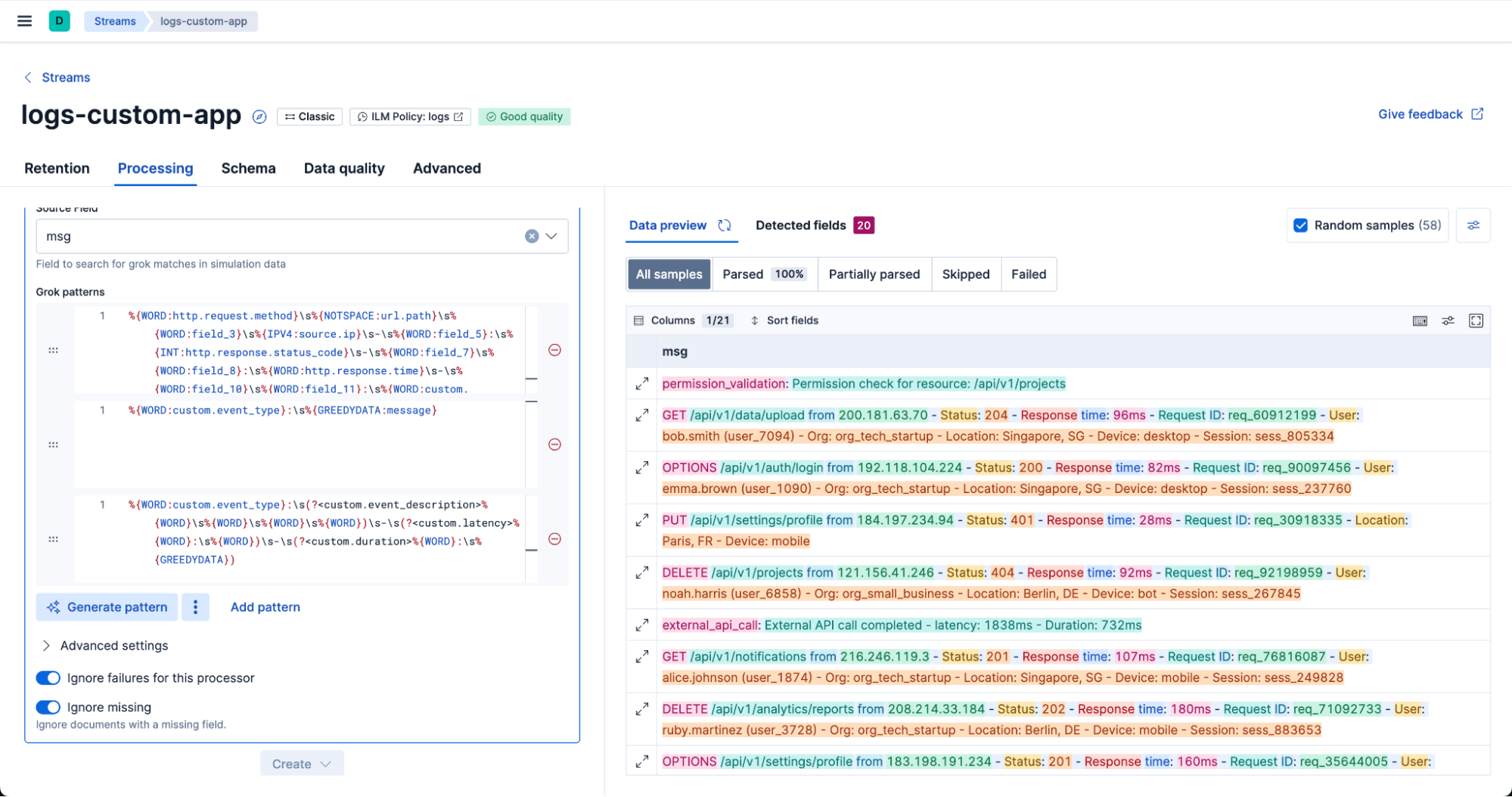
Highlights for Elastic Observability in 9.3:
Pattern-based compression for log messages via the introduction of the new pattern_text field type (now generally available) reduces the storage footprint of message fields by up to 50%.
Available as a technical preview, customers can now benefit from up to a 5x reduction in ES|QL query latency on metrics data as well as richer and more comprehensive analytics with more time series aggregation commands, exponential histograms, and lightweight metrics downsampling.
Also now available as a technical preview, the new Amazon Bedrock AgentCore integration provides users with an end-to-end observability solution for agentic AI applications running on Amazon Bedrock AgentCore.
Improvements to Streams, available now as a technical preview, use an agentic workflow to enable users to parse logs directly from the message field in a log document with just the click of a button.
Elastic Workflows, available now as a technical preview, gives operators the ability to create workflows that can be used for orchestration and autoremediation. It also integrates with Elastic Agent Builder, enabling operators to create tools that can integrate with external systems and create truly agentic workflows for both investigations and root cause analysis.
Find more details in the blogs linked above and in the Elastic Observability 9.3 release notes.
Elastic Security
In case you missed it … Elastic’s 2025 Global Threat Report provides a wealth of fresh insights on adversary trends and defender strategies derived from real-world telemetry. The report reveals a fundamental shift in how adversaries achieve success today based on threat activities identified throughout 2025. Elastic injects this intelligence right back into our detection logic to ensure you can detect and stop these sophisticated threats before they impact your business.
Elastic 9.3 includes a number of new and improved capabilities to ensure that security engineers, SOC analysts, and threat hunters alike have what they need to operate an AI-powered SOC.
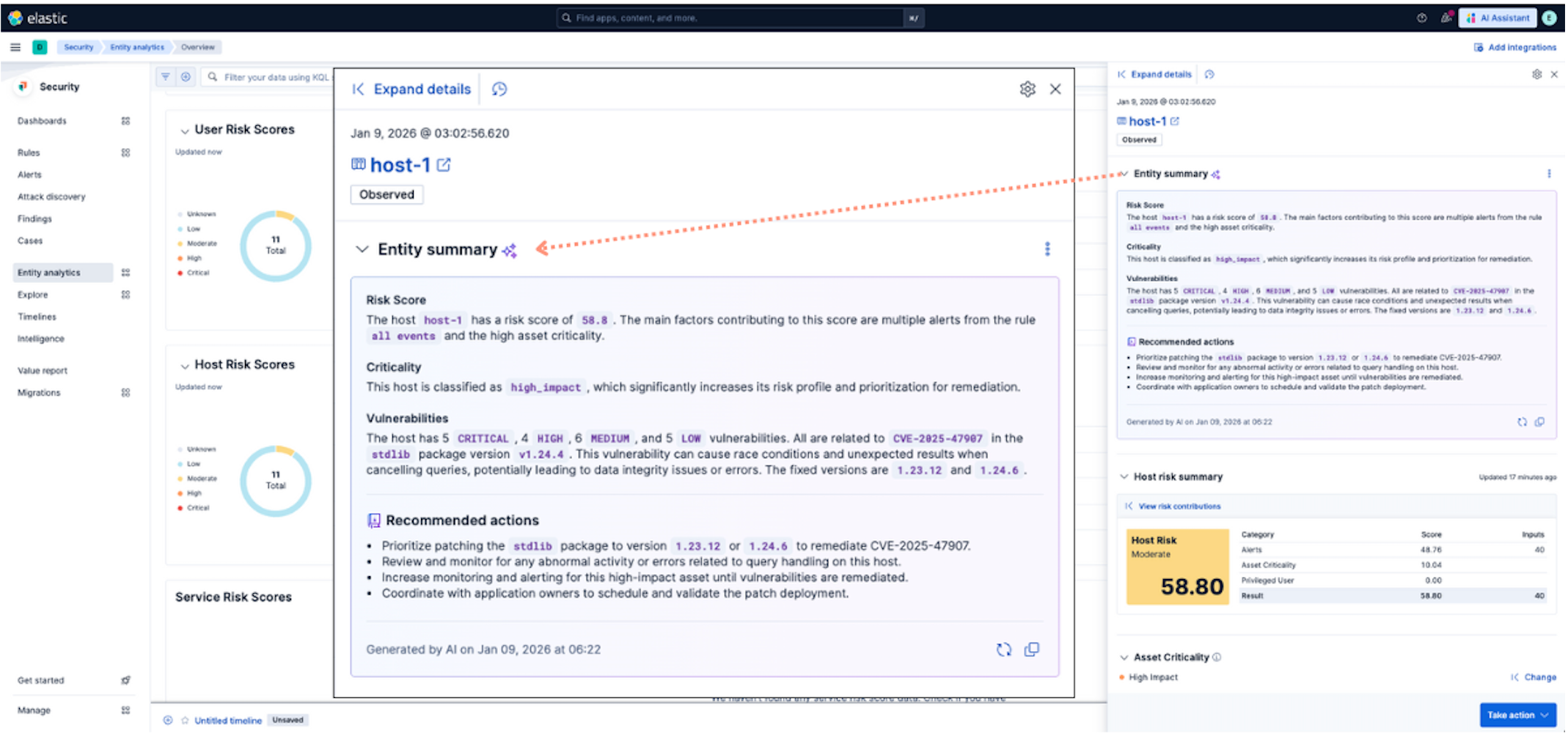
Highlights for Elastic Security in 9.3:
Automatic Migration for Rules has expanded its capabilities to include support for QRadar SIEM (tech preview), making it easier than ever for customers to migrate to and adopt Elastic’s AI-driven detection and investigation security solution.
Entity Analytics now offers Entity AI Summary (generally available) — an AI generated summary of entity risk scores with clear recommended actions based on associated anomalies, vulnerabilities, misconfigurations, and asset criticality.
For security use cases, Elastic Workflows provides a native engine for scripted automation to eliminate manual triage and execute reliable response actions. It also integrates with Elastic Agent Builder, enabling analysts to invoke AI agents grounded in their operational data and context to reason through complex investigations. In fact, with Elastic 9.3, Agent Builder features the next leap in conversational AI, a new prebuilt threat hunting agent that unifies Alerts, Attack Discovery, and Entity Risk Scores to accelerate investigations.
Automatic Gap Filling (generally available) provides security teams with new functionality to automatically backfill detected rule execution gaps; think: fast recovery for any potentially missed alerts and fewer false negatives.
And, in terms of endpoint security, Elastic Security now includes several new features (all generally available): Memory Dump (as a new Windows response action), two new osquery extensions (Browser History and Amcache), and a new library of prebuilt osquery queries and packs.
Find more details about these features in the Elastic Security 9.3 release notes.
The Elasticsearch Platform
With each new release, the Elasticsearch Platform is helping developers and practitioners (of all types) bridge the gap between enterprise data and high-quality AI experiences. We help to bridge this gap by providing unmatched relevance and precise context, remaining committed to open source and open standards, and ensuring that our platform and solutions are available anywhere our customers need them to be. In this way, when there are updates to Elastic’s core platform … all users win.
Highlights for the Elasticsearch Platform with 9.3:
Elastic Workflows, available now as a technical preview, brings automation closer to your data by integrating workflow automation into the Elasticsearch Platform. With support for both rules-based and agentic automation, Elastic Workflows enables teams to automate operational and business processes, responses, and investigations directly where their data lives, using Elastic’s context, permissions, and scale.
Advanced analytics with ES|QL: 9.3 transforms ES|QL into a multidimensional analytical engine. New support for inline stats allows for multiphased logic that preserves row-level data alongside aggregates, while advanced time-series functions and full-text lookup joins provide the depth needed to correlate complex telemetry and security data in a single piped query.
Find more details in the blogs linked above and in the Elasticsearch Platform 9.3 release notes.
Elastic Cloud Serverless
Finally, it’s worth noting that there has never been a better time to get started with Elastic Cloud Serverless.
In addition to cost alerts and regional expansion — Elastic Cloud Serverless is now available across an expanded footprint of 18 global regions — Elastic has recently implemented a major infrastructure upgrade for all serverless projects running on AWS. This performance boost delivers up to 35% lower search latency and 26% higher ingest throughput, ensuring a more efficient foundation for all of your search, observability, and security needs.
What’s not to love about significant speed and efficiency improvements at no additional cost?
What are you waiting for?
From the introduction of native automation with Elastic Workflows to the general availability of Elastic Agent Builder, it’s hard to imagine a more exciting start to a new year.
My advice: Stop reading this blog (you did great!), and get started today.
Elastic 9.3 is now available on Elastic Cloud — the hosted Elasticsearch service that includes all of the new features in this latest release.
The release and timing of any features or functionality described in this post remain at Elastic's sole discretion. Any features or functionality not currently available may not be delivered on time or at all.
In this blog post, we may have used or referred to third party generative AI tools, which are owned and operated by their respective owners. Elastic does not have any control over the third party tools and we have no responsibility or liability for their content, operation or use, nor for any loss or damage that may arise from your use of such tools. Please exercise caution when using AI tools with personal, sensitive or confidential information. Any data you submit may be used for AI training or other purposes. There is no guarantee that information you provide will be kept secure or confidential. You should familiarize yourself with the privacy practices and terms of use of any generative AI tools prior to use.
Elastic, Elasticsearch, and associated marks are trademarks, logos or registered trademarks of elasticsearch B.V. in the United States and other countries. All other company and product names are trademarks, logos or registered trademarks of their respective owners.
Share
- Share on Twitter
Share on Twitter
- Share on LinkedIn
Share on LinkedIn
- Share on Facebook
Share on Facebook
- Share by Email
Share by Email
- Print this page
Print