Why unified data, search, and interoperability are key for defence missions
Achieving data agility and sovereignty across multidomain operations
_(1).png)

 Share on Twitter
Share on Twitter

 Share on LinkedIn
Share on LinkedIn

 Share on Facebook
Share on Facebook

 Share by Email
Share by Email

 Print this page
Print
For defence operations to have the greatest chance of success, intelligence and information need to be securely accessible across domains. Whether tracking aerial threats or coordinating ground response, commanders need access to relevant insights, regardless of which service holds the data. The key lies in achieving both data agility and sovereign data control. Defence organisations can achieve both aims simultaneously when:
Data can remain in its secure original location while still being searchable across domains.
Military teams can query information across classification boundaries without moving sensitive content, rapidly getting to answers and not just links.
Open standards create secure pathways between previously isolated systems without compromising classification requirements.
AI transforms raw data into clear insights, addressing analysis backlogs while cutting decision time.
Machine learning accelerates pattern recognition across vast datasets that are too complex for human analysis alone.
Open by design: The role of open standards in secure interoperability
Interoperability is a core requirement for modern defence operations. For example, the Ministry of Defence’s (MoD) Data Strategy for Defence1 highlights the urgent need for standardisation to enable systems, across domains, services, and partners to exchange data seamlessly.
Open standards offer a clear path forward. They allow defence organisations to adopt new capabilities quickly, integrate across domains more effectively, and change vendors freely, reducing long-term upgrade costs and complexity. Elastic aligns with this vision with a commitment to open interoperable frameworks. Our open source technology uses standardised protocols, interfaces, and data models, making it easier for systems to correlate insights securely across classification levels and operational domains.
Unlike proprietary approaches, open standards ensure that military systems can communicate regardless of their origin or manufacturer — critical for operations that span multiple services, classifications, and domains. This reduces integration challenges and offers the freedom to adopt new capabilities without rebuilding entire systems. This also means existing investments can be protected, eliminating the custom development costs typically associated with connecting systems that weren’t designed to work together.
OpenTelemetry, for example, is an open source, vendor-neutral observability framework that lets defence teams standardise how telemetry data is collected and processed across distributed military systems — whether in cloud, on-prem, or hybrid. Rather than requiring proprietary agents for each monitoring tool, OpenTelemetry allows defence teams to instrument applications once and send that data anywhere. The outcome is visibility across complex environments while maintaining strict data sovereignty requirements.
Data stays put, control stays with you
Data sovereignty for defence means maintaining complete control over sensitive information — where it resides, how it's processed, and who can access it. The MoD's Data Strategy for Defence codifies this through its data rules, particularly emphasising that ‘defence will exercise sovereignty over its data,’ and ‘defence will standardise and exploit its data at the most effective points in the value chain.’
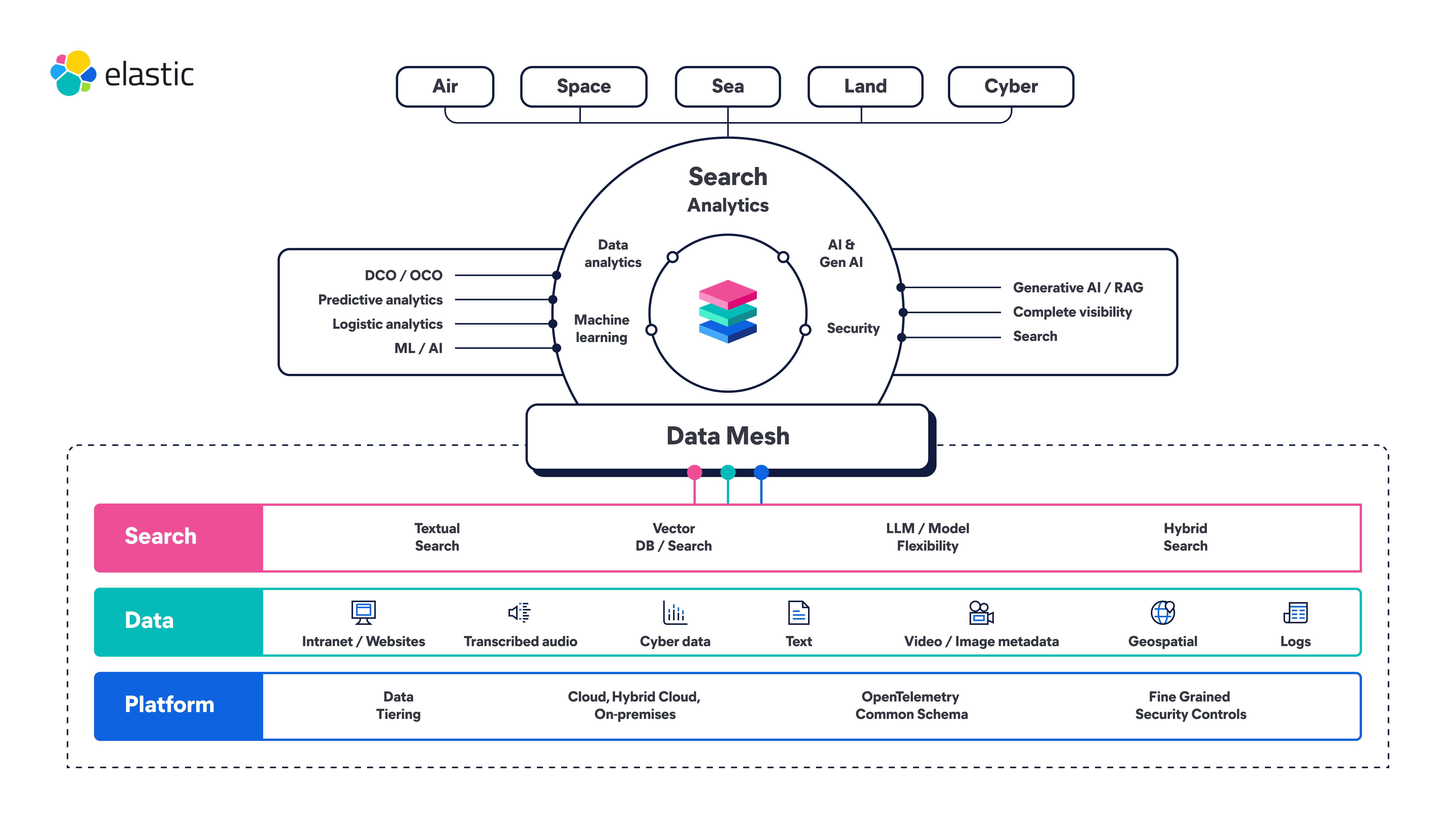
Meeting these requirements is challenging as long as data remains siloed. This is where a data mesh architecture becomes foundational. It unifies data silos, enabling domain-level ownership, data standarisation, and secure access across defence domains. Elastic’s capabilities, such as cross-cluster search and distributed search, help defence organisations operationalise their data, deliver faster insights, and speed up mission-critical operations while maintaining control and consistent governance.
Cross-cluster search supports maintaining full control over sensitive information by allowing queries to span multiple data repositories while the information remains in its original location without moving or duplicating data. Instead of consolidating data into a single vulnerable store, it takes the questions to the data. This approach means Navy intelligence stays on Navy infrastructure, Army data can remain on Army systems, and Air Force information can continue to reside on Air Force networks.
Unified ingestion enables data to be normalised and indexed at the edge within seconds, making it immediately available for analysis. All relevant data across formats, including time, space, geography, compliance level, or other attributes, can be analysed in seconds. Additionally, queries can be reused for operational efficiency and compliant inter-departmental data sharing. As a result, data is assured, discoverable, and interoperable and can be used as an enduring asset beyond siloed programs.
Accelerating defence insight with AI-powered search
A data mesh approach is also strategic when organisations look to operationalise AI. Defence organisations often operate in disconnected, intermittent, and low-bandwidth (DIL) environments. With retrieval augmented generation (RAG), military and defence agencies can run AI safely using their own data and knowledge base, ensuring accurate, up-to-date answers without hallucinations. Defence data can be securely connected to the selected large language model (LLM) to deliver mission-critical insights based on trusted internal information while being able to operate securely even in isolated environments.
Elasticsearch Platform
Elasticsearch Platform can transform mountains of raw defence data into actionable intelligence. It can rapidly provide context and identify patterns across vast datasets that would take human analysts weeks to discover. This includes detecting anomalies in radar signatures, correlating communications metadata, and surfacing relevant intelligence from decades of historical operations.
Vector search
Instead of requiring more skilled analysts, Elasticsearch Platform enhances existing teams to uncover insights faster. Vector search capabilities enable unstructured data analysis across domains. Intelligence reports, video footage, communications intercepts, and satellite imagery can now be searched together based on conceptual similarities rather than just keywords. This allows defence analysts to reveal hidden connections between seemingly unrelated information sources, dramatically accelerating the intelligence cycle.
Turning digital strategy into operational advantage
Together, data mesh, open standards, and AI create a practical path forward for defence data challenges by enabling diverse systems to communicate while extracting meaningful insights from complex information landscapes. These technologies align with strategies, such as the MoD's ‘digital backbone’2 vision, and offer immediate capabilities to support it.
Adopting flexible sovereign data architectures is no longer optional; it’s a requirement for future-oriented defence. Data mesh and open standards create a scalable foundation that adapts to new technologies and mission needs without complete system overhauls. Unified search across domains means faster intelligence cycles, enhanced collaboration, and better support for operational commanders enabling decision superiority. The result? Defence teams that deliver faster, sharper insights right when they’re needed most to optimise mission success.
To explore how data mesh, open standards, and AI can simplify complexity, improve decision-making speed, and enhance cyber resilience across Defence, download our white paper: The future of defence cybersecurity: AI and open standards reducing complexity.
Continue exploring the topic:
- Blog: Why data sovereignty is mission-critical for global defence organisations
- Blog: Enabling the MOD's defence data management strategy with intelligent data access
- Blog: Understanding data mesh in the public sector: Pillars, architecture, and examples
- White paper: Accelerate your mission with Elastic as a global data mesh
- Webinar: Decisions at speed – How defence leaders are unifying data for real-time insight
- Webinar: Observability in the open: OTel for public sector
Sources:
1. Gov.uk, “Data Strategy for Defence,” 2021.
2. Gov.uk, “Digital Strategy for Defence,” 2021.
The release and timing of any features or functionality described in this post remain at Elastic's sole discretion. Any features or functionality not currently available may not be delivered on time or at all.
In this blog post, we may have used or referred to third party generative AI tools, which are owned and operated by their respective owners. Elastic does not have any control over the third party tools and we have no responsibility or liability for their content, operation or use, nor for any loss or damage that may arise from your use of such tools. Please exercise caution when using AI tools with personal, sensitive or confidential information. Any data you submit may be used for AI training or other purposes. There is no guarantee that information you provide will be kept secure or confidential. You should familiarize yourself with the privacy practices and terms of use of any generative AI tools prior to use.
Elastic, Elasticsearch, and associated marks are trademarks, logos or registered trademarks of elasticsearch B.V. in the United States and other countries. All other company and product names are trademarks, logos or registered trademarks of their respective owners.
Share
- Share on Twitter
Share on Twitter
- Share on LinkedIn
Share on LinkedIn
- Share on Facebook
Share on Facebook
- Share by Email
Share by Email
- Print this page
Print