Building the foundation of trust in government digital strategies


 Share on Twitter
Share on Twitter

 Share on LinkedIn
Share on LinkedIn

 Share on Facebook
Share on Facebook

 Share by Email
Share by Email

 Print this page
Print
The Hague in the Netherlands is known worldwide as the City of Peace and Justice. In 2025, it is also emerging as a capital of digital sovereignty — a place where the balance between freedom and security is not just debated in courtrooms but increasingly designed into the very systems that underpin society.
The Hague is where technology, trust, and public values come together.
Eduard van Mierlo, Enterprise Account Executive, Public Sector, Elastic
Here, where international courts, ministries, and public agencies safeguard public values, the conversation about open data, AI, and digital infrastructure has moved beyond policy papers. It is now about urgency and ensuring that digital transformation strengthens democratic control, public trust, and resilience in the face of rapidly changing technology.
The European public sector’s turning point
Across Europe, digital transformation has moved from vision statements to regulated reality. Compliance frameworks like NIS2, DORA, and the EU AI Act are no longer distant aspirations; they now set deadlines and obligations for cyber resilience, operational continuity, and responsible AI.
Every national strategy, including the Dutch Digitalisation Strategy (NDS); France Numérique; Germany’s Onlinezugangsgesetz (OZG); Denmark’s National Strategy for Digitalisation; or the UK’s Department for Science, Innovation and Technology (DSIT) goals, is part of a shared European ambition: Build secure, sovereign, and value-driven public digital infrastructures that citizens can trust.
The stakes are high:
A municipality locked into a proprietary vendor may miss NIS2 incident reporting requirements.
A regulator hosting sensitive datasets outside GDPR jurisdiction risks losing control over its most valuable asset: public data.
An AI decision without explainability may collapse in court, undermining both legal defensibility and citizen trust.
These are not hypotheticals. They have already happened in parts of Europe, impacting the public’s trust.
Openness is the first building block of trust
Like its European counterparts, the Dutch National Digital Strategy (NDS) rightly treats open source and open standards not as nice-to-have ideals but as prerequisites for transparency, interoperability, and democratic oversight.
Open technologies ensure that:
Governments are not locked into a single vendor’s roadmap
Data is stored in nonproprietary formats, ensuring portability and resilience
APIs and integration layers remain transparent, inviting innovation by both established institutions and startups
Many European startups have been built on open foundations, creating jobs, stimulating innovation, and reducing time-to-market for solutions that matter. At Elastic, openness is by design. We harness global open source innovation and deliver it under trusted EU-based governance.
Sovereign digital infrastructure: Control by design
Digital sovereignty is now a national security concern. At its core, it ensures that public institutions decide where data lives, how it is secured, and under which legal frameworks it operates. Governments can no longer afford to host sensitive citizen data in infrastructures outside their legal jurisdiction.
That’s why sovereign cloud initiatives like KPN CloudNL in the Netherlands and Thales Sovereign Cloud in France are not special projects. Instead, they are baseline requirements for modern governance.
But sovereignty also requires deployment flexibility. With Elastic, public institutions can run their workloads:
Fully on-premises
In national sovereign clouds
In hybrid or multicloud configurations without losing functionality or control
Responsible AI and explainability: From buzzword to binding obligation
The EU AI Act has made one thing clear: Explainability is no longer optional. Whether an algorithm flags a potential security breach, denies a social benefit, or predicts infrastructure maintenance, the why must be transparent, verifiable, and improvable.
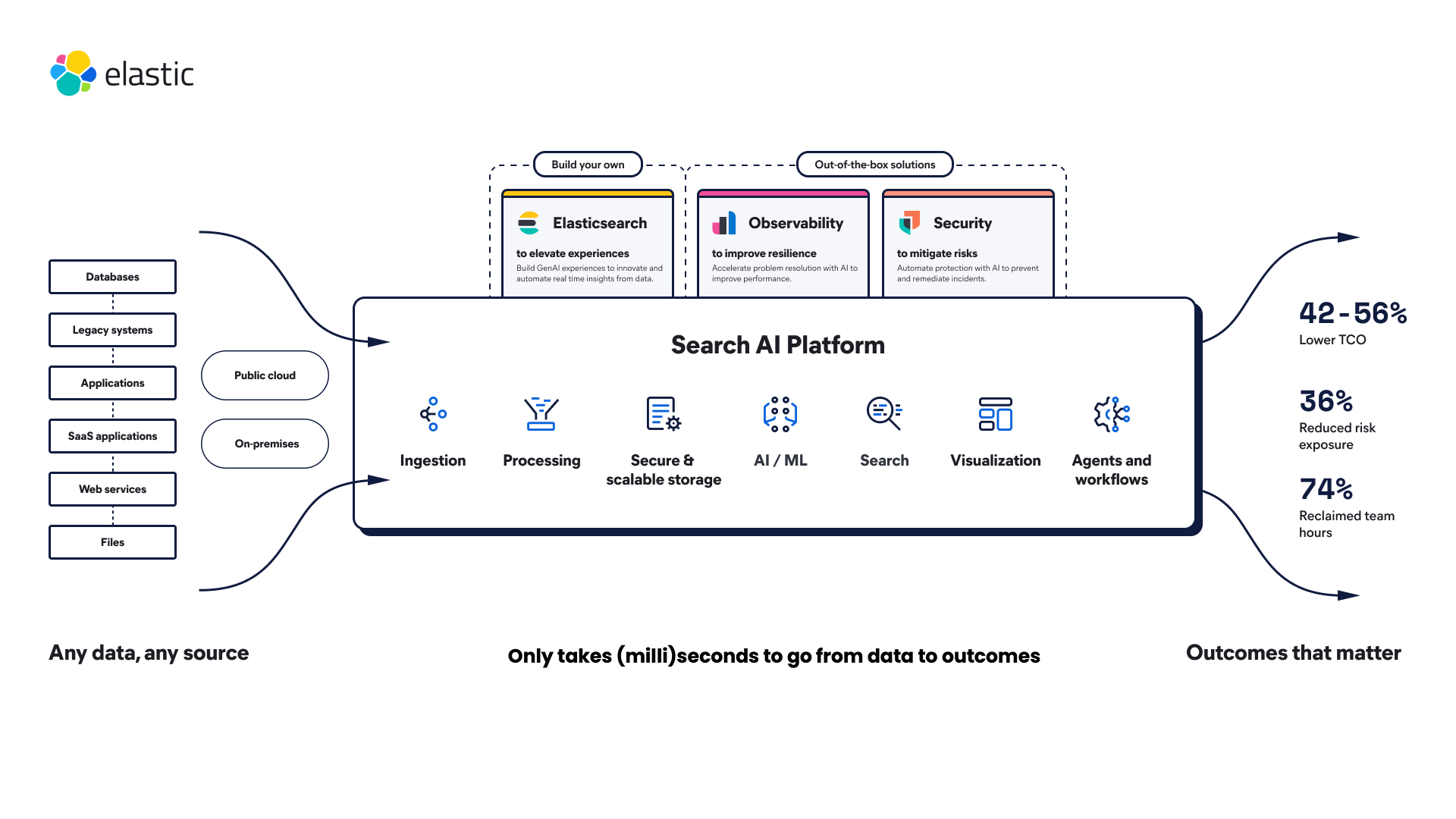
Elastic’s Search AI Platform creates a governed, searchable foundation where structured and unstructured data can be enriched and contextualised. This means AI doesn’t just become more powerful; it becomes more responsible and aligned with public values and legal requirements.
Cybersecurity and resilience: No blind spots allowed
Cybersecurity is not a layer to be added later; it is a core capability. In an era of interconnected systems, blind spots are a liability.
Built on Elastic’s Search AI Platform, Elastic Security enables:
Real-time detection and correlation of threats
Cross-environment visibility through cross-cluster search and replication
Rapid incident response with full auditability
Whether protecting a municipality’s citizen portal or a ministry’s national registry, the principle is the same: Without complete visibility, resilience is an illusion.
Closing the loop: Towards a data-driven, trusted government
A data-driven government is not about dashboards; it’s about decisions made in near real time with complete context. This requires breaking down silos, federating analysis across domains, and ensuring that every decision can be backed by auditable data.
For governments to build trust with their stakeholders around data and AI, they need to consider the following three principles:
Openness in code, standards, and governance
Sovereignty in infrastructure and data control
- Resilience in AI, security, and operations
A year-long conversation: From foundation to trust in action
This blog is the opening chapter of a year-long conversation. We will be back with more public sector content — from open source innovation to sovereign cloud and from responsible AI to cyber resilience. We will also showcase how European governments can go from vision to execution without sacrificing trust.
The Hague may be where this conversation starts, but the principles are universal. The challenge for governments is clear: Trust is earned in execution.
And execution is where Elastic thrives.
Mark your calendar: The Elastic{ON} on Tour returns to Amsterdam on 30 October 2025. We’ll be there in full force and look forward to connecting with you to continue the dialogue!
Continue exploring
- Webinar: Governance in Defence: Aligning AI Innovation with Compliance
- Blog: Understanding data mesh in public sector: Pillars, architecture, and examples
- Blog: Understanding AI in government: Applications, use cases, and implementation
- White paper: Accelerate your mission with Elastic as a global data mesh
- White paper: Does your Zero Trust strategy have a unified data access layer?
- Report: Analyzing the economic benefits of Elastic Security
The release and timing of any features or functionality described in this post remain at Elastic's sole discretion. Any features or functionality not currently available may not be delivered on time or at all.
In this blog post, we may have used or referred to third-party generative AI tools, which are owned and operated by their respective owners. Elastic does not have any control over the third party tools and we have no responsibility or liability for their content, operation or use, nor for any loss or damage that may arise from your use of such tools. Please exercise caution when using AI tools with personal, sensitive or confidential information. Any data you submit may be used for AI training or other purposes. There is no guarantee that information you provide will be kept secure or confidential. You should familiarize yourself with the privacy practices and terms of use of any generative AI tools prior to use.
Elastic, Elasticsearch, and associated marks are trademarks, logos, or registered trademarks of Elasticsearch N.V. in the United States and other countries. All other company and product names are trademarks, logos, or registered trademarks of their respective owners.
Share
- Share on Twitter
Share on Twitter
- Share on LinkedIn
Share on LinkedIn
- Share on Facebook
Share on Facebook
- Share by Email
Share by Email
- Print this page
Print