Transforming IT Help Desk: How Elastic’s Search AI Platform supercharges Salesforce Service Cloud
Elastic’s IT Help Desk Agent on Salesforce Service Cloud uses Search AI to move past traditional ticket queues, offering proactive and intelligent IT support.


 Share on Twitter
Share on Twitter

 Share on LinkedIn
Share on LinkedIn

 Share on Facebook
Share on Facebook

 Share by Email
Share by Email

 Print this page
Print
Access to precise, accurate help in real time marks an inflection point for modern IT operations. At Elastic, internal IT support relied on established best practices but encountered recurring challenges related to information access, Salesforce ticketing efficiency, and consistent knowledge surfacing. This catalyzed the investment in conversational workflows with Elastic Search AI Platform directly in the Salesforce Service Cloud. As “customer zero,” Elastic’s deployment does not simply illustrate technology adoption; it also provides a real-world proof point for the practical value of generative AI (GenAI) in resolving real operational barriers.
Instant AI assistance and streamlined support
Elastic’s customer relationship management (CRM) support agent introduces two clear avenues within the familiar Salesforce environment. The field team can now use GenAI for instant support guidance, validate solutions, or troubleshoot directly within the workflow; or, they can bypass the AI to submit help desk tickets for complex or nuanced scenarios that require human-agent expertise.
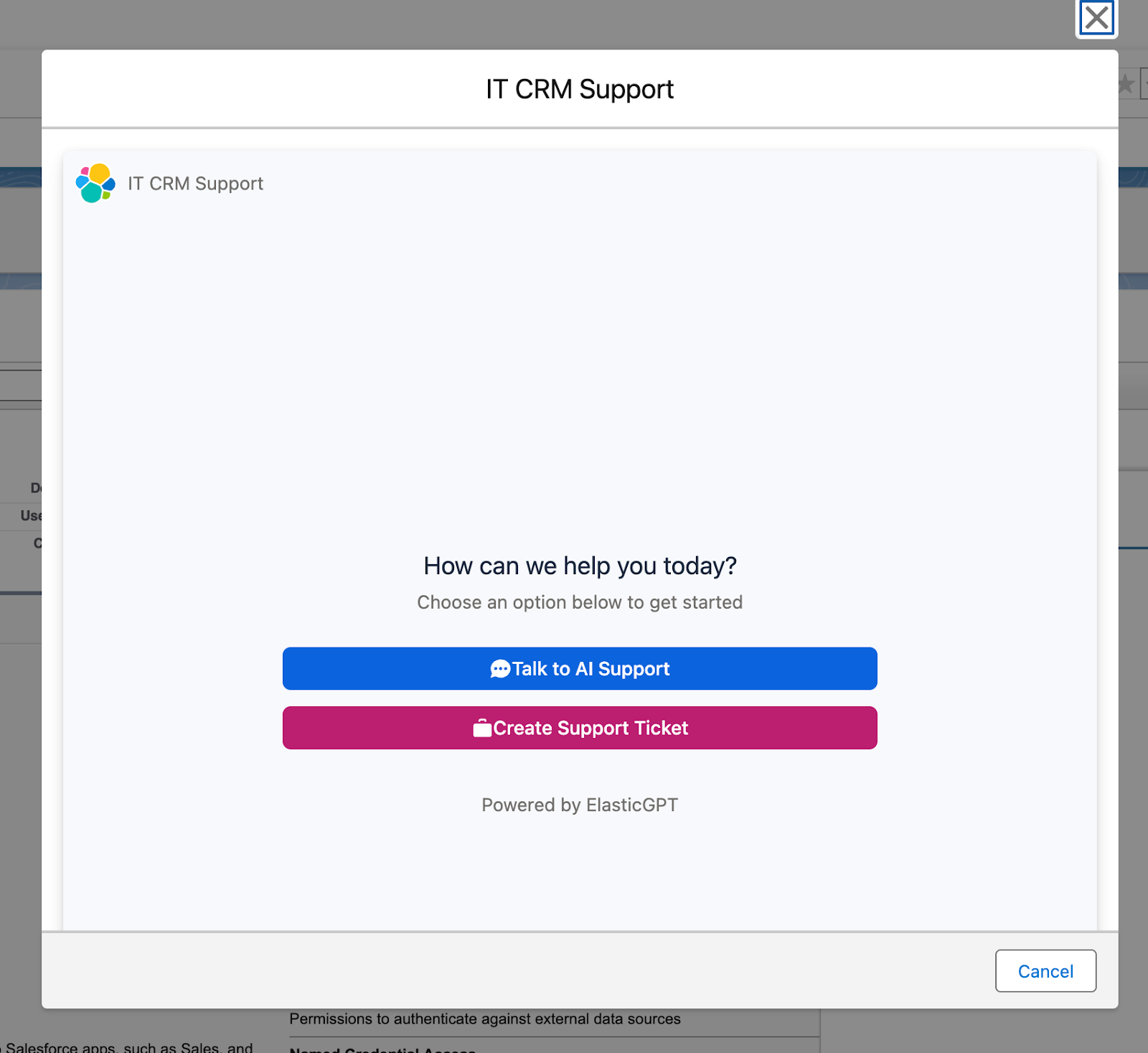
This dual pathway elevates support for teams supporting billing, revenue operations, partner channels, and sales. Answers are grounded in curated domains, including Elastic Wiki, ServiceNow knowledge articles, and Jira. Where AI responses suffice, manual ticket volume drops. When escalation proves necessary, ticket generation from chat pre-populates subject, details, and severity fields, reducing friction and minimizing errors. This baseline improvement in ticket quality, combined with full conversation context for human agents, accelerates both triage and final resolution.
Technical underpinnings: How Search AI powers the experience
Elastic’s internal agent employs Lightning Web Components (LWC) for the front-end chat client with MuleSoft-powered REST APIs brokering connections to ElasticGPT. This configuration keeps users anchored in their daily workflow, eliminating context switching while embedding real-time knowledge retrieval.
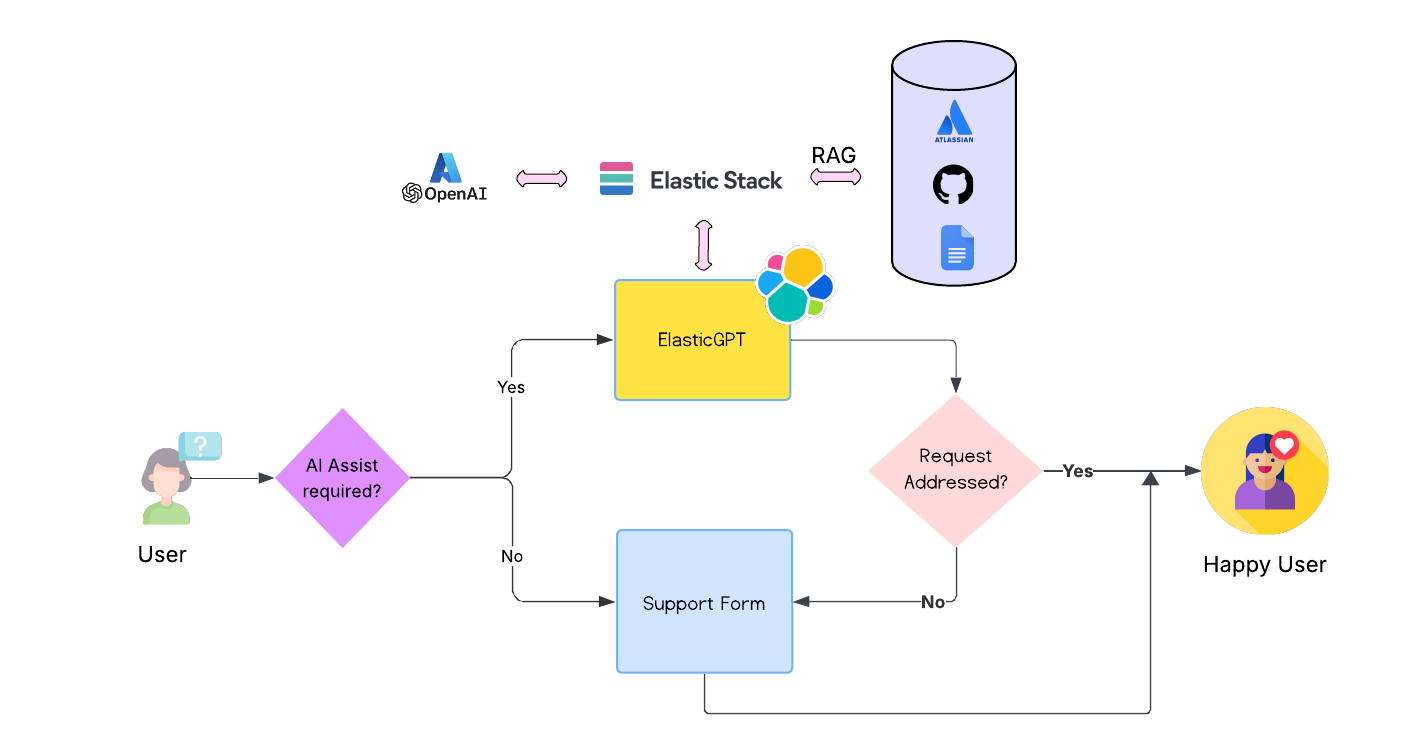
Ticket escalation uses conversational context, streamlining case population and supporting classification. At its core, ElasticGPT is the foundational GenAI capability that anchors all responses in access-controlled, enterprise-specific sources, such as JIRA, Wiki, GitHub, and Google Docs. Our IT Help Desk Agent scales off of ElasticGPT by integrating with Salesforce Service Cloud to deliver a personalized agent experience that supports field IT queries. To address performance, we monitor the experience with Elastic Observability to help internal product owners track satisfaction, deflection rates, and workflow bottlenecks. This provides an additional layer of accountability, which is vital for maintaining ongoing trust in internal automation.
Demo from the lens of a user
As a user seeking support, this demo showcases authentic product use through real-world support scenarios in the IT world. It begins with a user launching the CRM support agent in Salesforce, highlighting two core pathways: live chat with ElasticGPT for immediate answers and escalation to ticket creation when needed. Key features include:
Seamless access to ElasticGPT within Salesforce
- AI-guided responses based on live enterprise knowledge
- Automatic ticket field population from chat context
- Transfer of chat history to support agents for accurate case handling

Future outlook
Generative AI is reshaping the service industry and the way it embeds enterprise systems to support organizational needs and workflows. Elastic’s approach to customer-first starts with “customer zero.” Building products and experiences for our customers involves our teams using and testing our own technology for various use cases. Our IT HelpDesk Agent embeds AI into existing Salesforce workflows, delivering made-to-measure support and seamless ticket escalation while preserving genuine human involvement for complex issues. Integrated chat and ticketing features eliminate workflow obstacles, enabling teams to resolve issues efficiently and with clarity.
As you consider the path forward for your enterprise, this is the opportunity to harness Elastic’s Search AI Platform to enhance your own support systems. Unify institutional knowledge, streamline escalation, and equip every user with real-time, context-rich assistance to redefine how support is scaled. Elastic offers several integrations to native enterprise platforms, such as Salesforce, ServiceNow, or Zendesk, allowing you to build similar use cases for your tech stack.
Learn more about our generative AI success in the ElasticGPT case study.
The release and timing of any features or functionality described in this post remain at Elastic's sole discretion. Any features or functionality not currently available may not be delivered on time or at all.
In this blog post, we may have used or referred to third party generative AI tools, which are owned and operated by their respective owners. Elastic does not have any control over the third party tools and we have no responsibility or liability for their content, operation or use, nor for any loss or damage that may arise from your use of such tools. Please exercise caution when using AI tools with personal, sensitive or confidential information. Any data you submit may be used for AI training or other purposes. There is no guarantee that information you provide will be kept secure or confidential. You should familiarize yourself with the privacy practices and terms of use of any generative AI tools prior to use.
Elastic, Elasticsearch, and associated marks are trademarks, logos, or registered trademarks of Elasticsearch N.V. in the United States and other countries. All other company and product names are trademarks, logos or registered trademarks of their respective owners.
Share
- Share on Twitter
Share on Twitter
- Share on LinkedIn
Share on LinkedIn
- Share on Facebook
Share on Facebook
- Share by Email
Share by Email
- Print this page
Print