Curious about taking Elastic Cloud for a spin? Subscribe to Elastic Cloud on AWS Marketplace or Microsoft Azure Marketplace to receive up to $1,000 in billing credits.
Parts 1 through 6 of this series describe a governed control plane that classifies intent, enforces constraints, resolves conflicts, personalizes results, and routes to the appropriate retrieval strategy. This post introduces a different objective: ensuring the retailer's business priorities influence which of those relevant products rank highest, with that optimization governed per query through policies rather than applied as a static global setting.
In most ecommerce deployments, economic signals, like profit margin and product popularity, are either ignored in search ranking or applied as static, global weights. A fixed margin boost might push high-margin products up across every query, which works for "chocolate" (where shoppers are open to suggestion) but backfires for "baby formula" (where shoppers want the trusted, popular brand).
The governed control plane makes it possible to treat economic optimization as a per-query decision, expressed as policy data and managed through the same admin UI as every other governance mechanism. A merchandiser can say "for chocolate queries, prioritize margin" and "for baby formula queries, prioritize popularity", without writing code, without deploying changes, and with full auditability.
For the mathematical foundation of margin and popularity boosting in Elasticsearch, including the logarithmic scaling formula and factor tuning explanation, see Boosting e-commerce search by profit and popularity with the function score query in Elasticsearch.
Two business signals: Margin and popularity
Every product document in our product catalog carries two numeric fields:
margin: The product's profit margin as a percentage (0 to 200 in our dataset).popularity: A relative sales volume metric (0 to 10,000 in our dataset), such as weekly average units sold.
These fields represent two fundamentally different business objectives. Margin optimization pushes profit per transaction. Popularity optimization pushes conversion probability since products that many shoppers buy are products that the current shopper is likely to buy.
The baseline: Global boosting with business signals
Before introducing per-query policy overrides, the system applies a default boost for both margin and popularity. These are implemented using Elasticsearch's field_value_factor with logarithmic scaling inside a function_score query as described in Boosting e-commerce search by profit and popularity with the function score query in Elasticsearch.
The design has three properties worth noting:
- Calibrated range. Each signal's factor is calibrated so that it contributes at most approximately +1.0 to the boost multiplier at the top of its range. Combined with a baseline weight of 1, the final multiplier ranges from 1.0 (a product with zero margin and zero popularity) to approximately 3.0 (maximum margin plus maximum popularity). A product with strong business signals scores roughly 3x higher than an identical product with none, regardless of the BM25 score magnitude.
- Logarithmic scaling. The
ln1pmodifier grows fast at small values (rewarding incremental gains) but flattens at high values (preventing runaway scores from a single dominant product). This also makes the system resilient to data distribution changes: If the maximum popularity in a dataset shifts significantly, the boost curve stretches rather than breaking. - Multiplicative, not additive. The business-signal boost is applied multiplicatively against BM25 (
boost_mode: "multiply") rather than added to it. BM25 scores vary dramatically across queries, so an additive boost would have inconsistent impact depending on query specificity. Multiplicative scaling guarantees a consistent percentage uplift regardless of the absolute BM25 magnitude.
Per-query boosting overrides through policies
The default weights (1.0 for both margin and popularity) apply to every query. But the governed control plane makes it possible to override these weights on a per-query basis through the same policy engine described in Part 3 and Part 4.
Each policy document has two optional fields: margin_boost_weight and popularity_boost_weight. When a policy matches a query and includes weight overrides, those values flow through to the function_score construction, replacing the defaults.
Why per-query control matters
Consider two queries and why they demand different economic optimization strategies.
Margin boosting: Chocolate
A shopper searching for "chocolate" is browsing. They'll be satisfied by many chocolate-related products. The retailer's store-brand chocolate truffles at 60% margin might be just as appealing as the name-brand bar at 15% margin. Aggressive margin boosting pays for itself if the shopper doesn't care which chocolate they purchase and buys one of the margin-boosted hits.
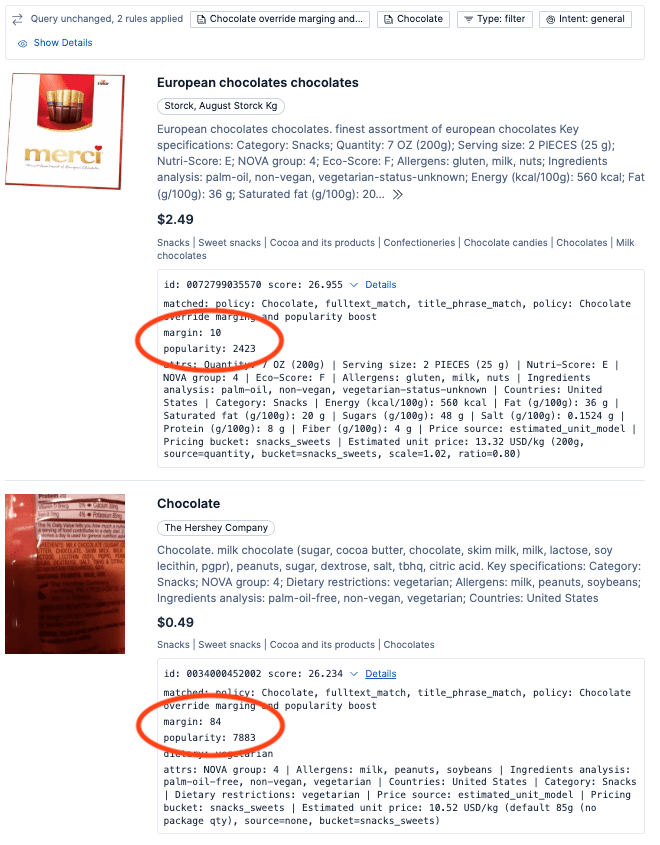
Chocolate results without margin boosting
To isolate the effect of per-query margin boosting, we first disable margin boosting entirely for this query (margin boost weight: 0). Without any margin signal, the ranking is driven by text relevance. In our dataset, the first hit has a margin of 10 and the next one has a margin of 84 (out of a max of 200) as follows:
Setting a margin boost on queries for “chocolate”
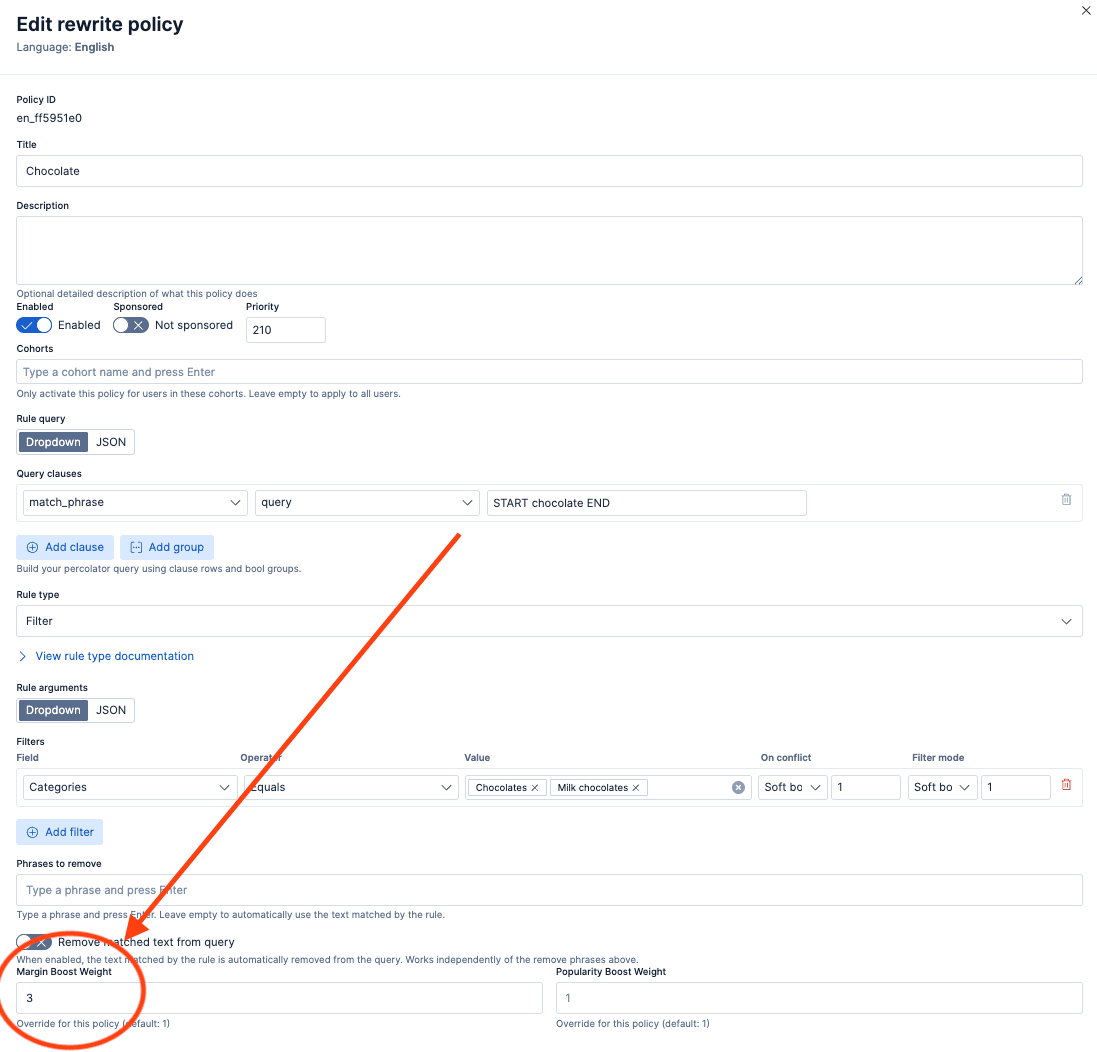
A merchandiser who decides that “chocolate” queries should prioritize margin makes that change in the admin UI, tests it against representative queries, and promotes it to production. The change takes effect on the next query. No engineering ticket, no deployment, no code change. The following "chocolate" policy sets margin_boost_weight: 3.0, which ensures that searches for chocolate will aggressively promote high-margin items.
Chocolate results with margin boosting
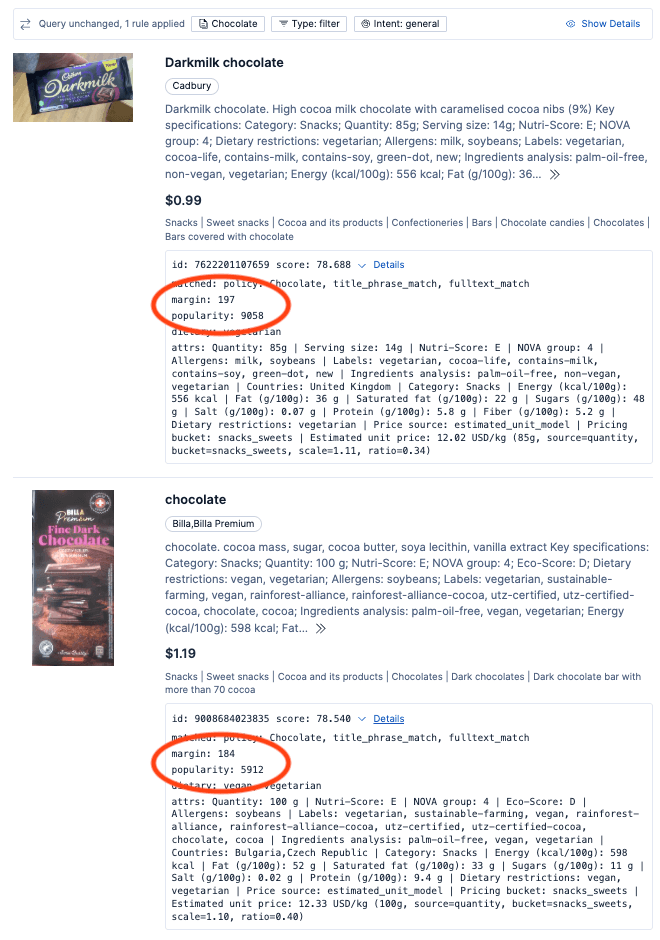
With the above margin boost policy enabled, the higher-margin chocolates with a margin of 197 and 184 are boosted to the top of the results as follows (remember that the maximum margin in our dataset is 200):
Popularity boosting: Baby formula
A parent searching for baby formula is not experimenting. They want the product that other parents trust. Pushing a high-margin store-brand formula above the established brand that thousands of parents are buying would feel wrong and erode trust. Popularity is the right signal here because it functions as social proof for a high-stakes purchase.
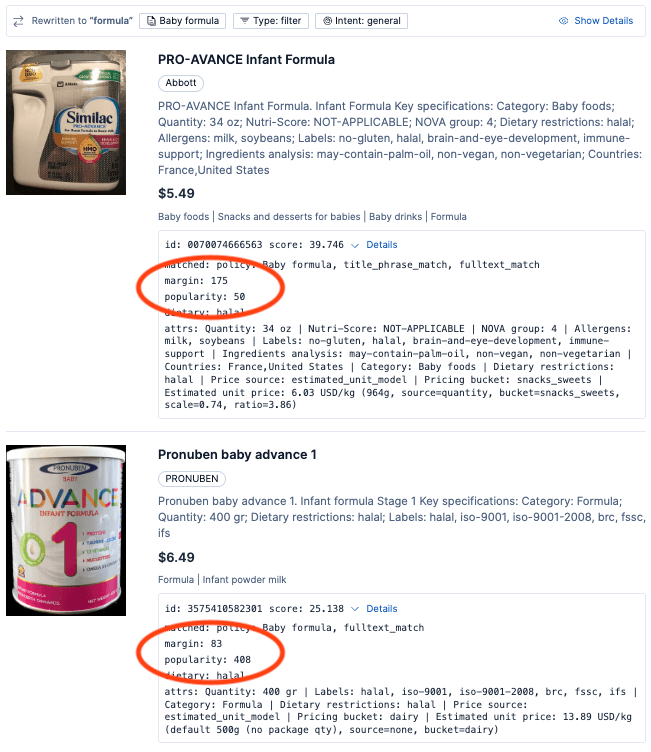
Baby formula results without a popularity boost
To isolate the effect of per-query popularity boosting, we first disable popularity boosting entirely for this query (popularity_boost_weight: 0). Without any popularity signal, the ranking is driven by text relevance. In this example, the top hit has a popularity of 50 on a scale that goes up to 10,000.
Setting a popularity boost on queries for “baby formula”
A "baby formula" policy sets popularity_boost_weight: 5.0 and margin_boost_weight: 0; formula searches prioritize what's popular, completely ignoring margin.
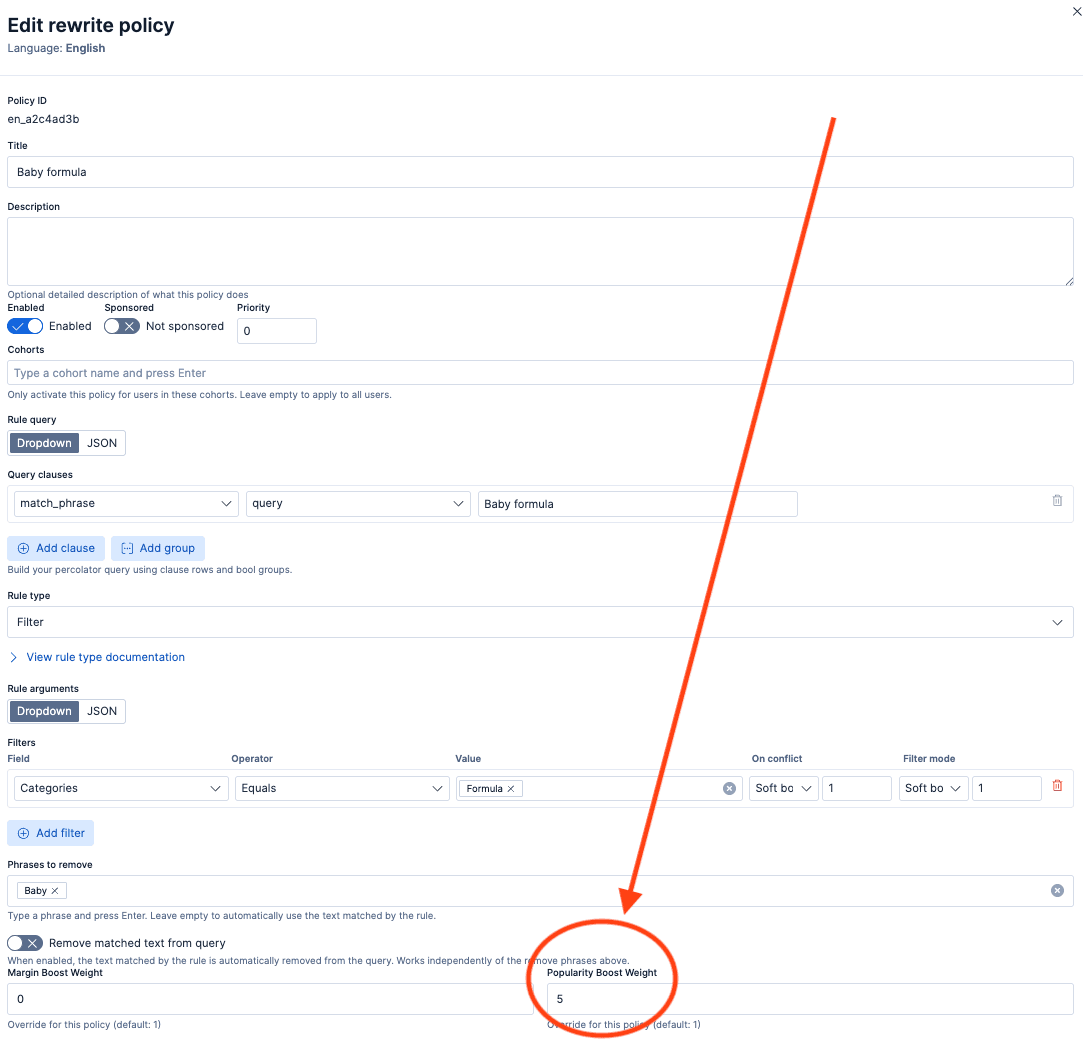
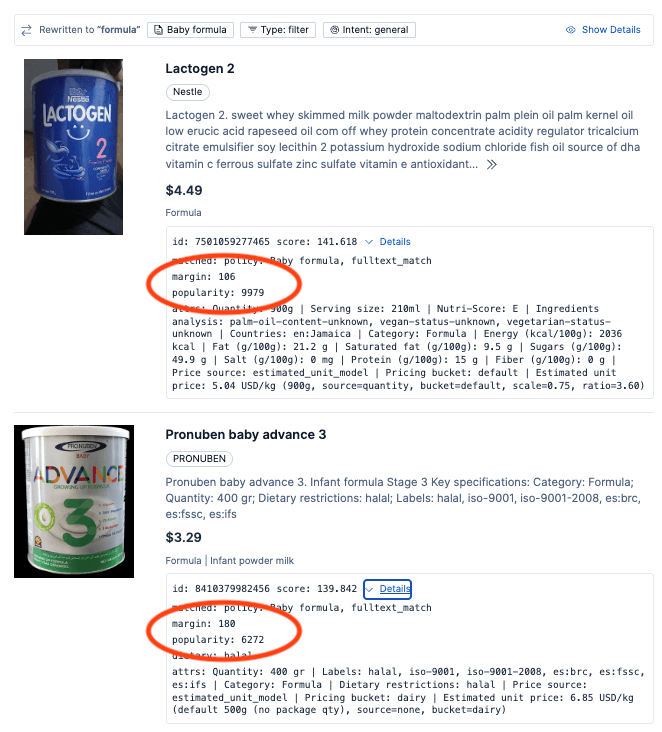
Baby formula results with popularity boosting
If we enable the above rule, then the most popular baby formula (Lactogen 2 with a popularity of 9979) will be boosted to the top of the results, as shown below.
Disabling business signals: Clearance
Not every query benefits from economic boosting. A shopper searching for "clearance" is looking for deals; margin and popularity are both irrelevant to that intent. A high-margin product is the opposite of what the shopper wants, and a popular product may not be on clearance at all.
A "clearance" policy sets margin_boost_weight: 0 and popularity_boost_weight: 0, which disables both business signals entirely. Results are ranked on pure text relevance with no economic influence. This completes the design space: Policies can amplify either signal independently, rebalance them, or turn them off altogether.
How overrides flow through the control plane
When the percolator returns matching policies, the control plane checks for margin_boost_weight and popularity_boost_weight fields on the highest-priority matching policy. If present, those values replace the defaults in the RewriteState. If no matching policy includes weight overrides, the default values (1.0 for both) are used.
The weights then flow through to the function_score construction when the final Elasticsearch query is assembled. The structure of the function_score doesn't change; only the weight values on the margin and popularity functions.
Weight overrides participate in the same governance model as every other policy mechanism. They’re subject to priority ordering: A Christmas campaign policy with margin_boost_weight: 0.5 will override a product-category policy with margin_boost_weight: 3.0 if the campaign policy has higher priority. The cascading transformation model from Part 3 applies: Economic optimization parameters are just another field in the policy's execution plan.
Interaction with other policies
Per-query weight overrides compose naturally with the constraint enforcement, conflict resolution, and personalization mechanisms described in earlier parts of this series.
Consider a search for "cheap chocolate" during a Christmas campaign, with a shopper who has a purchase history and belongs to a vegan cohort. The control plane processes this query through the full governance stack:
- The "cheap" policy extracts the price constraint and removes "cheap" from the query.
- The "chocolate" policy sets
margin_boost_weight: 3.0and constrains results to chocolate categories. - The “Christmas campaign” policy (higher priority) overrides the category constraint with seasonal categories and adjusts the price ceiling.
- The “vegan cohort” policy applies a soft boost to vegan-certified products.
- The margin and popularity boosts are applied with the governed weights (margin at 3.0× from the “chocolate” policy, popularity at the default 1.0×).
- The shopper's purchase history boosts are applied as the outermost scoring layer.
Every layer stacks multiplicatively. The economic optimization weights are governed by the same policy framework that controls category constraints, campaign overrides, and cohort-specific boosts. A merchandiser can tune all of these through the admin UI, all without code changes.
This example also illustrates where economic optimization sits in the scoring stack. The layers nest in a deliberate order: the base query (keyword or semantic match), then governance constraints (hard filters and soft boosts from Part 3 and Part 4), then business-signal boosts (margin and popularity with governed weights), and then purchase history personalization (Part 6). Each layer wraps the previous one, and the effects compound multiplicatively. Governance controls what appears. Economic optimization influences what ranks highest from the retailer's perspective. Personalization adjusts ranking further from the shopper's perspective.
Tuning guidance
The factor values in the baseline function_score are calibrated for the demo dataset's field ranges. A production deployment with substantially different ranges for margin or popularity should recalibrate the factors so that each signal contributes a consistent maximum boost. The logarithmic scaling provides built-in resilience to outliers and distribution shifts, but the factors are worth reviewing whenever the underlying data changes significantly. For the calibration methodology, see Boosting e-commerce search by profit and popularity with the function score query in Elasticsearch.
From economic optimization to agentic AI
The governed control plane now handles intent classification, constraint enforcement, conflict resolution, personalization, and economic optimization, all expressed as policy data, all managed through a business-editable admin UI, and all composable through a deterministic transformation framework.
The final post in this series asks what happens when the input to this system isn’t a search string typed by a human shopper, but an intent string extracted by an AI agent, and why the deterministic properties of the governed control plane become even more critical when the upstream decision-maker is probabilistic.
Put governed ecommerce search into practice
The per-query economic optimization described in this post (policy-governed margin and popularity weights composing with governance constraints, personalization, and campaign overrides) was designed and built by Elastic Services Engineering as part of our repeatable ecommerce search accelerators. Contact Elastic Professional Services.
Join the discussion
Have questions about search governance, retrieval strategies, or ecommerce search architecture? Join the broader Elastic community conversation.
Contenido relacionado

7 de julio de 2026
Your compliance posture just got an upgrade: Elasticsearch now supports FIPS 140-3
Elastic 9.4 brings FIPS 140-3 support for Elasticsearch and Kibana to GA. Here's what changes for federal, defense and regulated deployments, and how to migrate from 140-2.

19 de junio de 2026
Why your Elasticsearch cluster is hitting disk watermarks: 14 real-world causes explained
Learn how Elasticsearch disk watermarks work, why they trigger, and how to diagnose 14 of the most common scenarios Support encounters, from index bloat to ILM stalls.

29 de mayo de 2026
One API call per operation: how Elastic Cloud Hosted makes fleet-scale deployment management practical
Elastic Cloud Hosted adds five targeted APIs for upgrade, tier scaling, user settings, tags and snapshot repository linking, each replacing a multi-step deployment plan edit with a single focused call.
18 de mayo de 2026
Agentic AI search with deterministic guardrails in Elasticsearch for safe query execution
Agentic AI search systems often fail when LLMs generate queries directly. Learn how deterministic guardrails and a control plane architecture enable safe, reliable, and governed query execution with Elasticsearch.

11 de mayo de 2026
Personalizing ecommerce search: Integrating purchase history and user cohorts
Learn how to create a personalized ecommerce search experience in Elasticsearch without breaking governance. This post explains how to boost products a shopper has purchased before and how to activate cohort-specific policies based on user profiles.