Serial differencing aggregation
editSerial differencing aggregation
editSerial differencing is a technique where values in a time series are subtracted from itself at different time lags or periods. For example, the datapoint f(x) = f(xt) - f(xt-n), where n is the period being used.
A period of 1 is equivalent to a derivative with no time normalization: it is simply the change from one point to the next. Single periods are useful for removing constant, linear trends.
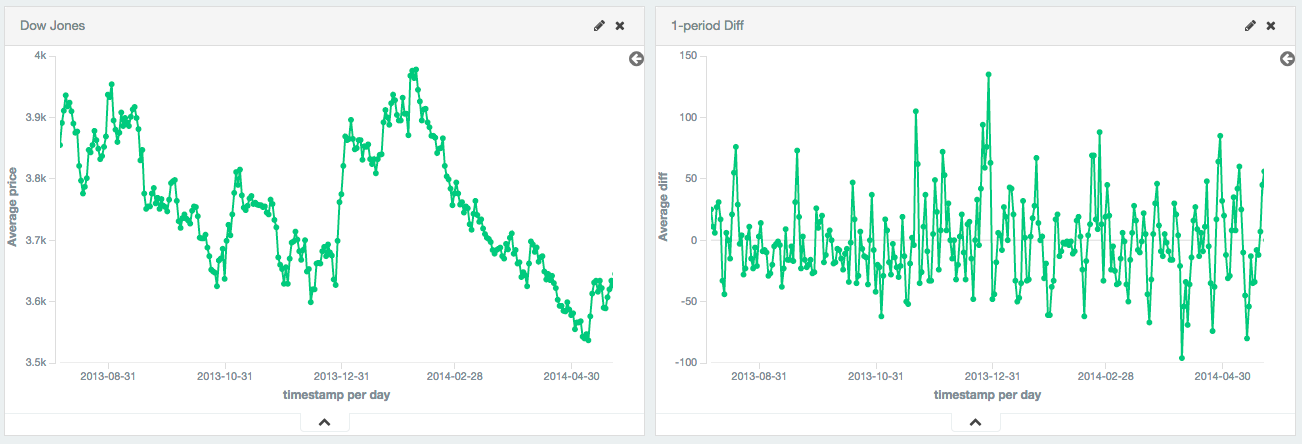
Single periods are also useful for transforming data into a stationary series. In this example, the Dow Jones is plotted over ~250 days. The raw data is not stationary, which would make it difficult to use with some techniques.
By calculating the first-difference, we de-trend the data (e.g. remove a constant, linear trend). We can see that the data becomes a stationary series (e.g. the first difference is randomly distributed around zero, and doesn’t seem to exhibit any pattern/behavior). The transformation reveals that the dataset is following a random-walk; the value is the previous value +/- a random amount. This insight allows selection of further tools for analysis.
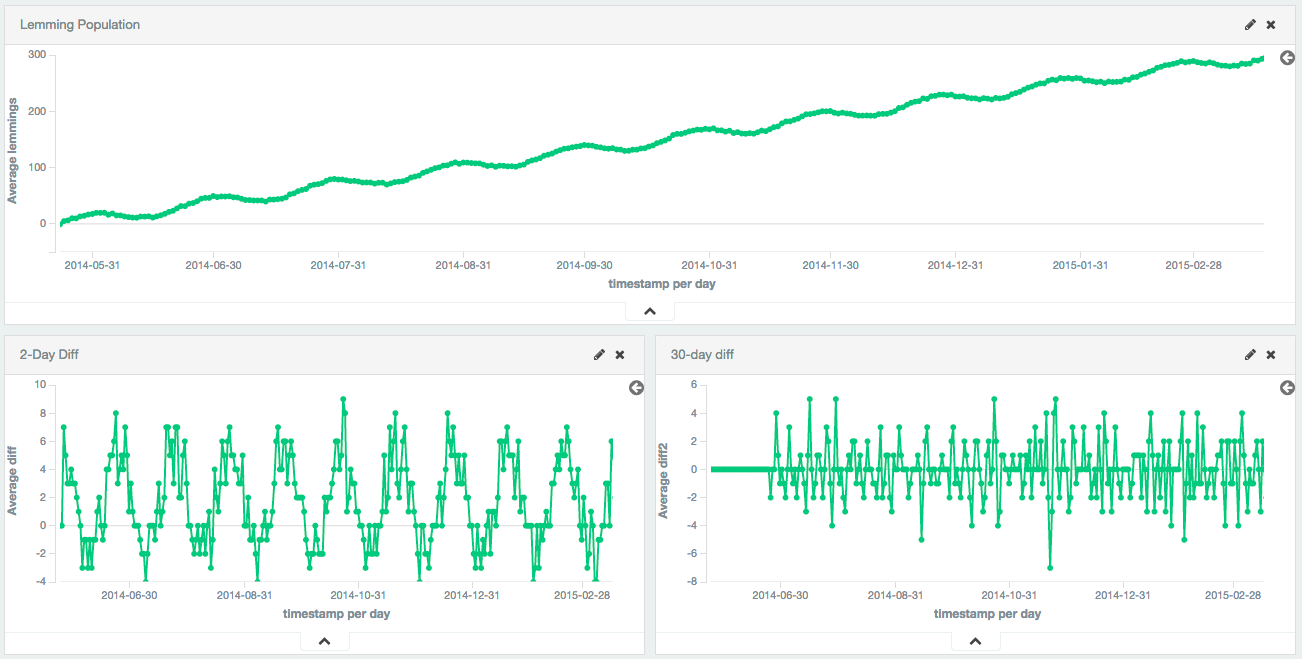
Larger periods can be used to remove seasonal / cyclic behavior. In this example, a population of lemmings was synthetically generated with a sine wave + constant linear trend + random noise. The sine wave has a period of 30 days.
The first-difference removes the constant trend, leaving just a sine wave. The 30th-difference is then applied to the first-difference to remove the cyclic behavior, leaving a stationary series which is amenable to other analysis.
Syntax
editA serial_diff aggregation looks like this in isolation:
{
  "serial_diff": {
    "buckets_path": "the_sum",
    "lag": 7
  }
}
Table 77. serial_diff Parameters
| Parameter Name | Description | Required | Default Value |
|---|---|---|---|
|
Path to the metric of interest (see |
Required |
|
|
The historical bucket to subtract from the current value. E.g. a lag of 7 will subtract the current value from the value 7 buckets ago. Must be a positive, non-zero integer |
Optional |
|
|
Determines what should happen when a gap in the data is encountered. |
Optional |
|
|
DecimalFormat pattern for the
output value. If specified, the formatted value is returned in the aggregation’s
|
Optional |
|
serial_diff aggregations must be embedded inside of a histogram or date_histogram aggregation:
response = client.search(
  body: {
    size: 0,
    aggregations: {
      my_date_histo: {
        date_histogram: {
          field: 'timestamp',
          calendar_interval: 'day'
        },
        aggregations: {
          the_sum: {
            sum: {
              field: 'lemmings'
            }
          },
          thirtieth_difference: {
            serial_diff: {
              buckets_path: 'the_sum',
              lag: 30
            }
          }
        }
      }
    }
  }
)
puts response
POST /_search
{
   "size": 0,
   "aggs": {
      "my_date_histo": {
         "date_histogram": {
            "field": "timestamp",
            "calendar_interval": "day"
         },
         "aggs": {
            "the_sum": {
               "sum": {
                  "field": "lemmings"
               }
            },
            "thirtieth_difference": {
               "serial_diff": {
                  "buckets_path": "the_sum",
                  "lag" : 30
               }
            }
         }
      }
   }
}
|
A |
|
|
A |
|
|
Finally, we specify a |
Serial differences are built by first specifying a histogram or date_histogram over a field. You can then optionally
add normal metrics, such as a sum, inside of that histogram. Finally, the serial_diff is embedded inside the histogram.
The buckets_path parameter is then used to "point" at one of the sibling metrics inside of the histogram (see
buckets_path Syntax for a description of the syntax for buckets_path.